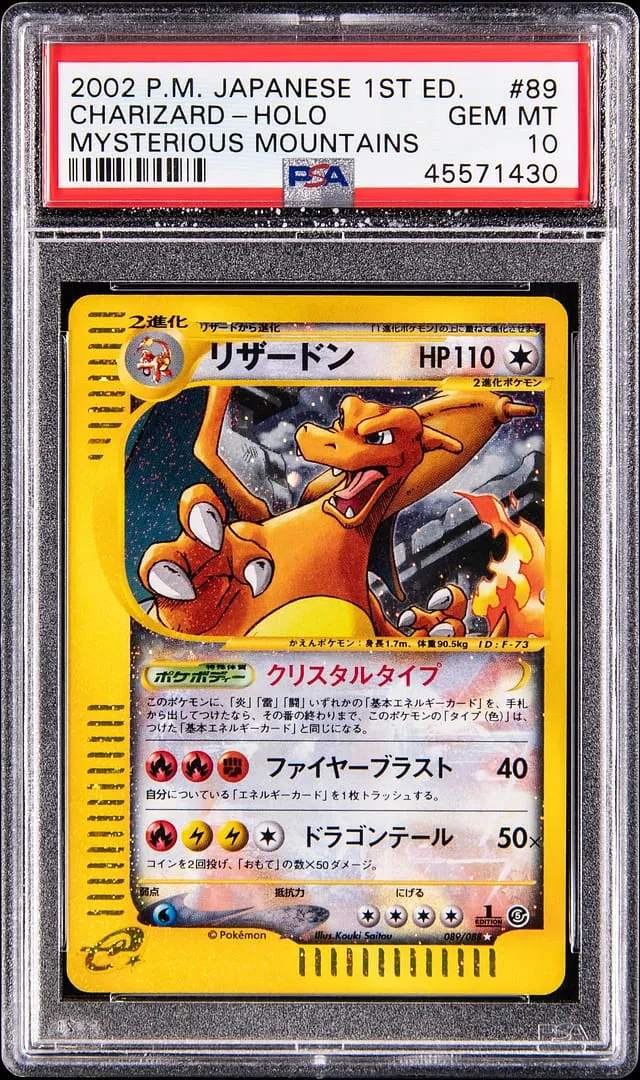
2002 Japanese Crystal Charizard PSA 10 sells for $51k
Breakdown of the $51,240 Goldin sale of a 2002 Japanese Mysterious Mountains Crystal Charizard PSA 10 and what it means for Pokémon collectors.
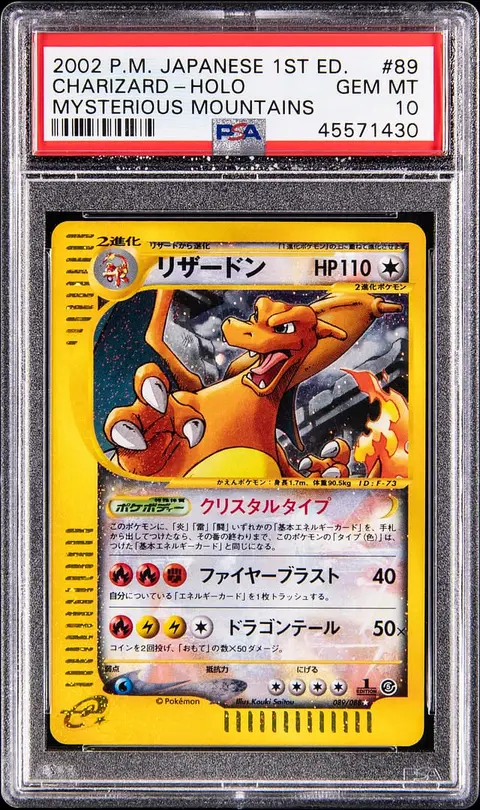
Sold Card
2002 Pokemon Japanese Mysterious Mountains 1st Edition Holo #89 Crystal Charizard - PSA GEM MT 10
Sale Price
Platform
Goldin2002 Pokémon Japanese Mysterious Mountains 1st Edition Holo #89 Crystal Charizard - PSA GEM MT 10 has long sat near the top of many advanced collectors’ want lists. A recent auction at Goldin on 2026-05-18 brought this grail into focus again, with a final price of $51,240.
In this post, we’ll walk through what this card is, why it matters, and how this sale fits into the broader market for Crystal Charizard.
The card at a glance
- Character: Charizard (Crystal Type)
- Year: 2002
- Set: Pokémon Japanese Mysterious Mountains (part of the Japanese e-Card era)
- Edition: 1st Edition
- Card number: #89
- Finish: Holo (holographic)
- Key issue status: Crystal Charizard is widely regarded as the chase card of the Japanese e-Card Crystal trio and a cornerstone Charizard issue.
- Grading: PSA GEM MT 10 (PSA’s highest standard grade)
- Parallel/variant: Crystal Type mechanic, distinct from standard Charizard prints of the era
This card comes from the Japanese equivalent of the English Skyridge era, known for its e-Reader layout and the introduction of “Crystal Type” Pokémon. The Crystal Charizard is one of the most visually distinctive and condition-sensitive Charizard cards ever printed.
Why this card matters to collectors
Crystal Charizard and the e-Card era
The 2002 Japanese Mysterious Mountains set is part of the broader e-Card era, which used card designs compatible with the Game Boy Advance e-Reader. Print runs for these sets are generally understood to be lower than the late-90s boom, and the combination of complex holofoil, yellow borders, and e-Reader strip made mint copies hard to preserve.
Within Mysterious Mountains, Crystal Charizard sits at the top of the pyramid:
- It’s a “Crystal Type” card, a special mechanic that changed the Pokémon’s type and featured unique artwork and templating compared to standard holo rares.
- It is broadly considered a key Charizard issue from the early 2000s, alongside the English Skyridge Crystal Charizard.
- For many Charizard player collectors (people who focus on one character across sets), this Japanese 1st Edition version is a must-have.
Because it dates from 2002, it doesn’t fall into the original 1999–2000 Base Set era, but it is still considered an early- to mid-era WotC-era-adjacent card. That combination of nostalgia, lower print, and difficulty in grading underpins its demand.
PSA 10 and population pressure
A pop report is the grading company’s census of how many copies exist in each grade. For this card in particular, PSA 10 copies are notably scarce relative to total submissions. While exact counts can change as more cards are graded, the general pattern has been:
- PSA 10 population is small compared to total PSA-graded copies.
- A meaningful share of existing raw and lower-grade copies show edge chipping, surface scratches, or print lines that keep them out of gem mint territory.
This makes each PSA GEM MT 10 example a premium asset within the Charizard and e-Card segments. Collectors often treat PSA 10 Crystal Charizards almost as their own tier, distinct from PSA 9 or lower.
Market context for this $51,240 sale
The Goldin sale on 2026-05-18 closed at $51,240. To understand what that means, it helps to look at comps—short for comparables—recent sales of the same card or closely related versions.
Because detailed sales data can vary from platform to platform and across time, it’s useful to group the context into broad trends rather than single-point references:
1. Same card, same grade (PSA 10)
Historically, PSA 10 copies of the 2002 Japanese Mysterious Mountains 1st Edition Crystal Charizard have:
- Often appeared at major auction houses like Goldin, Heritage, and PWCC rather than only on fixed-price marketplaces, due to limited supply.
- Traded in a high five-figure range in recent years, with realized prices influenced by timing, broader Charizard sentiment, and how many PSA 10s have surfaced in a given window.
Against that backdrop, the $51,240 result at Goldin in May 2026 sits in a range that collectors would recognize as consistent with other recent high-end Crystal Charizard outcomes: not a shock outlier, but still firmly in premium territory.
2. Same card, lower grades (PSA 9 and below)
Looking at closely related versions helps frame the grade premium:
- PSA 9 copies of this card tend to sell for materially less, often in a mid- to upper- five-figure or low five-figure band depending on timing and venue.
- PSA 8 and below see progressively wider price dispersion, as eye appeal (centered vs off-center, clean vs scratched holo) plays a larger role.
The gap between PSA 9 and PSA 10 price levels underlines how tightly collectors value grade on this particular card. When gem mint copies appear rarely, the step from 9 to 10 can carry a substantial multiplier.
3. Related Crystal Charizard issues
The most natural comparison is the English Skyridge Crystal Charizard, also from the e-Card era. While it is a different card and market, both are often discussed together:
- English Skyridge Crystal Charizard PSA 10 has seen some of the highest Charizard results outside 1st Edition Base.
- The Japanese Mysterious Mountains version traditionally trades at a significant but somewhat lower level than its English Skyridge counterpart, reflecting differences in print run assumptions, language preference, and regional collector bases.
Within this ecosystem, the Goldin PSA 10 Japanese copy at $51,240 tracks with the idea that Japanese high-end Charizard can command serious attention without necessarily matching the very top-tier English Skyridge highs.
Why this sale matters
Signals for high-end Japanese Charizard
This sale reinforces a few themes that many collectors have been watching:
Sustained demand for early-2000s Japanese premium cards – While vintage 1999–2000 cards get most of the headlines, this result suggests that serious collectors continue to allocate attention and capital to e-Card era Japanese releases.
Charizard as a long-term focal point – Charizard remains one of the most resilient characters in the hobby. Even when broader market sentiment cools or heats, premium Charizard pieces like this often demonstrate relatively steady interest compared to more speculative modern chase cards.
Grade scarcity still commands a premium – The strong spread between PSA 10 and PSA 9+ shows that collectors are still willing to pay up significantly for true top-pop (or near top-pop) examples of established blue-chip cards.
For newcomers and returning collectors
If you are newer to the hobby or coming back after a long break, this sale offers a few practical takeaways:
- Set research matters. Understanding where Mysterious Mountains sits in the broader e-Card era helps you see why this card isn’t just “another Charizard holo.”
- Condition drives outcomes. The same artwork with different grades can reflect vastly different realized prices, especially on difficult cards.
- Japanese cards deserve a look. English cards get more day-to-day attention in many Western circles, but high-end Japanese releases like this often have deep, knowledgeable collector bases of their own.
Figuring out value without overreaching
It’s important not to treat a single auction as a guarantee of future prices. Instead, collectors can use this Goldin sale from 2026-05-18 as one more data point:
- As an anchor when looking at private offers, cross-listings, or trade values for similar high-end Charizard or e-Card cards.
- As context when comparing PSA 10 to PSA 9 and below, or Japanese to English variants.
- As a reminder that supply for true gem mint copies is limited; even when the broader market slows, rare PSA 10s can still command strong interest.
Final thoughts
The $51,240 result for a 2002 Pokémon Japanese Mysterious Mountains 1st Edition Holo #89 Crystal Charizard in PSA GEM MT 10 at Goldin on 2026-05-18 highlights how established, character-driven grails continue to define the upper tier of the Pokémon market.
For Charizard collectors, it’s another confirmation that the Crystal era remains a key chapter in the character’s cardboard history. For broader hobbyists, it’s a useful case study in how rarity, grade, and set significance interact when serious collectors compete for a truly top-end card.