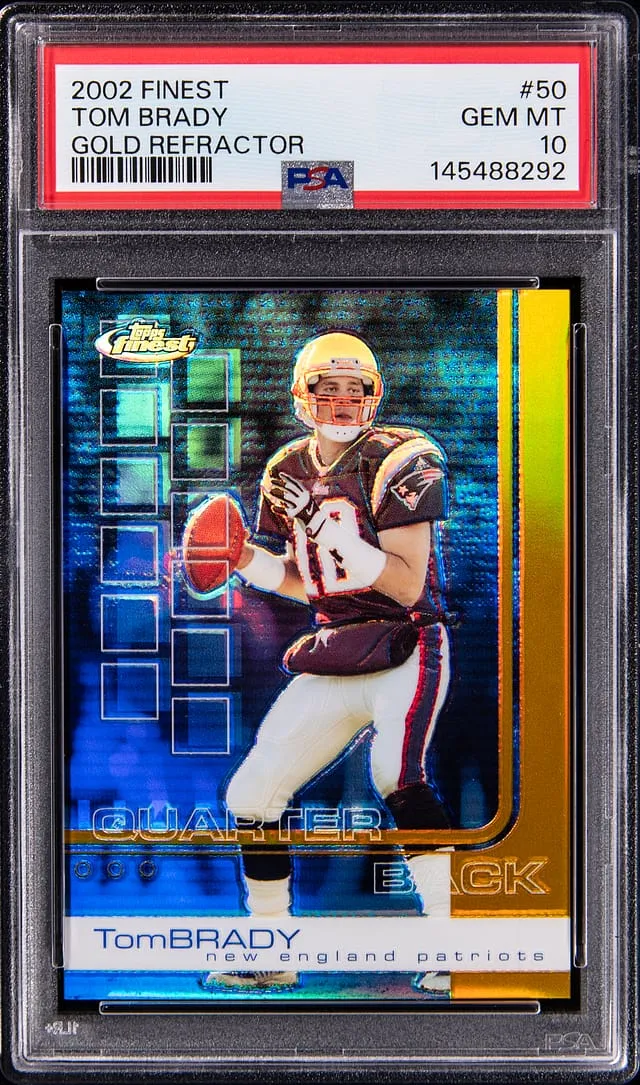
2002 Finest Gold Refractor Tom Brady PSA 10 Sale
A 2002 Topps Finest Gold Refractor #50 Tom Brady /25 PSA 10 (Pop 2) sold for $161,988 at Goldin on March 15, 2026. Here’s what it means for collectors.
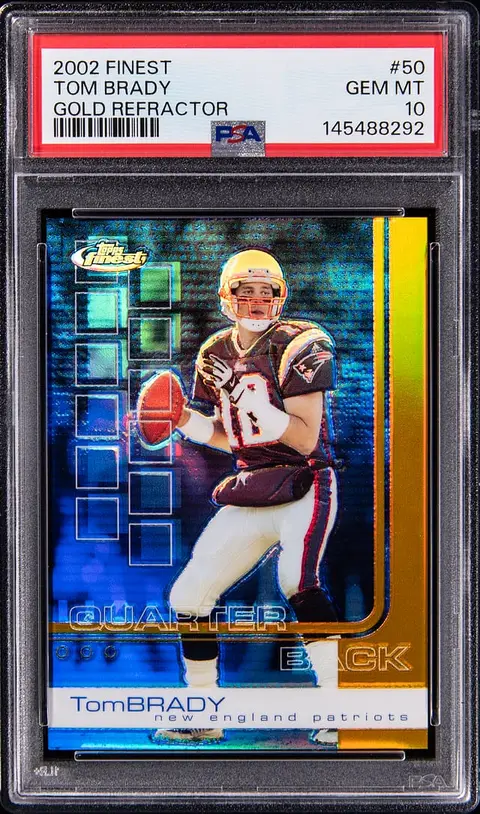
Sold Card
2002 Topps Finest Gold Refractor #50 Tom Brady (#14/25) - PSA GEM MT 10 - Pop 2
Sale Price
Platform
Goldin2002 Topps Finest Gold Refractor #50 Tom Brady (#14/25) - PSA GEM MT 10 - Pop 2 Sold for $161,988 at Goldin on March 15, 2026
For Tom Brady collectors and 2000s football specialists, this sale at Goldin on March 15, 2026 is a meaningful data point in a thin, high‑end market.
We’re looking at:
- Player: Tom Brady, New England Patriots
- Year / Set: 2002 Topps Finest Football
- Card: Gold Refractor #50
- Serial Numbering: #14/25 (only 25 copies produced)
- Grading: PSA GEM MT 10 (PSA’s highest standard grade)
- Population: Pop 2 in PSA 10 (only two copies in this grade, according to PSA’s population report)
- Result: $161,988 at Goldin, March 15, 2026 (UTC)
This is not a rookie card (Brady’s key rookies are from 2000), but it is an early‑career, low‑print, premium refractor from a respected chromium brand. For many modern and ultra‑modern football collectors, that combination of early Brady, gold refractor, and tiny PSA 10 population makes this a core “blue chip” piece within his non‑rookie portfolio.
Why this specific Brady matters
2002 Topps Finest: early‑era chrome for a rising star
Topps Finest has long been one of Topps’ premium chromium lines, sitting a step above base Topps for football in terms of technology and parallels.
By 2002:
- Brady had already won his first Super Bowl (2001 season) and was rapidly becoming the face of the league.
- The hobby was still in the early stages of the modern chromium / parallel era for football.
Within that context, a Gold Refractor /25 of Brady represents:
- A scarce parallel from the early part of his career.
- A card produced before his full GOAT status was cemented, which many collectors consider an attractive window.
This card is not his flagship rookie, but it occupies an important lane: early, low‑serial, high‑end parallel.
Gold Refractors and hobby importance
Gold parallels and gold refractors have become a kind of unofficial “currency” for modern collectors:
- They are typically short‑printed (in this case, /25).
- They sit near the top of the parallel hierarchy for many sets.
- They are frequently targeted by player collectors who focus on one player and chase rare color.
In football, especially for Hall of Fame‑level quarterbacks, early‑career gold refractors in gem‑mint condition form the backbone of many long‑term collections.
Grading and population: why Pop 2 in PSA 10 matters
A few grading concepts, explained briefly:
- PSA GEM MT 10 means PSA judged this card essentially flawless in terms of corners, edges, surface, and centering.
- A population report (“pop report”) is simply the grading company’s count of how many copies exist at each grade.
For this card:
- PSA shows only 2 copies in PSA 10.
- At just 25 copies printed, every upgrade to PSA 10 meaningfully shifts the market.
For a small, high‑end market like this, the difference between:
- PSA 9 (Mint) and PSA 10 (Gem Mint), and
- Gold Refractor vs. a more common parallel
can translate into a very large difference in sale price. A Pop 2 status tells us there is extremely limited supply of true top‑grade examples, and many advanced Brady or high‑end football collectors simply won’t accept less than a 10 for a centerpiece card.
Market context and recent sales
Because this is a low‑population, early 2000s gold parallel in PSA 10, public sales are sparse. That scarcity cuts both ways:
- It makes each sale more significant as a data point.
- It also means price discovery is choppy; a single auction can swing perceived value.
When we look at recent context around this lane of Brady cards, a few patterns emerge:
- Early‑career, low‑serial refractors (especially gold, /25 or lower) have consistently ranked among his most chased non‑rookie issues.
- Gem‑mint copies of those issues tend to sell far above lower grades because collectors know how hard it is to find clean 2000–2004 chrome surfaces and centering.
- Sales are infrequent, so collectors often refer back to:
- Prior public auction results for this exact card (when available).
- Comparable Brady gold refractors from adjacent years or sets.
In that context, the $161,988 price achieved at Goldin on March 15, 2026 sits squarely in the high‑end segment of the Brady parallel market. Without frequent recent comps for this exact card and grade, we can’t call it definitively low or high relative to a long record of identical PSA 10 sales, but we can say:
- It aligns with the idea that early Brady gold refractors in PSA 10 are treated by serious collectors as centerpiece assets.
- The pop 2 status and /25 print run are consistent with the premium reflected in the final price.
How this sale fits into the broader Brady market
Brady’s market has a few key pillars:
- 2000 rookie cards (Contenders, SP Authentic, Bowman Chrome, etc.).
- Early‑career chromium parallels from 2001–2004.
- Later premium inserts, patches, and autographs.
This 2002 Topps Finest Gold Refractor /25 fits firmly into the second pillar.
Compared to rookies:
- It is not a first‑year issue, so it typically trades at lower levels than true rookie grails.
- However, its combination of low serial (25), gold refractor status, and PSA 10 grade can pull it into conversations about high‑priority Brady holdings.
Compared to later, more plentiful issues:
- Print runs in the mid‑2010s and beyond are generally higher, with more parallel choices and more grading submissions.
- The 2002 Finest Gold Refractor remains relatively constrained: fewer copies exist, and fewer still are submitted to grading because of age and condition sensitivity.
As the hobby has matured, many advanced collectors have shifted attention from mass‑produced base rookies in high grade to low‑print, high‑quality parallels that are truly scarce. This card is a textbook example of that trend.
What collectors can take away from this result
For newcomers and returning collectors, a few practical lessons from this sale:
Understand the set and era.
- 2002 Topps Finest is an early chromium release from Brady’s first years as a star.
- Early 2000s cards often have tougher centering and condition issues than newer ultra‑modern cards.
Pay attention to serial numbering and population.
- “/25” means only 25 copies were printed.
- A “Pop 2 in PSA 10” means just two examples have achieved that top grade at PSA.
- When population is that low, even a single new submission grading a 10 can have an impact.
Comps are guides, not guarantees.
- “Comps” simply means comparable recent sales.
- With cards like this, comps are often sparse and can be months or years apart.
- Use them to understand a range, not to predict exact future outcomes.
Auction houses matter.
- High‑end Brady cards often surface at major auction houses like Goldin, which attract deep bidder pools.
- The March 15, 2026 Goldin result gives us a clear, public marker for this card’s current level within that environment.
Where this leaves the 2002 Finest Brady Gold Refractor market
With this sale logged at $161,988 on March 15, 2026 at Goldin, the hobby now has a fresh reference point for one of the premier non‑rookie Brady parallels in PSA 10.
For active collectors and small sellers, this result can be useful in a few ways:
- For Brady PC (“personal collection”) builders: it underlines how tightly held and competitive top‑end early Brady parallels are.
- For those considering grading similar 2000–2004 refractors: it’s a reminder of how large the gap between PSA 9 and PSA 10 can be when population is tiny.
- For sellers: it’s a solid benchmark when evaluating other early‑career gold refractors and similar short‑print color from comparable brands.
As always, this is one data point, not a prediction. But it’s a clear sign that the hobby continues to treat early‑career, low‑serial Tom Brady refractors—especially in gem‑mint condition—as cornerstone pieces in the modern football landscape.
This write‑up is for collectors who want context around a notable sale. It is not financial advice and should not be treated as a guarantee of future prices. Use recent sales and population data as tools, not promises.