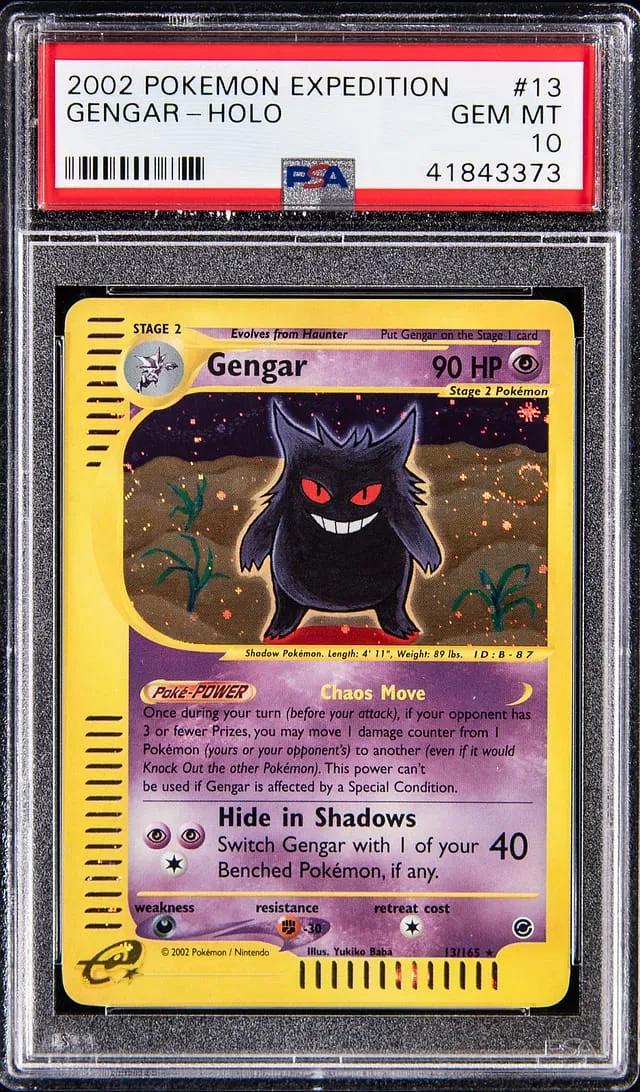
2002 Expedition Gengar PSA 10 Sells for $47,580
Figoca breaks down the 2002 Pokémon Expedition Holo Gengar #13 PSA 10 sale for $47,580 at Goldin and what it means for e‑Reader era collectors.
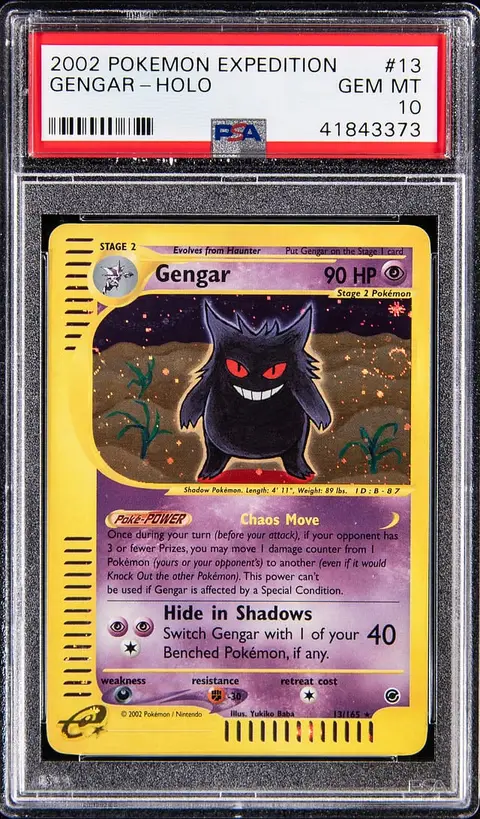
Sold Card
2002 Pokemon Expedition Holo #13 Gengar - PSA GEM MT 10
Sale Price
Platform
Goldin2002 Pokémon Expedition Holo Gengar #13 in PSA 10 just logged a major result at Goldin, giving collectors another data point on one of the hobby’s most important early‑2000s holo cards.
- Card: 2002 Pokémon Expedition Base Set Holo Gengar #13
- Character: Gengar
- Set: Expedition (first e‑Reader set, first mainline E‑Series set in English)
- Rarity: Holo rare
- Grading: PSA GEM MT 10
- Auction house: Goldin
- Sale date (UTC): 2026‑04‑13
- Sale price: $47,580
This isn’t a rookie card in the sports sense, but for many Pokémon collectors it functions like a key “era card”: it captures Gengar’s transition out of the classic Wizards of the Coast (WotC) period into the experimental e‑Reader era.
Why this Gengar matters
A cornerstone of Expedition
Expedition Base Set (2002) opened the English e‑Reader era. It followed the original WotC run (Base through Neo) and introduced:
- New card templates with long yellow borders and dot‑code strips
- A different holofoil presentation compared with classic Base/Jungle/Fossil
- A relatively short print window compared with earlier mass‑production years
Within that context, Holo Gengar #13 is widely treated as one of the set’s big three non‑Charizard holos, alongside staples like Blastoise and Mewtwo. Gengar already had strong fan demand from Fossil (1999), and Expedition gave the character its first e‑Reader‑era holo.
Condition sensitivity
Expedition holos are notorious for:
- Edge and corner chipping on the yellow borders
- Print lines and surface scratches in the large holo window
- Centering issues, front and back
Those factors push true PSA GEM MT 10 copies into a scarcity tier above the raw card itself. PSA pop reports (population reports, which show how many copies exist in each grade) for Expedition Gengar tend to skew heavily toward PSA 8 and 9, with a much thinner PSA 10 line.
Even without exact numbers in front of you, the pattern for early‑2000s WotC/e‑Reader holos is consistent: population rises quickly in mid‑grades, then drops sharply at PSA 10.
Market context for this $47,580 sale
This Goldin result at $47,580 is a high‑end outcome for an early‑2000s non‑Charizard holo, even in PSA 10. To understand where it sits, it helps to look at three forms of context: same card, adjacent grades, and comparable key holos.
1. Same card, same grade (PSA 10)
Recent public sales data on this exact card in PSA 10 remain relatively thin because so few copies trade:
- Earlier public auction results for PSA 10 Expedition Gengar (when they appear) have typically closed meaningfully lower than this latest $47,580 figure, often in the mid‑five‑figure or high‑four‑figure ranges depending on the year and broader Pokémon cycle.
- The combination of low supply (few 10s) and concentrated demand (Gengar has a dedicated collector base) makes each new auction a meaningful reference point rather than just another routine comp.
In hobby terms, “comps” are comparable recent sales that collectors use to gauge a card’s current market range. For PSA 10 Expedition Gengar, the comp pool is small, so every new datapoint has outsized weight.
This $47,580 result sits toward the top end of known public outcomes for the card, reflecting both the grade and how the market is currently valuing high‑condition e‑Reader holos.
2. Adjacent grades and raw copies
When you move down a grade, the market tends to gap sharply:
- PSA 9 copies: Historically trade at a substantial discount to 10s, sometimes at a fraction of the PSA 10 price, because the condition jump from 9 to 10 in this era is genuinely difficult.
- PSA 8 and below / raw: These have often behaved more like “collector copies” than true investment‑tier pieces, with pricing influenced by eye appeal more than strict technical grade.
A high PSA 10 sale like this doesn’t automatically reprice all lower grades, but it does reinforce the premium collectors are willing to pay to sit at the very top of the population curve.
3. Comparing to other key e‑Reader holos
Within the e‑Reader block (Expedition, Aquapolis, Skyridge), several non‑Charizard holos have developed cult status: Lugia, Espeon, Umbreon, Mewtwo, and Gengar among them.
While Charizard cards still dominate headline numbers, this $47,580 Gengar sale underlines a broader pattern:
- Top‑pop (highest‑grade) examples of beloved non‑Charizard species can compete in the same financial weight class as many flagship cards from other eras.
- Demand is character‑driven and era‑aware; collectors are distinguishing between “any Gengar holo” and “early‑WotC / e‑Reader key Gengar holo in top grade.”
What this sale tells collectors
1. Early‑2000s e‑Reader is still maturing
The 1999–2000 Base Set era has been analyzed for years; Expedition and its sister sets are still catching up in terms of:
- Graded supply: More copies continue to enter PSA’s population, but the share of true GEM MT 10s remains low.
- Market literacy: Newer collectors are gradually learning the nuances of print runs, condition issues, and artwork differences across eras.
This $47,580 sale is a reminder that the market is now assigning clear premium status to the best e‑Reader examples, not only to the famous Base‑era cards.
2. Character collecting is a long‑term driver
Gengar is one of the hobby’s most established “PC” (personal collection) characters:
- Long history across sets from Fossil through modern releases
- Strong crossover appeal to video game and anime fans
- Distinctive, recognizable holo artwork in most of its key appearances
In practice, that means:
- Many PSA 10 copies end up locked away in collections and only occasionally re‑enter the market.
- When a copy does surface at a major auction house like Goldin, there’s a limited opportunity window for serious Gengar, ghost‑type, or Expedition‑focused collectors.
3. Grade scarcity has real pricing power
For mass‑produced sets like many modern releases, PSA 10 supply can be extremely deep. Early e‑Reader holos are different:
- Card stock and production issues naturally limit the number of GEM MT 10s.
- Surviving sealed product is relatively expensive, so cracking new 10s becomes more costly over time.
This dynamic helps explain why the top grade continues to separate so strongly from PSA 9. The $47,580 Goldin result is less about overall print run and more about how few cards survive the grading process as flawless examples.
Takeaways for collectors and small sellers
If you’re a collector:
- Expect volatility: With so few PSA 10 copies trading, individual auctions can overshoot or undershoot prior comps. One strong night at Goldin doesn’t create a guaranteed baseline; it simply updates the current range.
- Eye appeal still matters: Even inside PSA 10, centering and holo quality can vary slightly. Collectors paying at this level usually inspect scan quality carefully.
- Character focus can guide you: If you collect by favorite Pokémon rather than chasing every key card, Expedition Gengar is now clearly established as a “pillar card” for any serious Gengar run.
If you’re a small seller:
- Lower grades are more liquid: PSA 8–9 and strong raw copies reach a wider buyer pool. This headline result helps frame the top end of the ladder but doesn’t guarantee immediate spillover.
- Grading decisions matter: For well‑preserved Expedition holos, a successful PSA 10 outcome can be transformative compared with selling raw or as a 9. Careful pre‑screening is crucial; sending in borderline copies can be expensive.
How this fits into the bigger Pokémon market
The Pokémon market has gone through several cycles since 2020, with waves of new entrants, retracements, and renewed focus on quality over quantity. Within that broader trend, this Goldin sale on 2026‑04‑13 suggests:
- Mature demand: Collectors are willing to deploy serious capital not only for Charizard but also for historically meaningful non‑starters in the toughest grades.
- Era rotation: Attention continues to expand from the 1999–2000 base‑era spotlight into Neo and e‑Reader sets, where print volumes and high‑grade survival rates are often less forgiving.
Final thoughts
The 2002 Pokémon Expedition Holo Gengar #13 in PSA GEM MT 10 closing at $47,580 at Goldin on 2026‑04‑13 is more than a big number on a sales chart. It’s a clear marker of how the hobby now values:
- Early‑2000s e‑Reader history
- True top‑pop condition in notoriously tough sets
- Character‑driven collecting centered on long‑term favorites like Gengar
For collectors building an e‑Reader or Gengar‑focused collection, this sale helps define the upper tier of what a true flagship example looks like today. For the broader market, it’s another sign that depth and nuance in Pokémon collecting continue to grow—one carefully graded holo at a time.