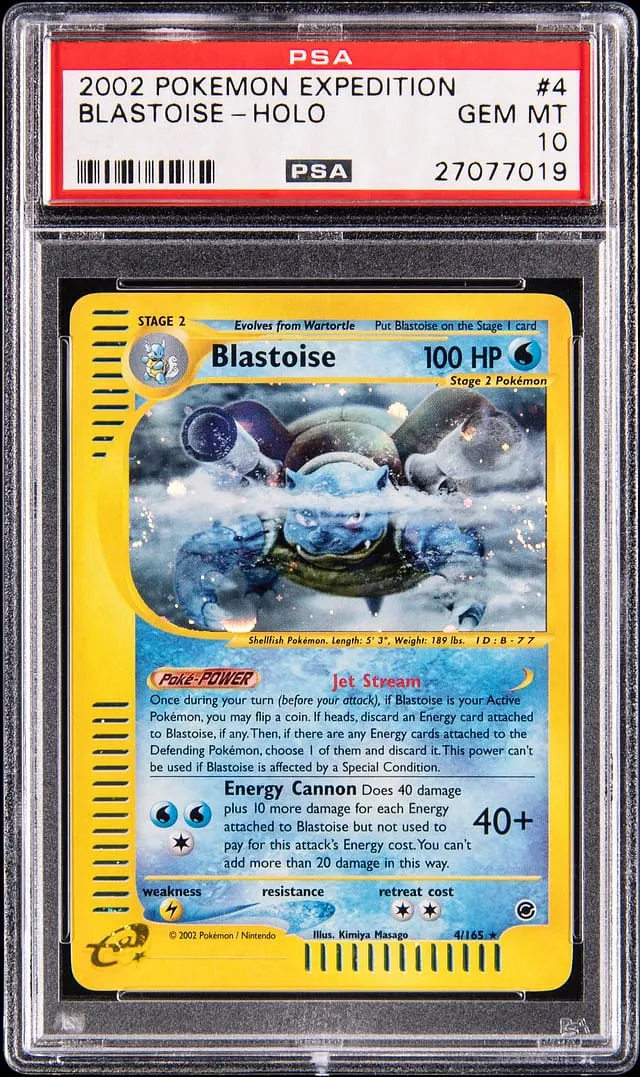
2002 Expedition Blastoise PSA 10 Sells for $14,762
A 2002 Pokémon Expedition Holo #4 Blastoise PSA 10 sold for $14,762 at Goldin. We break down the card’s significance and recent market context.
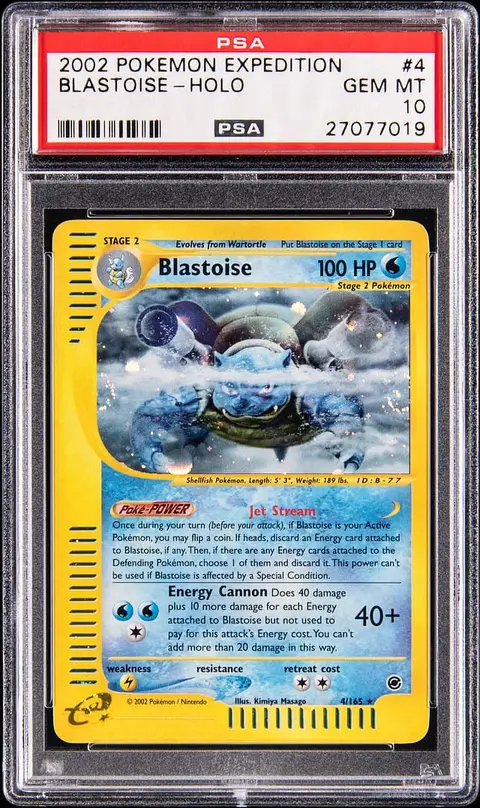
Sold Card
2002 Pokemon Expedition Holo #4 Blastoise - PSA GEM MT 10
Sale Price
Platform
Goldin2002 Pokémon Expedition Holo #4 Blastoise in PSA 10 is one of those cards that quietly sits at the crossroads of nostalgia, scarcity, and early‑2000s hobby history. On May 18, 2026, a copy sold at Goldin for $14,762, offering a clean data point for collectors tracking the mid‑era WotC (Wizards of the Coast) market.
In this breakdown, we’ll look at what this card is, why it matters, and how this sale fits into the broader price picture.
Card snapshot
- Character: Blastoise
- Year: 2002
- Set: Pokémon Expedition Base Set (e‑Reader era)
- Card number: #4
- Variant: Holofoil (standard set holo, not a reverse holo)
- Publisher/era: Wizards of the Coast, early e‑Reader generation
- Grading company: PSA (Professional Sports Authenticator)
- Grade: GEM MT 10
- Attributes: Classic holo, no autograph, no serial numbering
This is not a rookie card in the traditional sports sense, but for Pokémon collectors it functions as a key issue from the transition between the original WotC era and the short‑lived e‑Reader run. Expedition, Aquapolis, and Skyridge are widely seen as a bridge between the 90s Base/Jungle/Fossil nostalgia and the more modern EX and DP eras.
Why Expedition Blastoise matters to collectors
1. A cornerstone of the e‑Reader era
Expedition was the first English e‑Reader set, released in 2002. It introduced:
- The new card frame that became standard in later years
- The e‑Reader barcode strip along the edge
- A noticeably lower print run compared to early Base Set printings
Within that context, Blastoise is one of the anchor holos of the set alongside Charizard and Venusaur. Collectors chasing master sets, e‑Reader era binders, or WotC‑only collections often treat this card as a mandatory piece.
2. Holo vs. reverse holo
Expedition has both traditional holos and reverse holos. The card here is the standard holo version:
- Holo: Character art box and background are foil; follows the classic 90s WotC look.
- Reverse holo: The entire card outside the art box is foil, with a set stamp.
Both are collected, but many long‑time WotC fans gravitate toward the traditional holo look, especially for a starter‑evolution like Blastoise.
3. PSA 10 scarcity
When collectors talk about “pop” or “pop report”, they mean the population report – how many copies a grading company has given each grade.
For e‑Reader holos, PSA 10 GEM MT copies are relatively tough due to:
- Print quality and holo surfaces that pick up scratches easily
- Chipping along the colored borders
- Centering issues from the era
While exact population numbers can change as more cards are graded, Expedition holo starters are consistently low‑population in PSA 10 compared to later‑era Blastoise cards.
Market context for this sale
- Auction house: Goldin
- Sale date (UTC): 2026‑05‑18
- Realized price: $14,762
How this price fits with recent comps
In hobby slang, “comps” are comparable recent sales that help us understand the current price range of a card.
Based on recent public auction results across major marketplaces (Heritage, PWCC, Goldin, and fixed‑price marketplaces), Expedition Blastoise holo in PSA 10 has generally been trading in a low‑ to mid‑five‑figure range, with some variation depending on timing, auction venue, and card eye appeal.
Patterns we’ve seen:
- PSA 10 copies: Often land in a band roughly similar to this Goldin result, with some outliers up or down depending on market sentiment at the time of sale.
- PSA 9 copies: Typically sell at a noticeable discount from 10s, often in the mid‑four‑figure range, providing a lower‑entry alternative for collectors who care more about owning the card than hitting the top grade.
- BGS/CGC high grades: Gem‑level grades from other grading companies can trade at a modest discount or premium depending on subgrades, label preferences, and the buyer pool.
With that backdrop, $14,762 is within the expected range for a strong PSA 10 copy at a major auction house. It doesn’t look like a dramatic outlier, but rather a representative, healthy result for a key WotC‑era holo in top grade.
(As always, realized prices can drift over time as the broader Pokémon market moves, so this is a snapshot, not a forecast.)
Comparing to related Blastoise and Expedition cards
To understand this result, it helps to look at nearby cards collectors might cross‑shop:
- Expedition Blastoise reverse holo (PSA 10): Often a bit less visible at auction, with a thinner track record of high‑grade sales. Some collectors prefer the standard holo, while others specifically target reverse holos as a distinct chase.
- Other WotC Blastoise holos:
- Base Set and Base Set 2 Blastoise
- Legendary Collection Blastoise
- Other e‑Reader appearances and later‑era EX/Diamond & Pearl cards
The Expedition holo tends to sit in an interesting middle ground:
- Not as iconic or widely recognized as Base Set Blastoise
- Yet typically rarer in high grade and central to completing the e‑Reader era
This combination gives it a collector‑driven demand profile: more about set completion and era‑specific love than mainstream nostalgia alone.
What this sale might signal (without over‑reading it)
A single sale should not be treated as a prediction tool, but there are a few reasonable takeaways:
Steady demand for e‑Reader WotC holos
The realized price supports the idea that collectors continue to prioritize well‑graded WotC‑era cards, even outside the most famous printings like Base Set.PSA 10 premium remains meaningful
The gap between PSA 10 and PSA 9 for Expedition holos continues to be significant. For condition‑focused collectors, centering, surface, and edges are still driving real premiums.Auction venue still matters
A major platform like Goldin often brings enough bidders to surface solid, data‑rich results. This sale provides a useful reference point when comparing to smaller platforms or private deals.
Takeaways for different types of collectors
New or returning collectors
- This card shows how non‑Base‑Set WotC cards can be both nostalgic and scarce, especially in top grade.
- If you’re exploring early‑2000s Pokémon, Expedition, Aquapolis, and Skyridge are worth a deeper look.
Active hobbyists
- This Goldin sale gives a clear PSA 10 comp around the mid‑five‑figure mark as of May 2026.
- When assessing similar cards, compare:
- Grade (PSA 9 vs 10)
- Regular holo vs reverse holo
- Centering and print quality within the same numerical grade
Small sellers
- If you own raw (ungraded) Expedition holos, especially starter evolutions, this sale highlights the upside of strong condition when sending cards to PSA or other grading companies.
- For pricing lower grades or raw copies, use this sale as a top‑end anchor and scale down based on condition, grade, and marketplace.
Final thoughts
The 2002 Pokémon Expedition Holo #4 Blastoise in PSA GEM MT 10 that sold at Goldin on May 18, 2026 for $14,762 is a clear, grounded data point in a segment of the Pokémon market that tends to be collector‑driven rather than purely hype‑driven.
It sits at the intersection of:
- A beloved Gen‑1 starter
- A short‑printed, transitional WotC set
- A genuinely tough PSA 10 grade
For anyone building an e‑Reader run, a Blastoise‑focused collection, or simply studying how mid‑era WotC cards behave in the current market, this sale is worth bookmarking in your notes.
As always, use it as one piece of the puzzle alongside other recent comps, your own condition standards, and what you personally enjoy collecting.