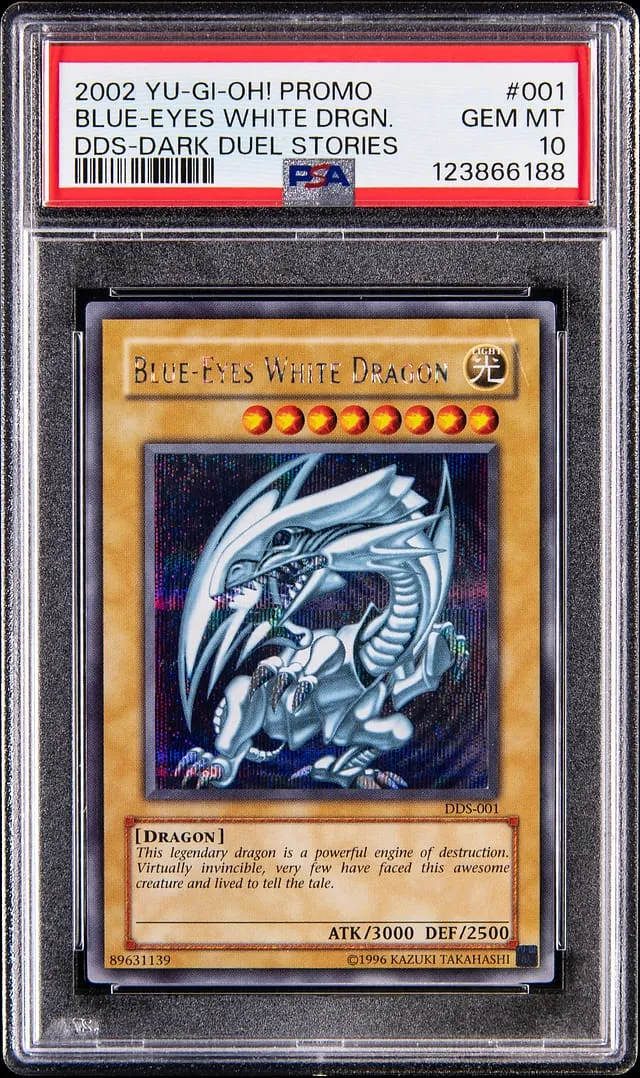
2002 DDS Blue-Eyes White Dragon PSA 10 Sells for $14K
Goldin sold a 2002 Yu-Gi-Oh! DDS #001 Blue-Eyes White Dragon PSA 10 for $14,640 on May 18, 2026. See the sale context and collector insights.
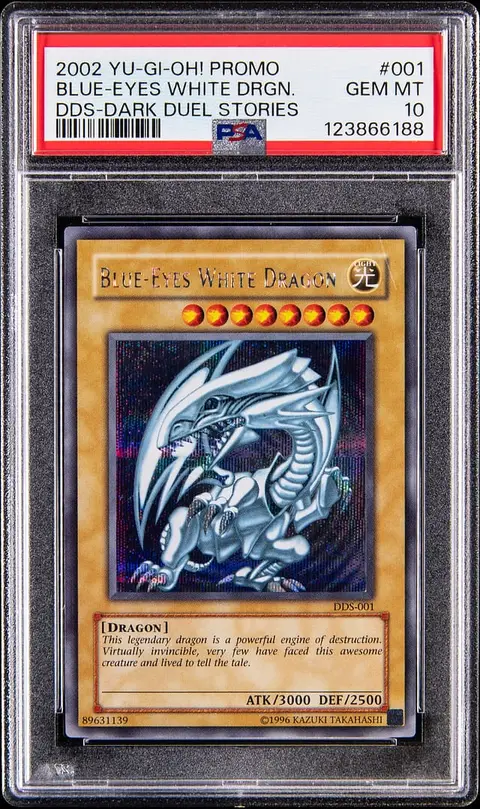
Sold Card
2002 Yu-Gi-Oh! Promo Dark Duel Stories #001 Blue-Eyes White Dragon - PSA GEM MT 10
Sale Price
Platform
Goldin2002 Yu-Gi-Oh! Promo Dark Duel Stories #001 Blue-Eyes White Dragon - PSA GEM MT 10 Sells for $14,640
On May 18, 2026, a copy of the 2002 Yu-Gi-Oh! Promo Dark Duel Stories #001 Blue-Eyes White Dragon graded PSA GEM MT 10 sold at Goldin for $14,640. For many Yu-Gi-Oh! collectors, this is one of the most recognizable early-era Blue-Eyes cards, and PSA 10 examples continue to act as a reference point for the broader Yu-Gi-Oh! promo market.
Card overview
- Game / IP: Yu-Gi-Oh!
- Character: Blue-Eyes White Dragon
- Year: 2002
- Set / Release: Dark Duel Stories Game Boy Color promo
- Card number: #001
- Type: English-language promotional card
- Status: Early key Blue-Eyes promo, widely treated as a core 2000s Yu-Gi-Oh! card
- Grading company: PSA
- Grade: GEM MT 10 (PSA’s highest standard grade)
- Attributes: Non-foil game promo (not a serial-numbered card, no autograph, no patch)
The Dark Duel Stories (DDS) Blue-Eyes White Dragon is part of a three-card promotional pack that came with the 2002 North American release of the Yu-Gi-Oh! Dark Duel Stories Game Boy Color game. The trio—Blue-Eyes White Dragon, Dark Magician, and Exodia the Forbidden One—became foundational cards for many Western Yu-Gi-Oh! fans.
Within that trio, Blue-Eyes has generally led the way in visibility and pricing, thanks to its central role in the early anime and its status as one of the hobby’s most recognizable monsters.
Why this card matters to collectors
Several factors keep the DDS Blue-Eyes near the top of many Yu-Gi-Oh! wantlists:
Early 2000s nostalgia
Released in 2002, this card sits squarely in the early Yu-Gi-Oh! era for English-language collectors. Many current adult collectors first encountered Blue-Eyes through either the televised series or exactly this promo pack.Iconic character linkage
Blue-Eyes White Dragon is one of the franchise’s flagship monsters. For character-focused collectors, the DDS promo is typically ranked alongside other early prints like Legend of Blue Eyes White Dragon (LOB) as a key early-era representation.Promo origin
As a video game promo, the card was not distributed through regular booster packs. While the game itself was widely available, the condition of cards that survived from kid-owned copies is highly variable. That makes true gem-mint examples harder to find than raw population might suggest.PSA 10 as a condition benchmark
PSA’s GEM MT 10 grade denotes a card that is essentially flawless to the naked eye: sharp corners, clean edges, strong centering, and no visible print or surface defects. For condition-sensitive Yu-Gi-Oh! collectors, the PSA 10 label is often the preferred endpoint, especially for display pieces.
Market and price context
The Goldin sale closed at $14,640 on May 18, 2026.
To put that into context, collectors usually look at “comps,” short for comparables—recent sales of the same card in similar condition—to understand where a new result sits. Public auction records for the 2002 DDS Blue-Eyes PSA 10 over the past few years have generally shown:
- A long-term pattern where PSA 10 copies command a strong premium over PSA 9 and lower grades, reflecting how sensitive Yu-Gi-Oh! collectors are to centering, print lines, and edge wear.
- Periods of heightened activity when nostalgia cycles or broader TCG interest spike, followed by periods of consolidation.
Recent public comps (across large marketplaces and auction houses) have often placed PSA 10 copies of this card in a mid–five-figure range, with some variation based on timing, auction platform, and bidder participation. Against that backdrop, the $14,640 Goldin result fits within the established high-end range for this card rather than marking an outlier or record-breaking price.
Lower grades have consistently tracked far below PSA 10 levels:
- PSA 9 copies tend to sell at a noticeable discount to PSA 10, reflecting even minor centering or surface issues.
- PSA 8 and below are often collected primarily for nostalgia or character display rather than as condition trophies.
While exact numbers move over time, the pattern itself—steep price curve from PSA 9 to PSA 10—is an important part of how the market values this card.
Population and scarcity
When collectors talk about a “pop report,” they are referring to a grading company’s population report: a count of how many copies of a given card have been graded at each grade level.
For the 2002 DDS Blue-Eyes:
- PSA has graded a meaningful number of copies overall, reflecting both its popularity and the fact that many collectors pulled and preserved these cards.
- However, true GEM MT 10 examples represent only a fraction of total submissions. Early Yu-Gi-Oh! promos are prone to centering issues, edge chipping, and surface wear from being handled without sleeves.
The net result: the card is not rare in an absolute sense, but high-grade scarcity—specifically the limited number of PSA 10s—supports the kind of price realized in this Goldin auction.
Where this sale fits in hobby terms
In the context of the broader Yu-Gi-Oh! market, this sale reinforces a few themes:
Early 2000s promos remain stable reference points
Even as modern Yu-Gi-Oh! products introduce new chase cards and rarities, early promos like DDS Blue-Eyes continue to anchor many collectors’ idea of what “important Yu-Gi-Oh!” looks like.Character-first collecting is strong
Many Yu-Gi-Oh! collectors chase by character rather than set. For Blue-Eyes collectors, the DDS promo is typically ranked as a must-have alongside other major prints.Condition premium is firmly entrenched
The gap between PSA 10 and lower grades on this card reflects a wider TCG trend: as more copies are graded, markets become increasingly precise about how much they will pay for near-perfect vs. very good condition.
Takeaways for different types of collectors
New or returning collectors
If you are coming back to the hobby and remember the Dark Duel Stories game, this sale is a reminder that some of the cards you might have owned or seen as a kid have become established long-term keys. Condition matters greatly; well-preserved copies can differ sharply in value from heavily played ones.Active Yu-Gi-Oh! hobbyists
For those already familiar with the card, this Goldin result provides another data point for your own price tracking. When reviewing your next DDS Blue-Eyes opportunity, it can be useful to compare:- Grade (and subgrade-level eye appeal, even within PSA 10s)
- Auction venue and timing
- Whether the card has strong centering and clean surfaces
Small sellers
If you are considering grading raw DDS promos or listing already-graded copies, this sale highlights:- The potential upside of high-grade copies when submitted to a major grading company like PSA.
- The importance of presenting high-resolution images and mentioning population context in your listings.
None of this should be taken as financial advice or a prediction about future prices. Instead, the Goldin sale of this 2002 Yu-Gi-Oh! Promo Dark Duel Stories #001 Blue-Eyes White Dragon – PSA GEM MT 10 on May 18, 2026 is best understood as a clear snapshot of how the market is currently valuing one of the franchise’s most familiar early-era cards.
For collectors who care about early 2000s Yu-Gi-Oh!, it remains a cornerstone piece—and this result shows that the hobby continues to recognize it that way.