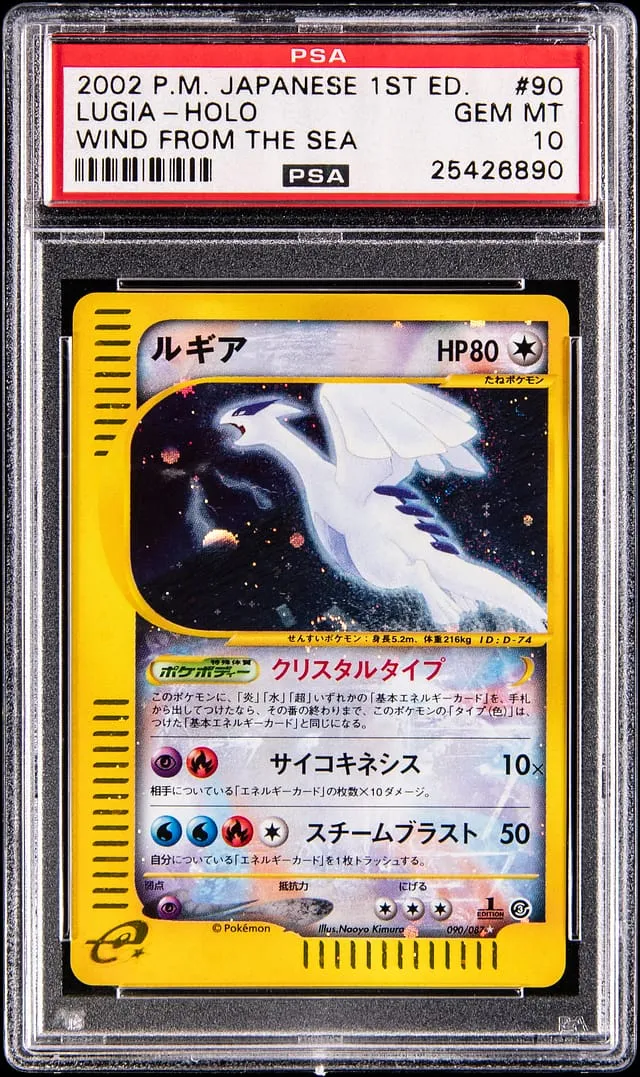
2002 Crystal Lugia PSA 10 Japanese Sale at Goldin
Breaking down the $40,260 June 2026 Goldin sale of the 2002 Pokémon Japanese 1st Edition Crystal Lugia PSA 10 and what it means for collectors.
Sold Card
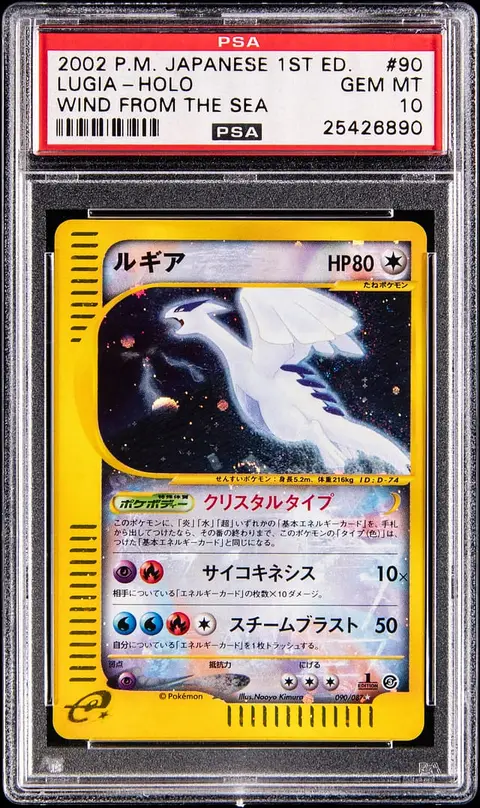
2002 Pokemon Japanese 1st Edition Wind From The Sea Holo #90 Crystal Lugia - PSA GEM MT 10
Sale Price
Platform
Goldin2002 Pokémon Japanese 1st Edition Wind From The Sea Holo #90 Crystal Lugia - PSA GEM MT 10 just changed hands at Goldin on June 1, 2026 for $40,260. For Lugia collectors and vintage‑era Pokémon fans, this is a meaningful data point for one of the most important non‑English Lugia cards in the hobby.
Card overview
Let’s start by clearly identifying the card:
- Character: Lugia
- Year: 2002
- Language: Japanese
- Set: Wind From The Sea (Japanese e-Series 4)
- Edition: 1st Edition
- Card number: #90
- Card type: Crystal Pokémon holo
- Manufacturer: Pokémon / Media Factory (Japan)
- Grading company: PSA
- Grade: GEM MT 10
This Crystal Lugia is not a rookie card in the sports sense, but it is widely treated as a key issue for Lugia collectors. The Japanese e‑Series Crystal cards sit at the intersection of early 2000s nostalgia, low print runs, and notoriously difficult grading.
Why this card matters
A cornerstone Lugia
Lugia has several major chase cards across eras (Neo Genesis, Neo Revelation shinings, various Gold Star and modern alts), but the e‑Series Crystals occupy a special lane:
- They come from the Game Boy Advance e‑Reader era, where cards could be scanned for extra content.
- Print runs were relatively low compared with late‑WOTC English sets and modern reprints.
- The Crystal subtype features unique card frames and multi‑type attacks that stand out even among other early 2000s holos.
Within that group, Japanese 1st Edition examples are especially valued by collectors who focus on original language releases and earlier print runs.
Set and era context
Wind From The Sea (Japanese e4) is part of the “e‑Series” block, often grouped by collectors with late‑WOTC to early EX era Pokémon (roughly 2001–2003). Some characteristics of this era:
- Smaller total supply than today’s ultra‑modern sets.
- Surface‑heavy foiling and colored borders that pick up scratches, edge wear, and print lines.
- Lower surviving gem‑mint rates, which helps explain why PSA 10 copies are chased.
For many returning collectors, this era lines up with the tail end of childhood collecting, which adds a nostalgia premium beyond pure scarcity.
Grading and population
“Pop report” is hobby shorthand for a grading company’s population report: how many copies exist in each grade. While individual numbers change over time, a few general points hold for this card:
- PSA 10s for Japanese e‑Series Crystals are meaningfully scarcer than PSA 9s.
- Many raw copies show edge chipping or small holo scratches, leaving them out of the top grade.
- The design’s colored borders make even minor whitening obvious, further tightening the PSA 10 population.
Because of that, price jumps between PSA 9 and PSA 10 on this card tend to be larger than what you might see on higher‑print modern cards.
Market context and recent sales
When collectors talk about “comps,” they mean comparable recent sales that help frame where a card typically trades. For this Crystal Lugia in PSA 10, useful comps include:
- Other recent PSA 10 sales of the same Japanese 1st Edition Crystal Lugia.
- PSA 9 copies of the same card.
- English Aquapolis Crystal Lugia in PSA 10, which is a closely related but separate issue.
Across major marketplaces and auction archives, Japanese 1st Edition Crystal Lugia has consistently tracked as a premium Lugia card, with PSA 10 examples selling significantly above lower grades. The $40,260 result at Goldin sits toward the higher end of the observed range for top‑grade copies, in line with:
- Strong but not unprecedented pricing for gem‑mint examples.
- A noticeable gap versus PSA 9 sales, reflecting grade scarcity.
Looking back over prior years, earlier record‑type results for Lugia chase cards have often involved Neo Genesis or high‑end English Crystals. This sale continues a pattern where Japanese e‑Series gems are closing the gap as more collectors deliberately target original‑language versions and niche e‑Series sets.
How this sale fits into the broader Lugia market
Instead of treating any one result as a forecast, it’s more useful to view it as one point on a trend line.
Some patterns around Lugia and similar era cards:
- Steady character demand. Lugia has remained a top‑tier legendary for over two decades, with consistent interest across both English and Japanese releases.
- Mature set recognition. e‑Series sets have moved from “underrated” status to being widely recognized as core 2000s chase sets, especially among seasoned collectors.
- Grade separation. High‑grade vintage and early 2000s cards often show bigger price differences between PSA 9 and 10 than newer products, simply because finding clean, pack‑fresh copies today is much harder.
This Goldin result doesn’t redefine Lugia overnight, but it reinforces several ongoing themes:
- Japanese 1st Edition key cards are not trailing far behind high‑profile English equivalents.
- e‑Series Crystals remain among the most respected Lugia issues in the hobby.
- Solid demand exists for top‑population, low‑supply slabs in established characters.
What collectors can take from this
Whether you are a newcomer, a returning collector, or an active hobbyist, here are a few grounded takeaways from this sale.
1. Understand the specific card, not just “Lugia”
“Crystal Lugia” can mean different things depending on language, set, and edition. Before you look at prices or listings:
- Confirm language (Japanese vs English).
- Confirm set (Wind From The Sea vs Aquapolis).
- Check for 1st Edition markings on Japanese cards.
- Check grading company and grade.
Small label differences can translate into very large price differences.
2. Use comps as a range, not a promise
The $40,260 sale on June 1, 2026 at Goldin is a useful comp, but it is only one data point. When you look at price context:
- Compare multiple recent auctions and fixed‑price results.
- Note whether the sale was a public auction or a best‑offer / private deal.
- Pay attention to timing; markets can move over months, not just years.
Thinking in ranges (for example, “recent PSA 10s have tended to fall in a certain band”) is usually more realistic than treating any single price as a rule.
3. Grade sensitivity is high on early 2000s foils
If you are considering crossing from raw to graded, or upgrading from a 9 to a 10:
- Expect a steep jump from near‑mint to gem‑mint for true chase cards like this.
- Look very carefully at surfaces and borders; e‑Series holos are unforgiving.
- Remember that population reports evolve as more cards are submitted.
4. Japanese e‑Series remains a focused niche
Demand for Japanese e‑Series tends to come from:
- Collectors who prioritize original language and set history.
- Character‑focused collectors (Lugia in this case) who chase every major key.
- Set builders tackling full e‑Series Crystal runs.
That means the buyer pool is smaller but often very knowledgeable, which can produce strong results when a top‑end copy surfaces on a major platform like Goldin.
Final thoughts
The $40,260 sale of the 2002 Pokémon Japanese 1st Edition Wind From The Sea Holo #90 Crystal Lugia in PSA GEM MT 10 at Goldin on June 1, 2026 adds another clear, public datapoint for one of Lugia’s most important non‑English issues.
For collectors, the main takeaway is not that prices must follow this result, but that:
- High‑grade examples of established, low‑supply chase cards continue to attract strong bidding.
- Japanese e‑Series Crystals are firmly entrenched as blue‑chip pieces within the Lugia lane.
As always, it’s wise to collect what you genuinely enjoy, use recent sales as context rather than prediction, and pay attention to the details on the label—especially when the difference between a 9 and a 10 can mean the difference between a strong card and a true headline sale.
figoca will continue tracking key auction results like this one so you can see how cornerstone cards evolve over time, across grades, languages, and marketplaces.