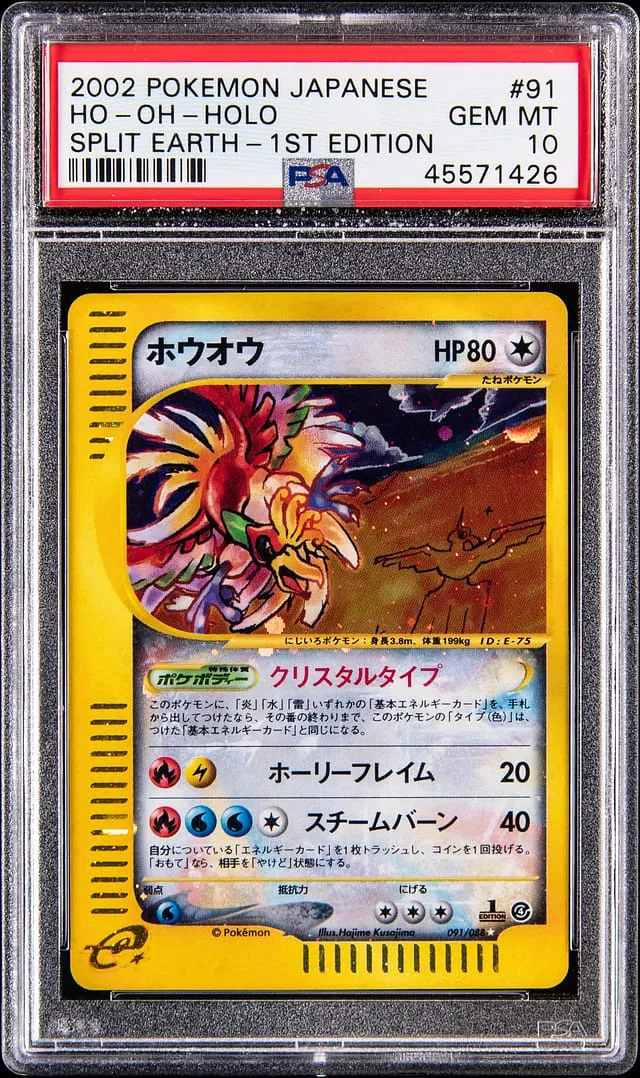
2002 Crystal Ho-Oh PSA 10 Japanese Split Earth Sale
Breakdown of the 2002 Japanese Split Earth Crystal Ho-Oh PSA 10 sale at Goldin for $14,945 and what it means for Pokémon card collectors.
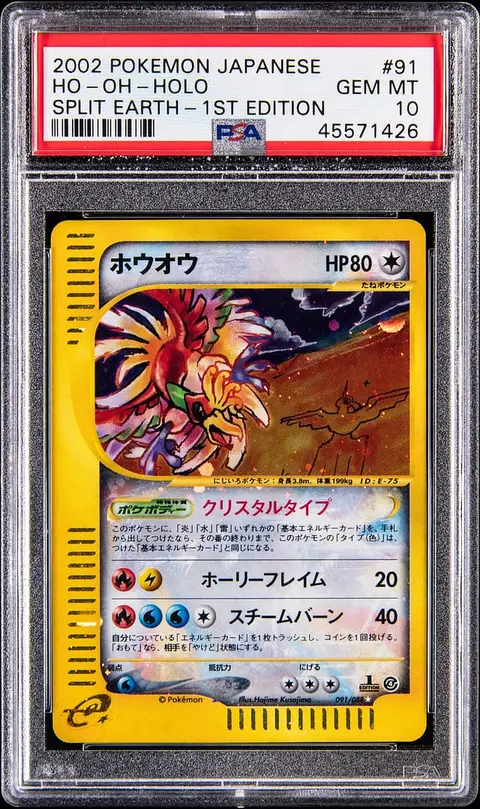
Sold Card
2002 Pokemon Japanese Split Earth 1st Edition Holo #91 Crystal Ho-Oh - PSA GEM MT 10
Sale Price
Platform
Goldin2002 Pokémon Japanese Split Earth 1st Edition Holo #91 Crystal Ho-Oh in PSA GEM MT 10 just crossed the auction block at Goldin on 2026-05-18, closing at $14,945. For collectors who follow early-2000s Japanese sets and the Crystal-era chase cards, this sale is a useful reference point for one of the tougher Ho-Oh cards in the hobby.
The card at a glance
- Character: Ho-Oh (Crystal type)
- Year: 2002
- Set: Pokémon Japanese Split Earth (e-Card era)
- Card number: #91
- Edition: 1st Edition
- Finish: Holo / Crystal-type
- Language/Region: Japanese
- Grading company: PSA
- Grade: GEM MT 10
- Key status: Crystal-era key issue for Ho-Oh collectors; non-rookie but a major chase card from the e-Card period
The Split Earth expansion is part of the Japanese e-Card era. These sets are known for their intricate designs, technical printing process, and relatively lower production compared with mass-market English sets from the same window. Within Split Earth, Crystal Ho-Oh sits in the top tier of chase cards, comparable in desirability (for this release) to Crystal Lugia and other Crystal-type headliners.
A PSA GEM MT 10 is PSA’s top grade, indicating the card is, by their standards, virtually flawless: sharp corners, clean edges, strong centering, and no visible print or surface defects under normal viewing.
Why Crystal Ho-Oh matters to collectors
1. Crystal-era prestige
Crystal-type Pokémon were a short-lived but memorable mechanic in the e-Card era. They sit alongside Gold Star and early EX cards as some of the most recognizable early-2000s chase cards.
Key points for Crystal Ho-Oh:
- It’s part of a defined, finite group of Crystal-type cards spanning a few sets.
- The artwork and layout are distinct to the e-Card period, which many collectors view as a bridge from classic WotC (Wizards of the Coast) designs to more modern aesthetics.
- Ho-Oh itself is a legendary mascot-level Pokémon with a loyal fan base, especially among Johto and second-generation fans.
2. Japanese e-Card scarcity and condition sensitivity
Japanese e-Card sets like Split Earth were not released with the same scale and visibility as English base-era sets. While exact print numbers are not public, most longtime collectors consider these sets:
- Less commonly opened in volume
- Harder to find in gem-mint condition today
E-Card stock and printing also present condition challenges—edge chipping, print lines, and centering can all hold back otherwise strong copies from achieving a PSA 10. That makes PSA 10 population ("pop") an important lens for understanding this sale. A pop report is essentially a census of how many copies of a card have received each grade from a grading company.
At the time of writing, public PSA population data (not reproduced here in full) indicates that Crystal Ho-Oh in PSA 10 is a relatively low-population card compared with mass-release modern holofoils. That low supply is a key piece of context for this $14,945 result.
3. Era positioning: not vintage, not ultra-modern
2002 sits in an interesting middle ground:
- It’s well past original Base/Jungle/Fossil “vintage” nostalgia.
- It’s well before the ultra-modern boom of full-art EX/GX/V and alternate art era.
This middle era has been gradually re-evaluated by the hobby as collectors who grew up with Game Boy Color/Advance and second-gen games hit their high-disposable-income years. Crystal Ho-Oh benefits from that demographic trend: it’s both nostalgic and demonstrably scarcer than a lot of mass-printed modern chase cards.
Price context: how does $14,945 stack up?
This Goldin sale closed at $14,945. When collectors talk about “comps,” they mean comparable sales—recent, publicly visible results for the same card (or as close as possible) used to understand where current market sentiment sits.
For this specific card—2002 Japanese Split Earth 1st Edition Crystal Ho-Oh in PSA 10—recent public comps are limited. High-grade Crystal cards do not trade every week, and when they do, results are often scattered across different auction houses and time zones. That makes it hard to draw a clean line of trend without over-interpreting isolated data points.
However, a few grounded observations are safe to make:
PSA 10 premium vs. lower grades
Across Crystal-era cards generally, PSA 10s tend to command a meaningful premium over PSA 9s because:- The pop gap between 9 and 10 is often significant.
- Condition-sensitive features (holo surface, e-Card edges) cause many copies to cap at 8 or 9. For Crystal Ho-Oh specifically, previous PSA 9 sales have generally trailed well behind five-figure territory, reflecting that usual 9–10 gap.
Relative position within Crystal cards
While exact ranking can shift over time, Crystal Ho-Oh is usually discussed in the same breath as other marquee Crystal Pokémon from the era. Cards like Crystal Lugia or Crystal Charizard often sit at the very top of the price spectrum, with other Crystal legendaries, including Ho-Oh, forming the next tier. A nearly $15,000 price tag for a PSA 10 aligns with that “upper tier but not the single top card” profile.Auction venue and timing
- Auction house: Goldin has become a common venue for higher-end Pokémon and TCG cards. A sale through a large, established auction house typically exposes the card to a wide bidder base, which can help establish a transparent market reference.
- Sale date: 2026-05-18 places this sale in a mature post-2020 boom market, where prices have had time to both expand and correct. That means this result is more useful as a modern-era benchmark than as part of the early speculative run-up.
Because public, identical comps are limited and market conditions evolve, this $14,945 figure is best treated as a notable marker in the card’s price history rather than as a fixed anchor point.
What this sale suggests to collectors
This Goldin result doesn’t rewrite the Pokémon price record books, but it does reinforce several themes that many hobbyists already observe:
High-grade, low-pop Crystal cards continue to be respected.
Even as attention cycles through new alternate arts and modern chase cards, the market continues to assign real value to top-grade Crystal-era pieces.Japanese e-Card sets have durable collector interest.
Despite being more niche than English sets for casual fans, Japanese e-Card cards have strong followings among focused collectors. Split Earth Crystal Ho-Oh fits neatly in that lane.Condition and certification matter.
A raw (ungraded) or lower-grade copy of this card would likely sell for a fraction of this result. The combination of PSA certification and a GEM MT 10 label remains a major driver of realized prices at the high end.
Takeaways for different types of collectors
If you’re new or returning to the hobby
- Crystal Ho-Oh is not an entry-level card, but it’s a great case study in how rarity, era, and grade combine to shape value.
- When you look up a card’s value, always:
- Check recent comps (recent sales for the same card and grade).
- Check the pop report (how many copies exist in each grade).
- Compare different auction venues and dates rather than relying on one sale.
If you’re an active Ho-Oh or Crystal collector
- This sale gives you a fresh guidepost for the top of the condition scale.
- If you hold a PSA 9 or BGS 9.5 copy, the 10 sale may help you frame your own expectations, but it’s important to remember that each grade step can be a major price jump.
- If you’re building a Crystal run, this confirms that completing a PSA 10 Crystal lineup remains a serious long-term project rather than a casual chase.
If you’re a small seller
- High-end results like this don’t automatically translate to lower grades or different versions, but they can increase attention around the character and set.
- If you’re listing raw or mid-grade Split Earth holos, clear photos and accurate descriptions (language, set, and condition) help buyers connect your card to the broader e-Card and Crystal narrative.
Final thoughts
The $14,945 sale of the 2002 Pokémon Japanese Split Earth 1st Edition Holo #91 Crystal Ho-Oh in PSA GEM MT 10 at Goldin on 2026-05-18 is another data point underscoring how the hobby views early-2000s Japanese chase cards.
It shows that:
- Legendary Crystal Pokémon in top grade still command serious attention.
- Japanese e-Card era cards occupy a stable, respected niche between vintage WotC and ultra-modern.
- Population, condition, and venue all matter when interpreting a single auction result.
For collectors, the key is not to treat any one sale as a prediction, but as one more piece of a longer-term story—both for Crystal Ho-Oh and for the evolving market around Japanese e-Card Pokémon cards.