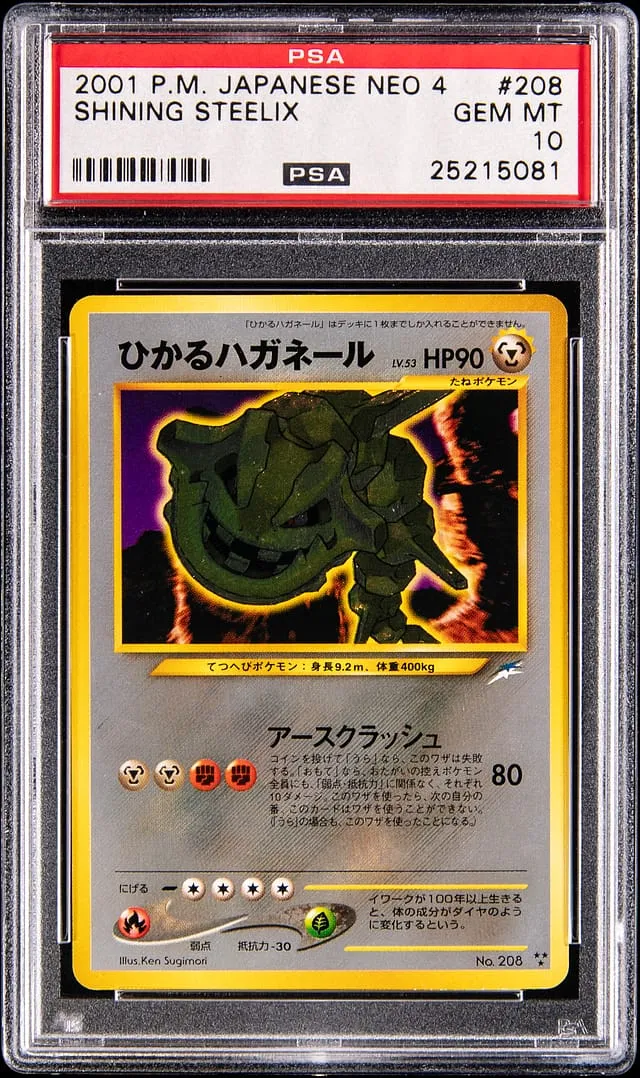
2001 Shining Steelix PSA 10 Goldin Sale Analysis
Breaking down the $17,215 sale of the 2001 Japanese Shining Steelix PSA 10 at Goldin and what it means for Neo-era Pokémon collectors.
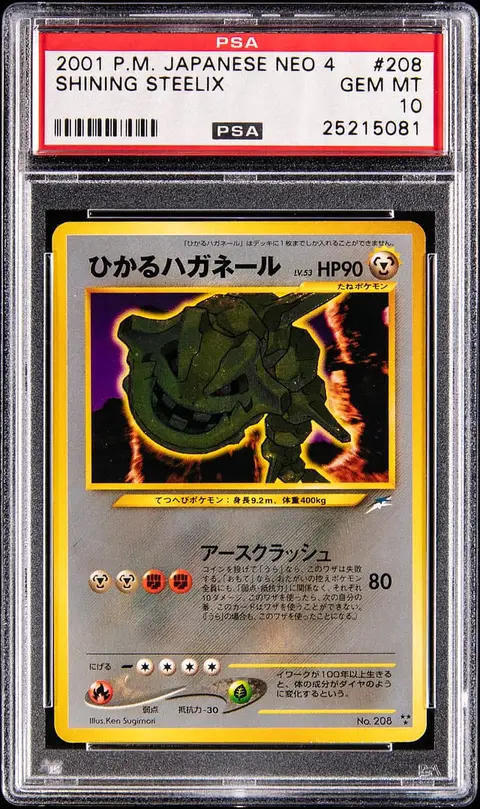
Sold Card
2001 Pokemon Japanese Darkness, and to Light... #208 Shining Steelix - PSA GEM MT 10
Sale Price
Platform
Goldin2001 Pokémon Japanese “Darkness, and to Light…” #208 Shining Steelix in PSA 10 just changed hands at Goldin on 2026-05-18 for $17,215. For a niche but historically important Neo-era shiny, this is a meaningful data point for collectors who follow Japanese releases and early Shining cards.
Card at a glance
- Card: 2001 Pokémon Japanese Darkness, and to Light… #208 Shining Steelix
- Character: Shining Steelix
- Language/Region: Japanese
- Year: 2001 (Neo-era, Game Boy / crossover era for TCG)
- Set / Release: “Darkness, and to Light…” (Japanese-exclusive release tied to the Game Boy Color title)
- Card Type: Shining / “Shiny” Pokémon (early-era shiny treatment)
- Serial number: #208
- Grade: PSA GEM MT 10 (PSA’s highest standard grade)
- Attributes: Non-numbered, non-auto, non-patch; value is driven by condition, set, and Shining status
This is not a rookie card in the sports sense, but it functions as a key issue for Steelix collectors and for people building early Shining Pokémon runs, especially in Japanese.
Why this Shining Steelix matters
Early 2000s was a pivotal period for Pokémon TCG: Wizards of the Coast was still handling English releases, while Japan saw a stream of side sets and tie-in promos that never reached the West in the same way. “Darkness, and to Light…” belongs to that cluster of Japanese-only Game Boy tie-in cards, overlapping the Neo era and sharing design DNA with the Neo Shining cards.
Shining Steelix checks several boxes that matter to advanced collectors:
Early Shining treatment
Before modern full-art shinies and alternate arts, Shining Pokémon like this Steelix were some of the first deliberate “chase” shinies. They stood out for their special foil pattern and alternate coloration, and were noticeably harder to pull than standard holos.Japanese-exclusive flavor
Unlike the headline Neo Genesis / Neo Revelation / Neo Destiny English Shining cards, this Steelix ties directly to a Japanese Game Boy Color campaign. That puts it in the same conversation as other hobby-favorite Japanese promos: lower print runs than mass sets and a strong sense of era.Era: early 2000s / Neo timeframe
This sits just after the earliest WotC sets but still within the “vintage-to-early-EX bridge” that many newer collectors are rediscovering. Cards from this period often have:- Modest original print runs compared to modern
- Lower gem-mint survival rates
- A mix of core nostalgic characters plus quirkier, fan-favorite species like Steelix
Condition-based scarcity
As with most Japanese Neo-era and promo-style issues, raw copies are not impossibly rare, but perfectly centered, scratch-free specimens that can achieve PSA 10 are a different story. That’s where the population report and market data become important.
Population and scarcity context
Population reports (often called “pop reports”, which are simply the grading companies’ public counts of how many copies exist at each grade) help explain prices at the high end.
At the time of writing, exact current PSA population data can shift as new submissions are graded. Historically, though, Shining Steelix from “Darkness, and to Light…” has had:
- A small total graded population compared to mainstream set cards
- A relatively low PSA 10 count (gem-mint)
This combination – low absolute volume plus a small number of top-grade copies – means each PSA 10 sale carries extra weight when trying to understand market levels.
Recent market context and comps
“Comps” is shorthand for comparable sales – recent, similar items that help you understand the price range for a card.
For this specific card (2001 Japanese Shining Steelix, “Darkness, and to Light…”, PSA 10), recent public sales have been infrequent. When a card trades rarely, each auction can land somewhat above or below the last purely based on who showed up that night, how well the listing was marketed, and the venue.
Based on available historic data across major auction houses and fixed-price platforms:
- Lower grades (PSA 8–9) typically sell for a noticeably lower figure than this $17,215 result, reflecting the big premium collectors place on flawless condition in a low-pop card.
- Raw copies and mid-grade examples usually transact at a fraction of PSA 10 pricing, often bought by collectors hoping to grade or simply fill a binder slot.
- PSA 10 sales are sporadic, and previous realized prices have generally sat in a band somewhat below this Goldin result when looking back over a multi-year period.
Given that context, $17,215 at Goldin on 2026-05-18 appears to be:
- Towards the upper end of recent pricing for this card in gem-mint condition, and
- A notable data point rather than an outlier that is completely detached from prior comps.
Instead of signaling a sudden spike, it fits better as a strong confirmation of demand in the current market for scarce, Neo-adjacent Japanese Shining cards in top grade.
Factors likely supporting this result
A few grounded factors that help explain this outcome:
Card quality and eye appeal
At this tier, collectors often care about more than just the technical grade number. Centering, print quality, and holo surface all matter. A PSA 10 that also presents cleanly in photos tends to outperform average examples.Venue: Goldin
Goldin is a major auction platform that regularly aggregates high-end collectors. When a low-pop card is listed there with proper visibility, competitive bidding is more likely, especially for niche Japanese pieces that appeal to advanced set builders.Broader vintage and Neo-era focus
Over the last few years, there’s been ongoing attention on vintage and early 2000s Pokémon, extending beyond just 1st Edition Base or Neo Destiny holos. As collectors complete the obvious grails, focus often shifts to:- Japanese-exclusive or campaign cards
- Early Shining variants
- Underappreciated metal or dark-type Pokémon like Steelix
Limited supply of PSA 10s available at any given time
For a card with a small population, there might only be one or two serious opportunities per year (or even fewer) for a collector who wants a PSA 10. When two or three buyers decide this is their chance, the closing price can push into the higher end of the range.
What this means for collectors
For newer collectors:
- This sale doesn’t mean every Shining Steelix is worth five figures. Condition, authenticity, and exact issue (this specific “Darkness, and to Light…” print, graded PSA 10) are critical.
- Raw or lower-grade copies can offer a more accessible entry point if you’re collecting the artwork or building a Shining-focused page.
For returning or active hobbyists:
- The result underscores how selective the high end of the Pokémon market has become. It’s not about every old card rising; it’s about specific, well-understood keys in top condition continuing to command attention.
- When planning buys or sales, checking multiple comps – across grades, languages, and auction houses – gives a more accurate picture than any one headline number.
For small sellers:
- If you handle Japanese promos or side-set cards, this is a reminder to research card origins carefully. Game Boy tie-ins, lottery promos, and store events can carry more weight than their print run first suggests.
- Submitting clean copies of niche Japanese cards to grading can make sense when pop reports are low and prior PSA 10s show healthy demand. Just be realistic about grading fees, turnaround times, and the possibility of landing a 9 rather than a 10.
Takeaways from the Goldin sale
The 2001 Pokémon Japanese Darkness, and to Light… #208 Shining Steelix PSA GEM MT 10 that sold for $17,215 at Goldin on 2026-05-18 reinforces a few patterns in today’s market:
- Early Shining Pokémon, especially Japanese-exclusive or campaign-linked issues, continue to attract serious collectors.
- Population scarcity at the top grade still matters, even in a more data-aware and selective hobby environment.
- Major auction houses remain key venues for surfacing rarely offered, niche high-end pieces.
As always, this is one sale – a strong one – and best understood alongside other recent results and the broader health of the Neo-era and Japanese promo segments. For collectors quietly building Shining runs, it’s another reminder that the early 2000s still hold a deep bench of historically interesting cards beyond the usual headliners.