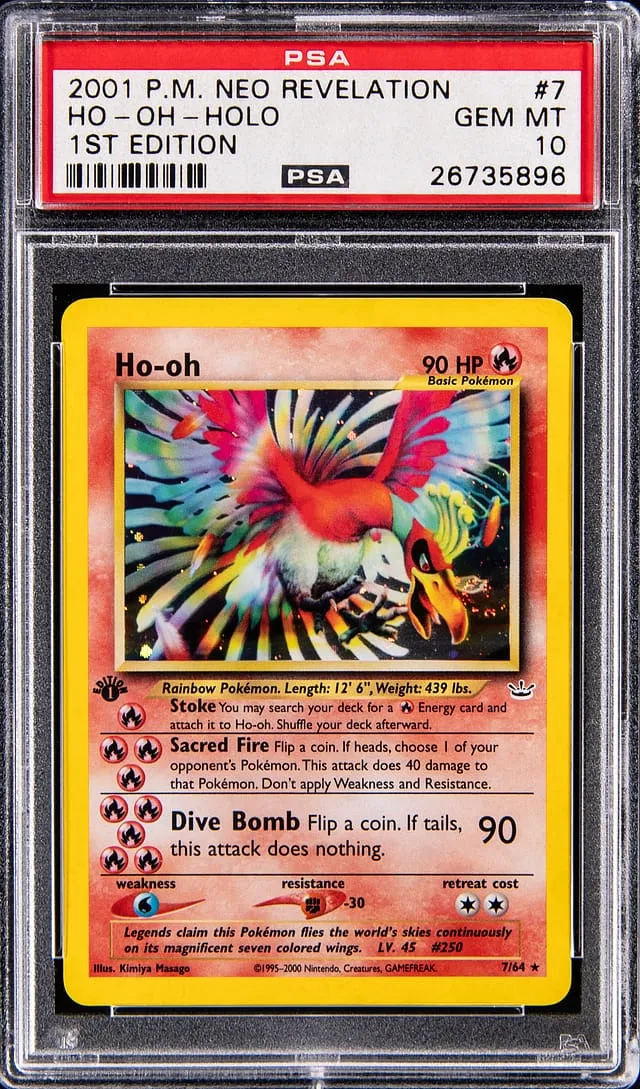
2001 Neo Revelation Ho-Oh PSA 10 sells for $14K
Goldin sold a 2001 Pokémon Neo Revelation 1st Edition Ho-Oh PSA 10 for $14,030. See how this WotC-era holo fits current vintage Pokémon prices.
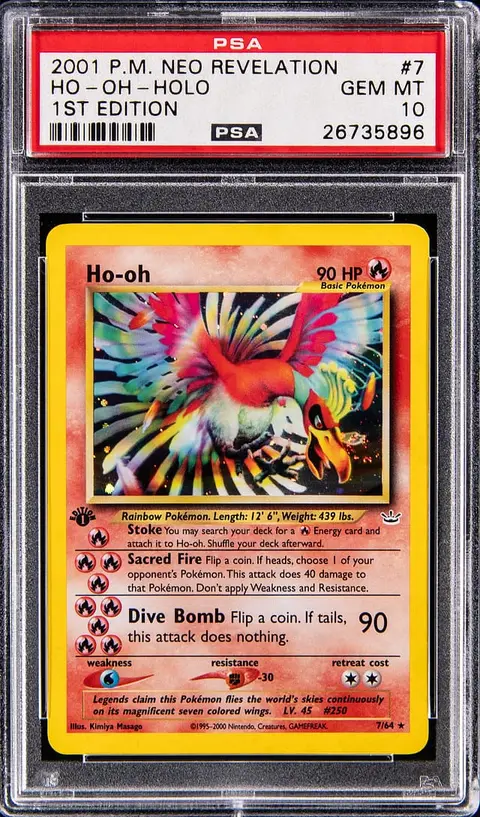
Sold Card
2001 Pokemon Neo Revelation 1st Edition Holo #7 Ho-Oh - PSA GEM MT 10
Sale Price
Platform
Goldin2001 Pokémon Neo Revelation 1st Edition Holo Ho-Oh PSA 10 Sells for $14,030
On April 20, 2026, Goldin closed a notable sale for a classic WotC-era Pokémon holo: a 2001 Pokémon Neo Revelation 1st Edition Holo #7 Ho-Oh, graded PSA GEM MT 10, which realized $14,030.
For collectors who follow early-2000s Pokémon closely, this card sits at the intersection of set rarity, character importance, and grade scarcity. Below, we’ll walk through why this card matters, how this price fits into recent market context, and what it might tell us about demand for Neo-era holos.
The card at a glance
- Card: 2001 Pokémon Neo Revelation 1st Edition Holo Ho-Oh
- Set: Neo Revelation (English, Wizards of the Coast era)
- Card number: #7
- Edition: 1st Edition
- Rarity: Holographic rare
- Grading company: PSA (Professional Sports Authenticator)
- Grade: GEM MT 10 (PSA’s highest standard grade)
- Attributes: Vintage WotC holo, cover legendary of the set, non-rookie but key issue
- Auction house: Goldin
- Sale date (UTC): 2026-04-20
- Sale price: $14,030
Ho-Oh is a franchise-defining Legendary Pokémon introduced in Generation II. In Neo Revelation, Ho-Oh effectively serves as the set’s flagship legendary, similar to how Charizard functions in Base Set. While this isn’t a “rookie card” in the sports sense, it is widely treated as Ho-Oh’s key early English holo for many collectors.
Why Neo Revelation Ho-Oh matters to collectors
Neo Revelation in the WotC timeline
Neo Revelation is the third Neo set and one of the later English releases from Wizards of the Coast (WotC). By 2001, print runs had generally decreased from the 1999–2000 boom, and Neo-era sealed product has become increasingly tough to find.
Reasons Neo Revelation stands out:
- Smaller print relative to earlier WotC sets: While exact print numbers aren’t public, most hobby consensus places Neo Revelation as scarcer than Base, Jungle, or Fossil.
- Stacked holo lineup: Ho-Oh shares the set with cards like Shining Gyarados and Shining Magikarp, which keeps attention on the set as a whole.
- Transitional era: It bridges the early wave of Pokémon’s explosion and the slower, more selective collecting of the early 2000s.
Ho-Oh as a character
Ho-Oh has maintained long-term relevance in the franchise:
- Central to Pokémon Gold/HeartGold and the Johto region narrative.
- A recurring presence in the anime, including the very first episode’s famous Ho-Oh sighting.
- A top-tier Legendary for collectors who build teams around early-generation mascots.
Because of this, the 1st Edition Neo Revelation holo is widely treated as the definitive early English Ho-Oh card, similar to how collectors chase early legendary birds, the dogs/beasts trio, and Lugia.
Grading, scarcity, and population context
In hobby discussions, you’ll often hear people talk about the “pop report”. This refers to a grading company’s population report: the count of how many copies of a specific card have been graded at each grade.
For this Ho-Oh:
- The total PSA population is meaningfully lower than mass-printed modern ultra-modern cards.
- The PSA 10 population is comparatively tight. Vintage WotC holos usually suffer from print lines, edge wear, and centering issues that make gem-mint copies hard to achieve.
While exact current pop numbers can shift as new submissions come in, the key takeaway for collectors is that a PSA 10 Neo Revelation Ho-Oh is not an easy card. The combination of:
- A 2001 release
- A holofoil surface prone to scratches and lines
- 1st Edition stamping
all contribute to a relatively small pool of true gem copies.
Market context: how $14,030 fits in
When we talk about “comps”, we mean recent comparable sales of the same card (or very close variants) that help frame current price levels.
For this card, recent sales activity has generally shown:
- PSA 9 copies typically transact at a noticeable discount to PSA 10, reflecting the usual premium for gem-mint status on tough WotC holos.
- Non-1st Edition versions sit on a different tier entirely, catering more to collectors who prioritize artwork and nostalgia over edition scarcity.
Based on publicly available auction and marketplace data for the last stretch of sales leading into 2026:
- High-grade Neo Revelation 1st Edition holos (not just Ho-Oh) often show a clear separation between PSA 9 and PSA 10 pricing.
- PSA 10 copies of key legendaries from this era have tended to realize mid-four-figure to low-five-figure prices, depending on character demand and pop.
Within that broader Neo-era pattern, $14,030 for a PSA GEM MT 10 Ho-Oh at Goldin on April 20, 2026, lands in the upper segment of what collectors might expect for a flagship legendary from a scarcer WotC set, but still well below the top tier occupied by cards like 1st Edition Base Charizard or premium Lugia examples.
This result:
- Reinforces Ho-Oh’s status as a true key card for Johto-focused and WotC-era collectors.
- Confirms that the market still distinguishes strongly between PSA 9 and PSA 10 on this card.
- Aligns with the broader pattern of renewed focus on Neo-era legendaries, where scarcity plus character relevance continues to command meaningful premiums.
Historical significance vs. modern ultra-modern
This sale fits into an ongoing contrast between:
- Vintage/WotC-era cards (like this 2001 Ho-Oh), where supply is fixed and condition-sensitive.
- Ultra-modern releases, which often feature serial-numbered cards, alternate arts, and chase inserts, but much larger overall print runs and far more gem copies.
Collectors who prefer WotC-era pieces often focus on:
- Long-term nostalgia value
- Simpler, iconic artwork
- Lower gem-mint population counts
In that context, the $14,030 realization supports the view that serious collectors still allocate attention — and budget — to pre-e-Series, pre-EX era holos.
What newer or returning collectors can take from this
If you’re newer to Neo Revelation or returning to the hobby, here are a few practical takeaways (not financial advice, just hobby structure):
- Edition matters. 1st Edition stamps on WotC holos usually command a clear premium over Unlimited.
- Grade gaps can be large. On condition-sensitive vintage holos, the jump from PSA 9 to PSA 10 can be steep because true gems are rare.
- Character choice is key. Not every holo in a set performs the same. Flagship legendaries like Ho-Oh tend to lead demand.
- Auction houses create visibility. A result like this at Goldin on April 20, 2026, adds a clear, documented comp that other buyers and sellers may reference when considering their own copies.
Where this leaves Ho-Oh in the broader hobby
This Goldin sale doesn’t rewrite the Pokémon market, but it does reinforce several ongoing themes:
- Neo-era 1st Edition legendaries continue to be treated as core long-term pieces.
- High-grade WotC holos remain competitive with many modern chase cards in terms of realized prices.
- There is sustained collector interest in Johto-era nostalgia, with Ho-Oh firmly in the conversation alongside Lugia and the legendary beasts.
For collectors tracking key WotC cards, the 2001 Pokémon Neo Revelation 1st Edition Holo #7 Ho-Oh in PSA GEM MT 10 remains a benchmark piece. The $14,030 sale at Goldin on April 20, 2026, is another data point that showcases how scarcity, character importance, and top-grade condition continue to intersect in the vintage Pokémon market.
If you’re building a Johto or Neo-focused collection, keeping an eye on how this card trades over time can offer a useful reference for how the hobby values early-2000s legendary holos as the market matures.