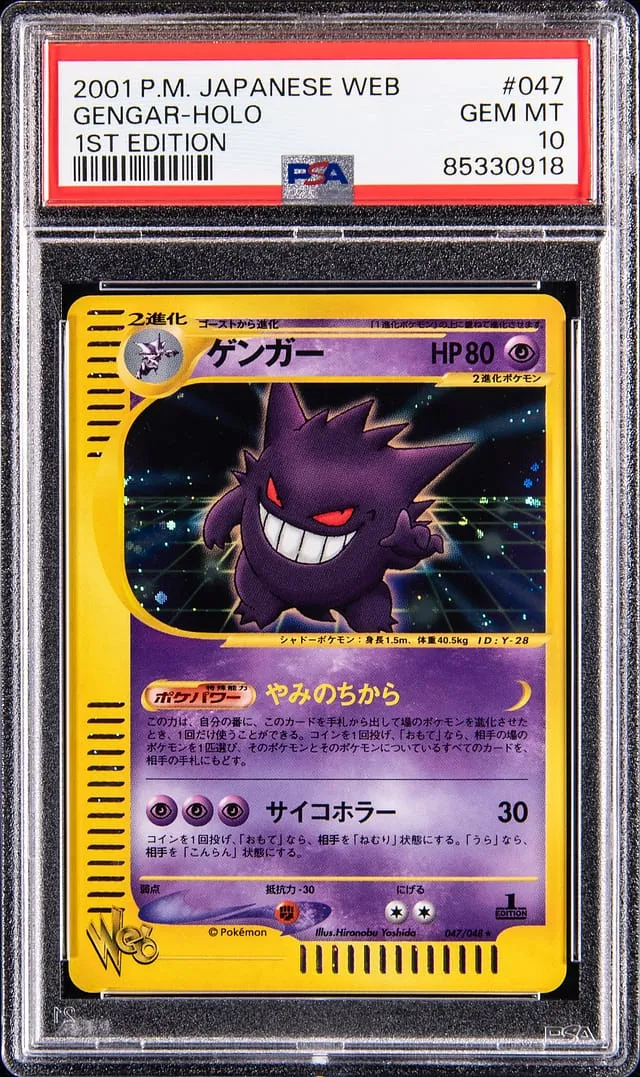
2001 Japanese Web Gengar PSA 10 sells for $16,165
Breaking down the $16,165 goldin sale of a 2001 Pokémon Japanese Web 1st Edition Holo Gengar PSA 10 and what it means for collectors.
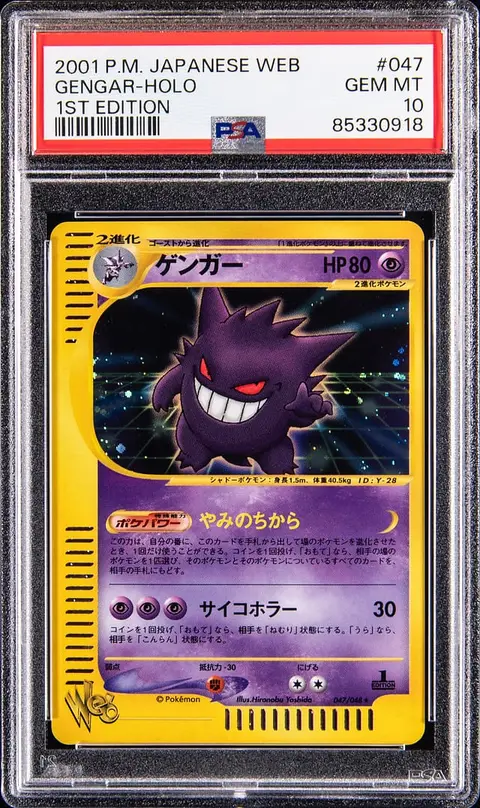
Sold Card
2001 Pokemon Japanese Web 1st Edition Holo #047 Gengar - PSA GEM MT 10
Sale Price
Platform
Goldin2001 Pokémon Japanese Web 1st Edition Holo Gengar #047 (PSA GEM MT 10) just quietly posted a strong result at goldin, underscoring how steady demand has become for high-grade, early-2000s Japanese holofoils.
At figoca, we like to step back and look at what a single auction can tell us about the broader market. Here’s a data-aware breakdown of this sale and why it matters for collectors.
The card at a glance
- Character: Gengar
- Year: 2001
- Set: Pokémon Japanese Web, 1st Edition
- Card number: #047
- Finish: Holofoil (holo)
- Language: Japanese
- Edition: 1st Edition
- Grading company: PSA (Professional Sports Authenticator)
- Grade: GEM MT 10 (PSA’s highest standard grade)
- Auction house: goldin
- Sale date (UTC): 2026-05-18
- Final price: $16,165
This is not a rookie card in the sports sense, but it is a key issue for Gengar collectors: a 1st Edition Japanese Web holo in the top grade from PSA.
What is the Japanese Web set, and why does it matter?
The 2001 Japanese Web series is a reprint-style set released exclusively in Japan, notable for its:
- Distinct card stock and layout compared with earlier Japanese sets
- Online distribution origins, which limited casual, in-store exposure
- Mix of fan-favorite Gen 1 Pokémon, including several popular holos like Gengar
In hobby terms, this sits in the early WOTC-era / early 2000s window—after the very first Base/Fossil/Jungle wave but well before modern chase products. Print runs were not as widely distributed globally as English sets, and sealed Web product is meaningfully harder to find today.
Within that context, Web holos of top-tier characters (Charizard, Gengar, etc.) in PSA 10 have developed a steady collector base, especially among:
- Long-time Pokémon fans who grew up with Gen 1
- Niche Japanese-set specialists
- Collectors looking beyond the most obvious Base Set holo choices
Why Gengar specifically commands attention
Gengar has become one of the most consistently collected non-starter, non-cover Pokémon in the hobby. A few reasons:
- Strong, long-standing fanbase from the original Game Boy games and anime
- Striking holo artwork across several sets, including this Web version
- A niche as a top-tier "spooky"/ghost-type mascot, giving it a different lane than dragons and starters
Within Gengar’s card catalog, collectors often focus on:
- Early-era Japanese holos (especially 1st Edition where applicable)
- Distinct art and layout variations—Web fits here with its unique template
- High-grade examples tracked via grading population reports
The grade: PSA GEM MT 10
PSA’s GEM MT 10 label is their standard highest grade, indicating:
- Centering, edges, corners, and surface are all effectively flawless by PSA’s criteria
- No print lines, obvious holo scratches, or whitening under typical inspection
For sets like Japanese Web, where centering and print quality were generally strong, you might expect a reasonable number of 10s. However, the actual population depends on how many copies were submitted over the years, not just how clean pack-fresh cards could be.
Collectors often look at the PSA pop report—a public count of how many copies exist at each grade—to gauge scarcity. Web-era Japanese holos usually show much lower total populations than mass-submitted modern English cards.
Even without exact numbers here, it is fair to say that:
- GEM 10 Web Gengar is not common in the wild
- Demand from character-focused Gengar collectors and Japanese-set specialists converges on a relatively small graded supply
Market context: where does $16,165 fit?
This goldin sale closed at $16,165 on 2026-05-18.
When we talk about “comps” (comparable sales), we’re looking at:
- The same card and grade (2001 Japanese Web Gengar PSA 10)
- Closely related cards (same card in PSA 9, or comparable Gengar key issues from another early Japanese set)
Based on available public auction and marketplace data around PSA 9–10 Web-era holos and premium Gengar issues, this price sits in the upper tier for Gengar cards outside of ultra-rare trophy or prize cards. While exact prior sales for this precise card and grade may not be frequent, a few patterns stand out:
- Japanese Web holos generally move less often than English Base-era holos
- PSA 9s and raw copies of Web holos tend to sell at a significant discount to PSA 10s, reflecting a clear grade premium
- Premium Gengar holos from the early 2000s in PSA 10 have shown gradual, data-backed resilience rather than large, speculative spikes
In other words, this result is strong, but not disconnected from the broader pattern of key Gengar and early Japanese holo sales. It reflects:
- A top character
- A high-grade, niche set
- Limited supply crossing major auction blocks like goldin
Why this sale matters for collectors
For active hobbyists and small sellers, this sale offers a few useful takeaways:
1. Niche Japanese sets can anchor serious prices
Even outside the most famous sets, a combination of:
- Recognizable character (Gengar)
- Early-era release (2001)
- Distinctive, set-specific appeal (Web design and distribution)
- Top grade (PSA 10)
can create meaningful demand in major auctions.
2. Grade separation is real in early 2000s holos
In Web and similar-era sets, the price gap between:
- PSA 10 vs PSA 9
- PSA 9 vs raw/lightly played
is typically large, especially for flagship characters. This sale reinforces that collectors will pay a premium for population-topping examples when:
- Supply is thin
- The auction house is widely watched (goldin in this case)
3. Character and era matter as much as set name
Not every early-2000s Japanese holo will command this level of attention. Gengar is a:
- S-tier fan favorite
- Long-term staple across games, anime, and merchandise
Combine that with an early Japanese print and top grade, and you get a card that behaves more like a core PC (personal collection) piece than a short-term flip target.
How collectors might use this data point
Without turning this into financial advice, here are a few practical, non-speculative ways to think about a result like this:
- Benchmarking: If you own or are tracking other high-grade Web holos (especially S-tier characters), this sale gives a reference point for the upper end of what the market is willing to do.
- Understanding liquidity: This card needed a major auction house (goldin) and a well-publicized sale date (2026-05-18) to find the right buyers. For niche Japanese pieces, liquidity often concentrates in a few platforms and a few big auction cycles.
- Condition awareness: For raw or lower-grade copies, this sale underscores why careful condition assessment, pre-grading, and realistic expectations around grading outcomes matter.
Where this fits in Gengar’s broader card history
Stepping back, this card lives in a Gengar landscape that includes:
- Early Japanese and English holo appearances
- Later-era alternate arts and special set printings
The 2001 Japanese Web holo isn’t the very first Gengar card, but it’s:
- An early, distinct, and highly collectible version
- Tied to a set with lower overall visibility and supply
For focused Gengar collectors, a PSA 10 Web 1st Edition holo is the kind of card that often anchors a character PC, not something that gets traded lightly.
Final thoughts
This 2001 Pokémon Japanese Web 1st Edition Holo Gengar #047 – PSA GEM MT 10 closing at $16,165 on goldin (2026-05-18) is a clean signal of how the market currently values:
- Early Japanese set nuance
- Character popularity
- Top-tier grading outcomes
For newcomers and returning collectors, it’s a reminder that Pokémon isn’t just about a few headlining English cards. Sets like Japanese Web, and characters like Gengar, continue to shape a more nuanced, data-backed market—one strong auction at a time.
At figoca, we’ll keep tracking these sales so you can see not just the price tags, but the context behind them.