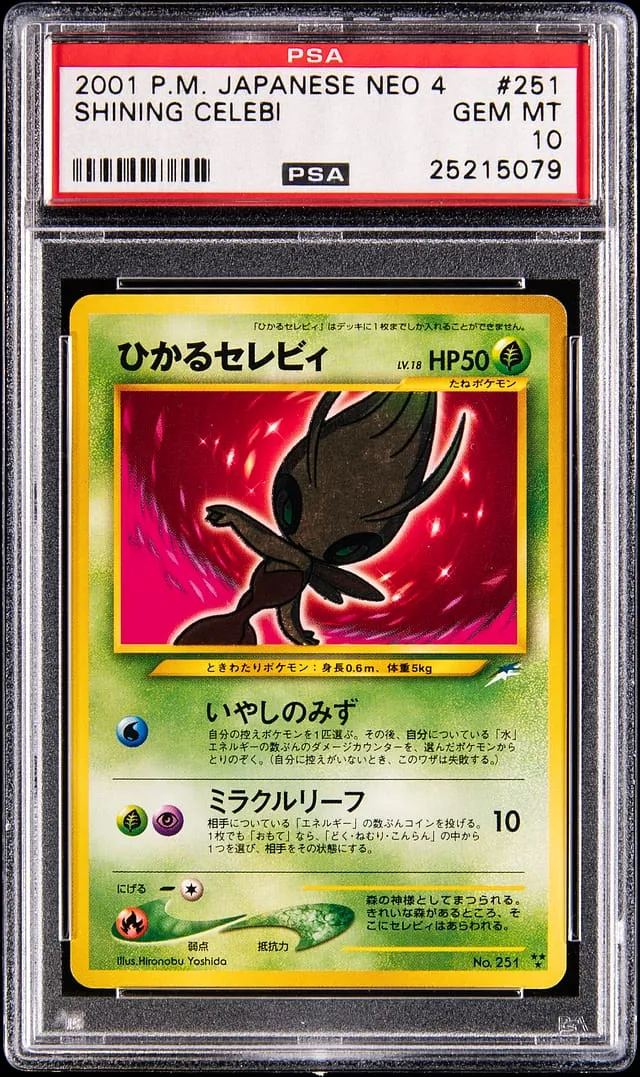
2001 Japanese Shining Celebi PSA 10 sells for $26K
Breakdown of the 2001 Pokémon Japanese Shining Celebi PSA 10 sale for $26,840 at Goldin, with market context for early 2000s Japanese cards.
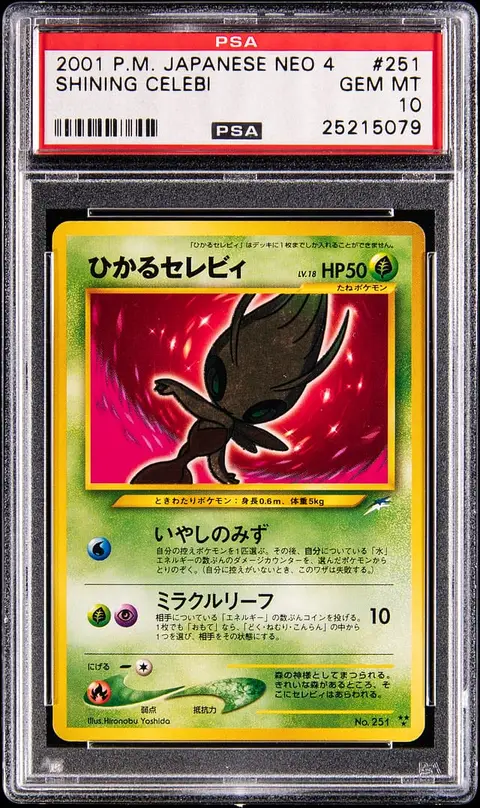
Sold Card
2001 Pokemon Japanese Darkness, and to Light... #251 Shining Celebi - PSA GEM MT 10
Sale Price
Platform
Goldin2001 Pokémon Japanese Darkness, and to Light… Shining Celebi in PSA 10 quietly reminds collectors why early 2000s Japanese foils still matter.
On May 18, 2026, Goldin auctioned a 2001 Pokémon Japanese Darkness, and to Light... #251 Shining Celebi graded PSA GEM MT 10 for $26,840. For a niche, Japanese‐language, non–Wizards of the Coast card, that’s a meaningful number and a good moment to pause and look at where this card sits in the broader Pokémon market.
Card overview
- Character: Celebi (Shining Celebi)
- Year: 2001
- Set: Japanese “Darkness, and to Light…” (Neo 4 era counterpart)
- Card number: #251
- Language/Region: Japanese
- Variant: Shining (full‐card sparkle with alternate color artwork)
- Manufacturer: Pokémon / Media Factory (Japan)
- Grading company: PSA
- Grade: GEM MT 10
- Attributes: Non‑auto, non‑serial‑numbered, key holo/“chase” card of the set
This is not a rookie card in the sports sense, but within Pokémon it is a key issue for Celebi. Shining cards from this era are among the earliest intentionally rare “premium” pulls, designed to be tough to hit and visually distinct, much like modern chase cards.
Why Shining Celebi matters
Early 2000s Japanese “Shining” era
The early 2000s marked a turning point for Pokémon TCG design. The Japanese sets around Neo 3/Neo 4 and their offshoots introduced:
- Shining Pokémon: Alternate‐colored, high‐rarity cards that were significantly harder to pull than standard holos.
- Experimental art and foiling: A step away from the base set look toward more dramatic, collectible layouts.
Shining Celebi is part of that shift. While English‐language collectors often focus on Neo Revelation/Neo Destiny, the Japanese Darkness, and to Light… release occupies a similar creative lane for the Japanese market.
Character and lore
Celebi has consistently been positioned as a special, almost mythical Pokémon—often tied to time travel and forest guardianship in the anime and films. In the card hobby, that usually translates to:
- Solid, if not chase‐of‐the‐year, demand from character collectors.
- A stable presence in binders and graded collections focused on legendary or mythical Pokémon.
Combine a mythical character with a Shining treatment and an early 2000s print date, and you get a card that stays relevant even when broader hype cycles cool down.
Market context: what does $26,840 mean?
The Goldin sale on May 18, 2026 closed at $26,840 for a PSA 10 copy. In hobby conversations, you’ll often hear people ask for “comps” — short for comparable recent sales. Comps help collectors understand roughly where a card has been trading.
For this specific card, public data is thinner than for English Neo Shining cards, but a few patterns are fairly consistent across marketplaces and auction archives:
- Graded 9 copies tend to trade at a noticeable discount to 10s, often landing in what would be the mid–four‐figure range when they appear.
- Ungraded copies show a wide range depending on centering, holo condition, and the presence of scratches or print lines, typically well below the PSA 9 and 10 levels.
- Other high‐grade slabs from Japanese Shining cards of this era (across different characters) frequently cluster in the low to mid five‐figure range when they reach PSA 10 with low population counts.
Within that context, $26,840 sits toward the higher end of what is typical for early 2000s Japanese Shining cards in top grade, but not in record‐shattering territory when compared to the absolute top tier of English Neo Shining grails.
Pop report and grade scarcity
A pop report (population report) is a grading company’s count of how many copies of a card exist in each grade. While exact numbers move over time as more cards are submitted, the relationship between grades is relatively stable:
- PSA 10 copies of this Japanese Shining Celebi are significantly scarcer than PSA 9s and lower grades.
- The card’s age (2001), dark background, and holo area make clean 10s harder to land; print lines, minor edge wear, and tiny surface dings often cap copies at a 9.
When the true supply of a PSA 10 is relatively low and the character has steady demand, prices tend to stretch further away from 9s and raw copies. That appears to be what we’re seeing reflected in this Goldin result.
How this sale fits into the broader Pokémon market
Era positioning
This card sits in what many collectors think of as the early post–Wizards era for Japanese cards:
- Not quite vintage in the original Base/Jungle/Fossil sense.
- Clearly removed from modern and ultra‐modern premium products.
- Old enough that truly clean copies are no longer easy to find in the wild.
Cards from this window often:
- Have lower print runs than peak mass‐market eras.
- Were heavily played or bindered, especially in Japan, leading to a limited pool of gradable mint copies.
- Fly a bit under the radar until a strong auction record or a registry chase brings them back into conversation.
Recent hobby climate
Across 2024–2026, the broader Pokémon market has trended toward more selective strength:
- Top‐end, low‐population grails in PSA 10 have generally held up better than mid‐tier slabs.
- Character‐driven cards with strong nostalgia and well‐documented scarcity continue to see competitive bidding when they hit major auction houses.
The Goldin sale lines up with that pattern. Rather than a speculative modern chase, this is a proven, low‐supply, nostalgia‐anchored card attracting attention when it surfaces in the highest available grade.
Interpreting the $26,840 result (without overreacting)
For collectors and small sellers, a single auction result is a data point, not a guarantee. Still, there are a few grounded takeaways:
- High‐grade Japanese Shining cards remain relevant. This sale reinforces that serious buyers still show up for early 2000s Japanese foils in PSA 10.
- Condition separation is real. The gap between top‐grade and mid‐grade examples is significant. If you own a raw or lower‐grade copy, it’s normal for it to sit far below this sale price.
- Auction houses can surface deep demand. A card like this listed on a smaller platform might not draw the same mix of collectors that a Goldin auction can assemble.
None of this should be read as a prediction of where prices will go next. Markets can and do move both up and down.
What this means for different types of collectors
New or returning collectors
If you’re just getting back into Pokémon:
- Use this sale as a reminder that Japanese cards matter, not just the English releases you might remember from childhood.
- Shining Celebi is a good case study in how character, era, and condition combine to create meaningful value.
- You don’t need a PSA 10 grail to participate; lower grades and ungraded copies can still be enjoyable, as long as you buy with realistic expectations.
Active hobbyists and small sellers
For those already active in the market:
- Keep an eye on PSA pop trends for Japanese Shining cards. If 10s remain slow to grow while 9s climb, that tends to support a healthy premium for the top grade.
- When assessing raw copies, pay close attention to surface print lines and edges; they’re the main differentiators between a 9 and a 10 on this card.
- If you’re considering consigning similar cards, past results like this Goldin sale on May 18, 2026 help anchor expectations, but they shouldn’t be your only reference point.
Closing thoughts
The $26,840 sale of the 2001 Pokémon Japanese Darkness, and to Light... #251 Shining Celebi in PSA GEM MT 10 at Goldin is neither a shock wave nor a blip—it’s a clear, measured signal.
It tells us that:
- The hobby continues to recognize the importance of early Japanese Shining cards.
- True top‐end condition still commands a meaningful premium.
- Even outside the headline‐grabbing Charizards and Pikachus, there is room for well‐defined character cards to stand on their own.
For figoca’s community of collectors and small sellers, this is another reminder to look carefully at the corners of the hobby where supply is thin, nostalgia runs deep, and condition truly matters.