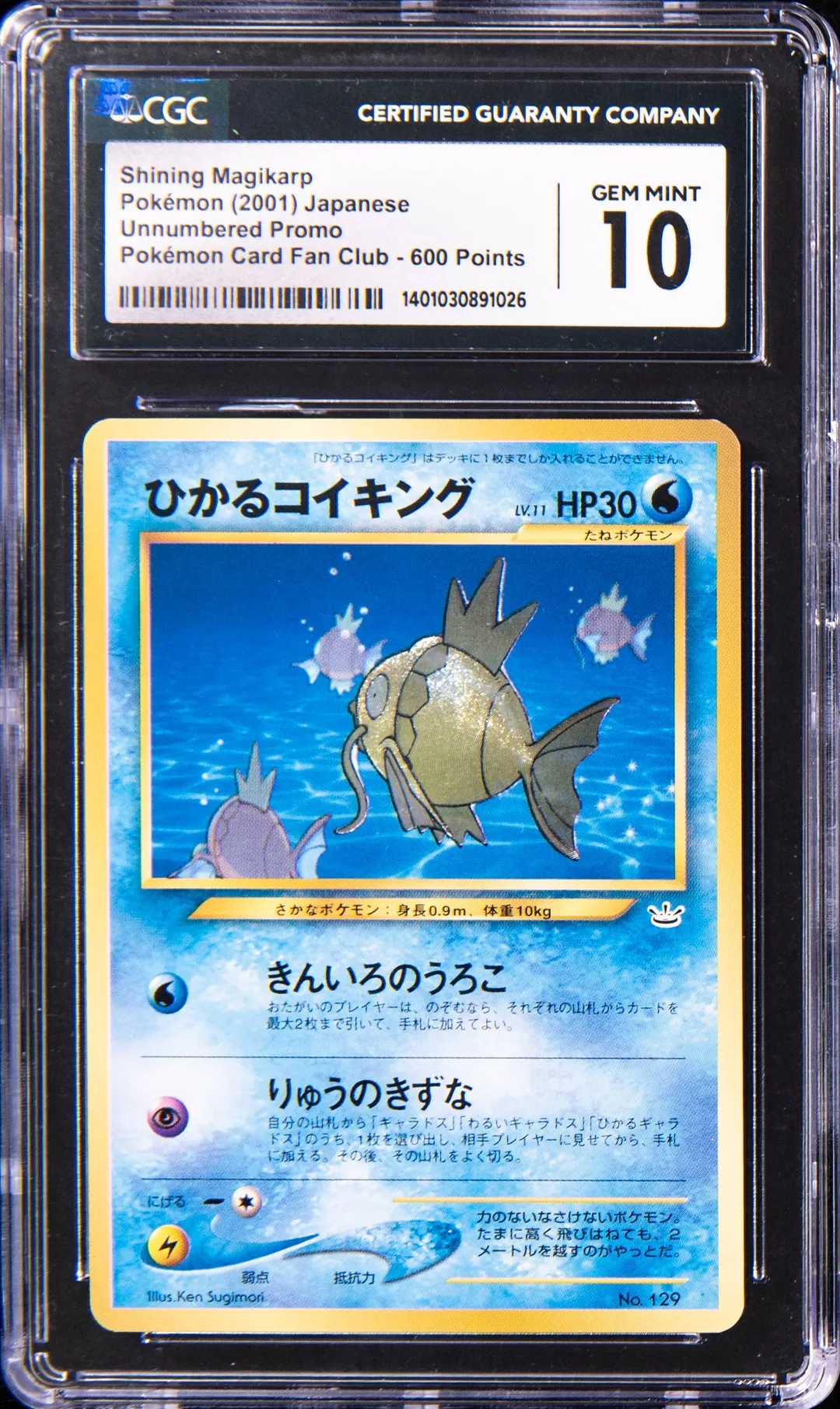
2001 Japanese Fan Club Shining Magikarp CGC 10 Sale
A CGC 10 pop 3 2001 Japanese Fan Club 600 Points Shining Magikarp sold for $21,080 at Goldin. Here’s what it means for Pokémon collectors.
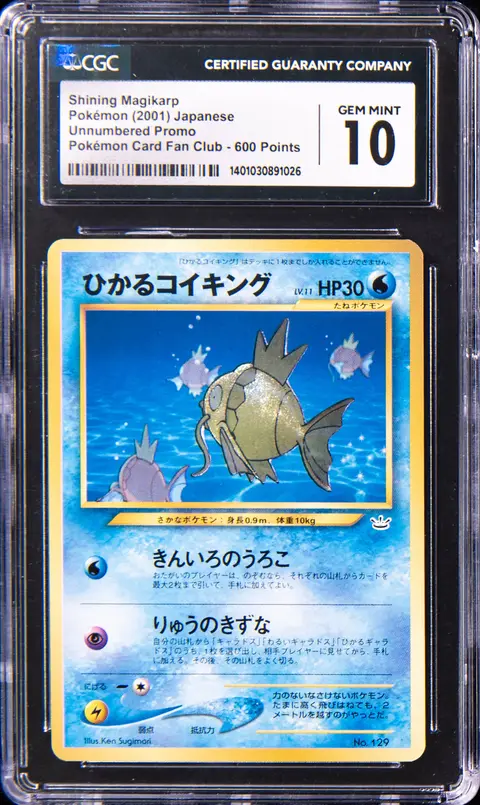
Sold Card
2001 Pokemon Japanese Unnumbered Promo Pokemon Card Fan Club, 600 Points Shining Magikarp - CGC GEM MINT 10 - Pop 3
Sale Price
Platform
Goldin2001 Pokémon Japanese Fan Club 600 Points Shining Magikarp in CGC 10 GEM MINT quietly crossed an important milestone on February 16, 2026, when it sold for $21,080 through Goldin. For a niche, early‑2000s Japanese promo, that is a meaningful data point for both Pokémon collectors and market watchers.
In this article, we’ll walk through what this card actually is, why the Fan Club promos matter, how CGC’s population report shapes the story, and where this $21,080 result fits within recent sales.
Card overview: what exactly sold at Goldin?
- Card: Shining Magikarp
- Year: 2001
- Origin: Pokémon Card Fan Club (Japan)
- Type: Unnumbered promo, 600 points reward
- Language: Japanese
- Rarity tier: High‑tier Fan Club prize (600 points)
- Grading company: CGC
- Grade: CGC GEM MINT 10
- Population: Pop 3 in CGC 10 at the time of sale (three copies in this grade)
- Auction house: Goldin
- Sale date (UTC): 2026‑02‑16
- Sale price: $21,080
This is not the more commonly seen Neo Revelation Shining Magikarp from the regular Japanese or English set. It is an unnumbered Fan Club promo, obtainable only by accumulating points and redeeming them through the official Japanese Pokémon Card Fan Club in the early 2000s.
Because of that distribution method, this card started life in the hands of dedicated players and fans who had to actively engage with the game and promotions, rather than being pulled from packs.
What is the Pokémon Card Fan Club 600 Points Shining Magikarp?
In the late 1990s and early 2000s, the Japanese Pokémon Card Fan Club ran a points‑based rewards program. Players could collect points through various hobby activities and mail them in for exclusive promotional cards.
The 600 points tier was notably demanding, and the rewards at that level are among the more respected Japanese promos of the era. Shining Magikarp at 600 points sits in the upper difficulty band, and the redemption‑only model means:
- There were no booster packs for this card.
- Distribution was limited to engaged Fan Club members in Japan.
- Many copies went straight into decks, binders, or children’s collections, not sleeves and top loaders.
Within the broader Pokémon landscape, Shining Magikarp is a cult favorite. The character itself is famously weak in gameplay but loved for its eventual evolution into Gyarados, and “Shining” cards (featuring different‑colored, sparkling Pokémon) have become an iconic sub‑category.
This particular Fan Club version is therefore a key issue for Shining Magikarp character collectors and Japanese promo specialists.
Era and set context: early‑2000s Japanese promos
This card comes from what many collectors consider the early WotC‑adjacent / early e‑Series era in Japan (around 2000–2003). A few characteristics of that period matter for value and scarcity:
- Print runs were lower and more targeted than later mass‑market eras.
- Promos tied to clubs and events often had unclear but small distributions.
- Condition preservation was inconsistent; many promos were handled casually.
For grading, this era tends to show:
- A sharp drop‑off at the top grades (BGS/CGC/PSA 10).
- Noticeable issues with edge wear, print quality, and surface scratching, especially on holo promos.
That backdrop makes a CGC GEM MINT 10 especially meaningful. CGC has built a reputation for relatively tight grading standards, particularly on centering and surface. A pop report of 3 total in CGC 10 points to very limited supply in this grade.
Population and grading: why pop 3 in CGC 10 matters
A population report (or “pop report”) is a grading company’s public record of how many copies of a card they’ve graded at each grade level.
For this Shining Magikarp:
- CGC 10 population: 3 copies
- Lower CGC grades (9.5, 9, etc.) show up in higher numbers, as expected for a sensitive early‑2000s holo promo.
Even without exact cross‑company totals in front of us, the broader pattern for this card is consistent:
- Few total graded copies compared with mainstream set releases.
- A very thin top end: 10s are scarce across grading companies.
A pop 3 in CGC 10 means that any high‑end auction of such a copy is more a function of who shows up that day than of a deep, liquid market. That’s important when interpreting what $21,080 really tells us.
Market context: how does $21,080 compare?
In hobby shorthand, collectors talk about “comps”—recent comparable sales used to gauge a card’s current price environment.
While public data for this exact configuration (Japanese Fan Club 600 Points Shining Magikarp in CGC 10) is limited, we can frame this sale using three angles:
Same card, different grades and slabs
- Lower‑grade copies (in PSA 9/CGC 9/CGC 9.5/BGS 9) have historically sold for significantly less than this result, often well under the five‑figure range depending on timing and venue.
- The premium for a true GEM MINT 10 over a strong 9 or 9.5 on rare Japanese promos is typically substantial because so few exist.
Same character, different key cards
- Neo Revelation Shining Magikarp (especially in high‑grade English and Japanese PSA 10s) has seen a healthy collector base, but the Fan Club 600 Points promo generally carries stronger scarcity and lore appeal.
Similar‑tier Japanese promos
- Other early‑2000s Japanese reward or mail‑in promos with limited distribution (especially at higher point tiers) have shown that top‑grade copies can command five‑figure results in strong venues.
Within that context, $21,080 for a CGC 10 pop‑3 promo sits toward the upper band of what seasoned collectors might expect, but not out of line with how the market has gradually started to price rare Japanese promos with real scarcity in top grade.
Because the card surfaces infrequently at this level, it’s more accurate to view this as a fresh data point in a thinly traded market rather than a definitive long‑term price anchor.
Why collectors care about this card
Several factors combine to make this a significant card for focused collectors:
True scarcity from distribution
The Fan Club points system intentionally limited who could obtain the card, unlike set cards pulled from packs.Character and theme appeal
Shining Magikarp blends two collector lanes:- Shining/“shiny” Pokémon, a long‑running and popular sub‑theme.
- Magikarp itself, an underdog character with a surprisingly strong fanbase.
Early‑era Japanese promo pedigree
Many of the hobby’s most respected Pokémon cards are not pack‑pulled but promos earned through events, clubs, or mail‑ins. This card fits squarely in that tradition.Top‑grade tension
A low total population is one thing; only three CGC 10s ramps up the competition among collectors who prioritize the “best obtainable copy” standard.Growing appreciation for Japanese exclusives
Over the last few years, collectors have paid more attention to Japanese promos that were once niche knowledge. This sale continues that trend: high‑end buyers are now comfortable allocating serious budget to well‑documented, historically interesting Japanese issues.
Interpreting the Goldin sale: what does $21,080 tell us?
A few measured observations from this auction:
- Venue matters: Goldin is a high‑visibility auction house for premium cards. Strong venues tend to attract advanced bidders, which can lift outcomes for rare, specialized items.
- Thin supply means spiky prices: With only three CGC 10s, even modest changes in bidder participation can produce large swings from one auction to the next. This is typical for genuinely scarce promos.
- Grade premium is alive and well: The result reinforces the market’s willingness to pay a visible premium for true GEM MINT examples of important Japanese promos, especially when pop reports confirm very few 10s.
- Data point, not destiny: With so few sales to triangulate, this should be read as one important comp rather than a long‑term guarantee of where the card “should” sit.
For collectors tracking this card, the Goldin sale can serve as:
- A reference price when considering future auction listings or private offers.
- A reminder that sub‑grades, eye appeal, and timing still matter around any single benchmark sale.
Takeaways for different types of collectors
For newcomers and returning collectors
This card illustrates how:
- Not all valuable Pokémon cards come from booster packs.
- Japanese promos can be just as important as English set cards, sometimes more so.
- Understanding distribution (how a card was originally obtained) is central to understanding rarity.
For active hobbyists and character collectors
The sale reinforces that:
- High‑grade Japanese promos with established lore are continuing to find serious buyers.
- CGC 10s on early‑era holos can behave like separate assets from their 9/9.5 counterparts due to scarcity.
For small sellers
While most people will not be listing a CGC 10 Fan Club Shining Magikarp, this auction is a useful case study:
- Rare, condition‑sensitive promos can benefit from grading when the card is genuinely high‑end.
- Choosing the right venue and timing matters more as population numbers get smaller.
Closing thoughts
The February 16, 2026 Goldin sale of the 2001 Pokémon Japanese Unnumbered Promo, Pokémon Card Fan Club 600 Points Shining Magikarp in CGC GEM MINT 10 (pop 3) at $21,080 is another quiet but notable chapter in the story of Japanese Pokémon promos.
For collectors who focus on Shining cards, early‑era Japanese exclusives, or top‑pop population pieces, this auction provides a fresh, well‑documented benchmark—and a reminder that some of the hobby’s most interesting cards were never meant to be pulled from a pack at all.