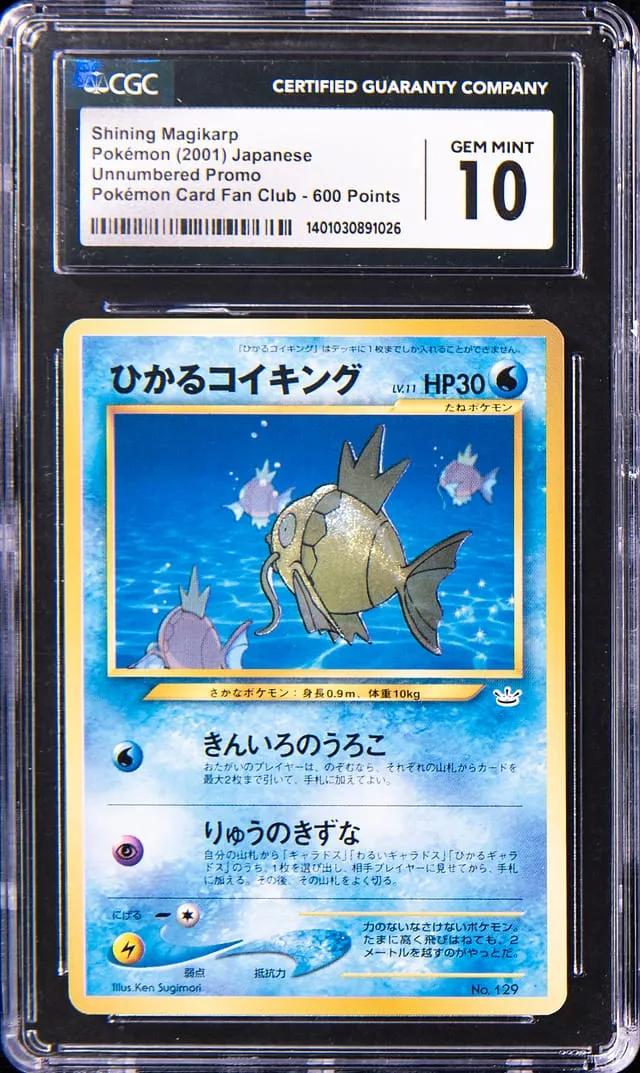
2001 Fan Club Shining Magikarp CGC 10 Sells for $21K
Goldin sold a 2001 Japanese Fan Club 600 Points Shining Magikarp CGC 10 (Pop 3) for $21,080. See why this rare promo matters to Pokémon collectors.
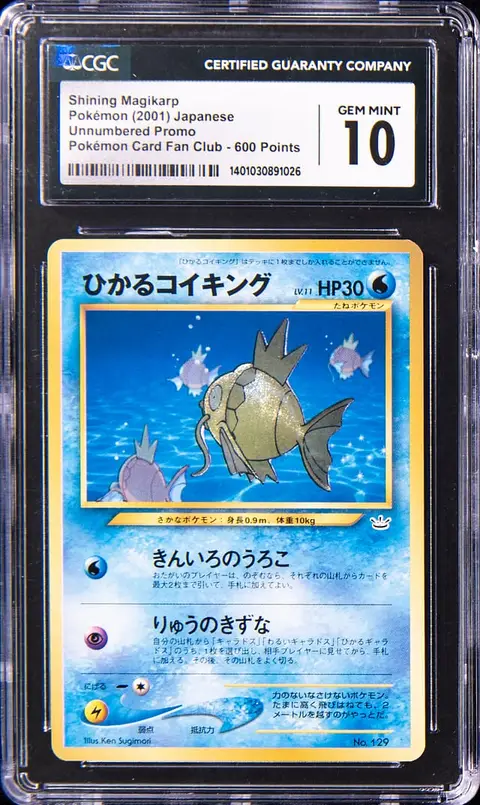
Sold Card
2001 Pokemon Japanese Unnumbered Promo Pokemon Card Fan Club, 600 Points Shining Magikarp - CGC GEM MINT 10 - Pop 3
Sale Price
Platform
GoldinA $21,080 sale for a Magikarp?
That’s exactly what happened on February 16, 2026, when a 2001 Pokémon Japanese Unnumbered Promo Pokémon Card Fan Club, 600 Points Shining Magikarp in CGC GEM MINT 10 sold at Goldin for $21,080. For a niche, early-2000s Japanese promo, this is a meaningful data point for both vintage Japanese collectors and rarity-focused Pokémon fans.
In this breakdown, we’ll look at why this card matters, how rare a CGC 10 really is, and where this sale fits into recent market activity.
Card overview: what exactly sold?
- Year: 2001
- Card: Shining Magikarp (Holo)
- Language / Region: Japanese
- Type: Unnumbered Promo
- Source: Pokémon Card Fan Club reward
- Point Cost: 600 points
- Set: Pokémon Card Fan Club (not a standard booster set)
- Rarity profile: Premium mail-in style promo, not pack-pulled
- Grading company: CGC
- Grade: GEM MINT 10
- Population (pop) in this grade: 3 (Pop 3, per CGC census)
- Autograph / patch / serial: None – pure, original card
This is not a rookie card in the sports sense, but within Pokémon it functions as a key early-era Shining variant and a grail-level Japanese promo for character collectors.
What is the 600 Points Fan Club Shining Magikarp?
In the early 2000s, the Japanese Pokémon Card Fan Club ran a points-based reward system. Collectors earned points by participating in Pokémon-related activities and could redeem those points for exclusive promo cards.
Shining Magikarp at the 600-point level was one of the higher-tier rewards, meaning:
- Fewer people could realistically redeem it compared to lower point promos.
- It required time and commitment, not just opening packs.
- Copies were likely handled and mailed, so pristine examples are harder to find.
The artwork features the iconic Shining Magikarp with its alternate golden coloring, a design that became a cult favorite. It predates many modern “shiny” treatments and comes from the era when Shining Pokémon felt genuinely rare and unusual.
Why collectors care about this card
A few key factors drive interest in this specific Magikarp:
Early-era Japanese promo
2001 falls into what many collectors consider the “neo/early e-series” era, overlapping with the tail end of WotC-era aesthetics. Japanese promos from this period frequently have:- Smaller print runs than mass English releases.
- Unique artwork and distribution stories.
Fan Club redemption structure
Because this was a 600-point reward, it wasn’t easily accessible. Unlike the typical pack-pulled card, you had to accumulate points and go out of your way to redeem them.Shining / shiny appeal
Shining Magikarp has become one of the most recognizable Magikarp cards across languages. For character collectors who focus on Magikarp, Gyarados, or early-era shinies, this promo is a cornerstone.High-grade scarcity
The copy that sold is a CGC GEM MINT 10 with a Pop 3 (only three graded at that level by CGC).A population report (often shortened to “pop report”) is the grading company’s census of how many copies exist at each grade. Low population at the top grade often supports a premium over lower grades.
Market context: where does $21,080 fit in?
This Goldin sale at $21,080 is a strong result for this card, and especially for this grade. Looking across the broader market:
Exact CGC 10 comps:
Public, CGC 10 sales of this exact Fan Club 600 Points Shining Magikarp are sparse. A Pop 3 in a young grading census is not something that trades weekly, so we expect thin data.PSA and BGS comparisons:
While direct, up-to-date PSA 10/BGS 10 comps can vary, high-grade Japanese Fan Club Shining Magikarp copies have historically commanded five-figure prices when they appear, especially in PSA 10.CGC 10 sales in many segments have often been priced somewhat below equivalent PSA 10s, but that gap has been tightening in certain niches as collectors become more comfortable with CGC for Pokémon.
Lower grades:
Sub-Gem copies (e.g., PSA 9, CGC 9, BGS 9) historically land meaningfully lower than the top pop. In rare Japanese promos, the jump from a 9 to a 10 can be especially large because:- Supply at 10 is usually extremely limited.
- Many collectors view a 10 as a long-term “keeper” card, so they don’t hit the open market often.
In this context, $21,080 sits in the expected band for a premium, top-grade copy of a historically important Japanese promo. It is not outlandishly high for a Pop 3 gem from this era, but it does underscore that serious collectors are still willing to pay up for:
- Early 2000s Japanese promos
- Character-focused grails
- True top-pop grades
Because supply is thin and appearances at major auction houses are rare, each high-grade sale like this tends to act as a new reference point, rather than neatly fitting into a predictable price ladder.
Why CGC GEM MINT 10 matters here
For Pokémon, CGC has built a following based on:
- Stricter surface and centering evaluation
- Transparent subgrades (when ordered)
- A growing pop report for Japanese and English cards
When a card is Pop 3 in CGC 10, it tells us:
- Very few submissions have met the strictest standard.
- Many existing raw or lower-grade copies likely have print lines, edge chipping, or centering issues that hold them just below Gem Mint.
Collectors who chase the top of the pop report pay a premium for these cards because they’re not just buying the card, but also the scarcity of the grade.
What this sale signals for the market
Grounding this in what we can actually see:
Healthy demand for early Japanese promos
Despite broader market fluctuations, niche but historically important Japanese promos like the Fan Club Shining Magikarp continue to find competitive bidding at established auction houses such as Goldin.Continued respect for top grades
The steep price difference between gem and non-gem copies appears intact. Collectors are still very grade-conscious, especially with early holo and Shining cards that are prone to flaws.Character and story still matter
Magikarp is not a powerhouse in the games, but the “Shining Magikarp” concept, plus the Fan Club story, keeps it near the top of many want lists.
It’s important not to over-interpret a single sale, especially in a thinly traded segment like high-end Japanese promos. Instead, this result is best viewed as one strong data point in an ongoing pattern: serious collectors are still willing to pay substantial amounts for historically significant, low-pop, early-2000s Pokémon promos in the best possible condition.
Takeaways for different types of collectors
New or returning collectors
- You don’t need a $21,080 budget to appreciate this card. Use it as a reference for how rarity, distribution method, and condition all feed into value.
- If you like Shining Magikarp, there are more accessible versions (like later English prints) that capture the same character without Fan Club-level prices.
Active hobbyists
- When researching cards like this, check multiple sources: auction archives, pop reports, and any available private sale notes.
- “Comps” (short for comparable sales) in this niche will be sparse; think in ranges instead of expecting a perfectly clear market price.
Small sellers
- For rare Japanese promos, accurate identification is crucial. Note:
- Language (Japanese)
- Promo type (Unnumbered, Fan Club)
- Point level (600 Points)
- Condition swings pricing dramatically. A small surface issue that keeps a card at a 9 instead of a 10 can mean a large dollar difference.
Final thoughts
The February 16, 2026 Goldin sale of a 2001 Pokémon Japanese Unnumbered Promo Pokémon Card Fan Club, 600 Points Shining Magikarp – CGC GEM MINT 10 (Pop 3) for $21,080 highlights how deep the Pokémon market goes beyond the usual headliners like Charizard.
For collectors who value story, scarcity, and condition, this card checks all three boxes—and this sale gives the rest of us a clear, concrete snapshot of what that combination can look like in today’s market.