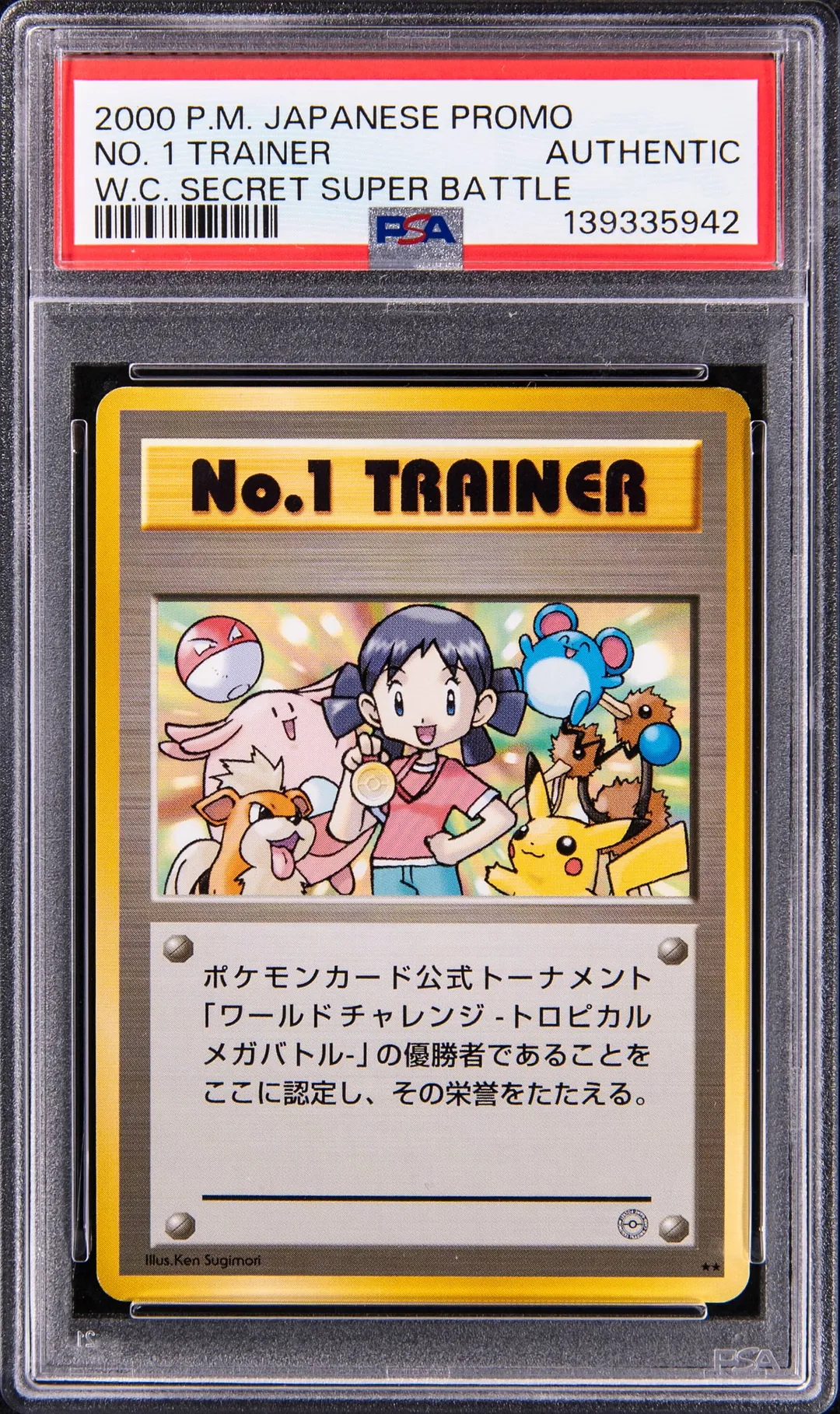
2000 No. 1 Trainer Trophy Card Sells for $27,280
A 2000 Pokémon Japanese World Challenge Secret Super Battle No. 1 Trainer PSA Authentic sold for $27,280 at Goldin. Here’s what that means for collectors.
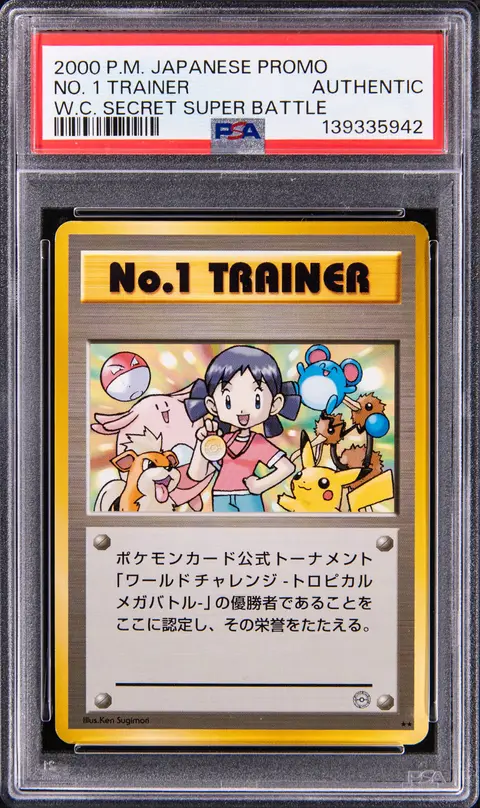
Sold Card
2000 Pokemon Japanese Promo World Challenge Secret Super Battle No. 1 Trainer - PSA Authentic
Sale Price
Platform
GoldinThe 2000 Pokémon Japanese Promo World Challenge Secret Super Battle No. 1 Trainer is one of those cards that quietly sits at the core of high‑end Pokémon collecting. A copy graded PSA Authentic just sold at Goldin on 2/16/26 for $27,280, offering another data point for a card that almost never comes to market.
What exactly is this card?
- Year: 2000
- Region: Japanese
- Type: Trophy promo (not a pack‑pulled card)
- Event: World Challenge Secret Super Battle
- Title on card: No. 1 Trainer
- Character: Typically features iconic Pokémon artwork rather than a specific in‑game “player”
- Grading: PSA Authentic (card is genuine, but no numerical condition grade)
This is not a mass‑produced set card like Base Set Charizard. It’s a trophy card, meaning it was awarded to top finishers at a specific tournament event held in Japan around 1999–2000, alongside the better‑known Super Secret Battle and Tropical Mega Battle promos.
Trophy cards are some of the earliest prizes ever given out in competitive Pokémon, produced in very low quantities and distributed only to winners. That makes them more comparable to championship rings than standard trading cards.
Why collectors care about No. 1 Trainer trophy cards
Across Pokémon, “No. 1 Trainer” cards represent:
- Ultra‑low production: Estimates for print runs are typically in the tens, not thousands. Exact numbers aren’t public, but all reputable sources treat them as extremely scarce.
- Direct tie to the competitive scene: These were earned at invitation‑only or qualification‑based events, not bought in stores.
- Historical importance: They document the earliest era of organized Pokémon play in Japan, just a few years after the TCG launched.
This specific World Challenge Secret Super Battle variant sits in the same broad family of early Japanese No. 1 Trainer trophies as the Tropical Mega Battle and Super Secret Battle promos. For many high‑end collectors, owning any early No. 1 Trainer is a long‑term goal.
Understanding the PSA Authentic grade
This copy received a PSA Authentic label, not a numerical grade like PSA 6 or PSA 9.
- “Authentic” means PSA confirms the card is genuine.
- It may have been altered, heavily worn, mis‑sized, or submitted with a request to authenticate only, not grade.
- For ultra‑rare trophies, some collectors care more about existence and authenticity than exact numerical condition, especially when the population is tiny.
In practice, this means comparing the sale to other PSA numeric grades is imperfect. With cards this scarce, the market often prices each copy on its own merits: eye appeal, provenance, and timing.
Market context and recent sales
Because this is such a low‑population trophy card, public sales are sparse, and they’re spread across different events and grading labels. That makes precise comparisons difficult, but some patterns are clear:
- Early Japanese No. 1 Trainer and similar trophy promos have repeatedly sold in the five‑ to six‑figure USD range over the past several years across major auction houses.
- Numerically graded copies (especially mid‑ to high‑grade) tend to command premiums when they appear at places like Goldin, Heritage, and PWCC.
- Authentic‑only or lower‑grade examples can trade at a discount to those high‑grade records but still at serious trophy‑card levels because of sheer scarcity.
Against that backdrop, the $27,280 price realized on 2/16/26 at Goldin fits into the lower to mid tier of the broader trophy‑card spectrum, which includes higher‑profile records for other No. 1 Trainer variants and related event promos. It represents a meaningful but not record‑setting result for this general class of card.
Because sales for this exact 2000 World Challenge Secret Super Battle No. 1 Trainer surface infrequently, this auction essentially resets the most recent public comp (short for “comparable sale,” a recent transaction collectors use as a reference point). Future sellers and buyers are likely to look back at this Goldin result when trying to frame value, even if condition, signatures, or provenance differ.
Trophy card era and scarcity
This card sits in what many collectors consider the early trophy era of Pokémon: late 1990s to early 2000s.
Typical traits of this era:
- Print runs: Tiny. Cards were created for specific events rather than mass distribution.
- Documentation: Exact numbers are not always fully documented, adding a layer of mystique and caution.
- Grading behavior: Some original winners held these raw for years; others submitted just to confirm authenticity. That’s why you see a mix of numerical grades, Authentic labels, and sometimes no graded examples at all for certain variants.
In terms of demand, trophy cards often appeal to:
- High‑end collectors building historical or “museum‑style” collections.
- Long‑time players who value the tournament history and early community roots.
- Specialist Pokémon historians who focus on specific events like Super Secret Battle, Tropical Mega Battle, or World Challenge.
How this sale fits into the larger Pokémon market
The $27,280 sale comes in a market that has cooled from the peak of 2020–2021 but has seen:
- More selective strength at the very top: truly scarce, historically important pieces have generally held up better than mass‑produced modern chase cards.
- Increased transparency: Auction houses like Goldin, PWCC, and Heritage make it easier to track realized prices for rare items, even if trophy comps remain thin.
Within that environment, this World Challenge Secret Super Battle No. 1 Trainer result shows:
- There is still real capital and interest for top‑tier historical items, even when graded “Authentic” instead of a high numeric grade.
- Collectors continue to distinguish between trophy cards and standard set cards, often giving the former a separate mental “lane” for value and collectability.
It’s important to note that a single sale—especially for a card with so few public appearances—does not establish a firm, predictable price range. It simply provides one more reference point in a very thin market.
What collectors and small sellers can take away
For newer or returning collectors:
- This card is a clear example of why rarity isn’t just about age. A 2000 card can be vastly rarer than many 1996–1999 releases if it was an invite‑only trophy.
- Terms like “trophy card,” “No. 1 Trainer,” and specific events (World Challenge, Super Secret Battle, Tropical Mega Battle) are worth learning; they’re pillars of high‑end Pokémon.
For active hobbyists and small sellers:
- Comps may be sparse for items like this. When you can’t find many recent sales, focus on:
- Event and era importance
- Population reports (if available)
- Similar trophy cards from the same time period
- Grading choice matters differently for trophies versus pack cards. Some collectors will accept Authentic labels if the card is otherwise impossible to replace.
For high‑end buyers considering similar pieces:
- Each public auction helps clarify a very thin segment of the market, but it’s still driven by a handful of motivated participants.
- Factors like provenance (who originally won or owned the card) and eye appeal can create large differences between superficially similar copies.
Final thoughts
The 2000 Pokémon Japanese Promo World Challenge Secret Super Battle No. 1 Trainer PSA Authentic sale at Goldin on 2/16/26, at $27,280, underscores the quiet resilience of true trophy cards.
While modern set cards and sealed product can see more frequent cycles of enthusiasm, these early No. 1 Trainer trophies tend to move on a slower, more deliberate timetable. Every public sale adds another chapter to the documented history of one of Pokémon’s most exclusive categories.
For collectors who track the top of the market—not just for investment reasons, but to understand the hobby’s history—this result is another reminder that early Japanese tournament prizes remain central to the Pokémon story.