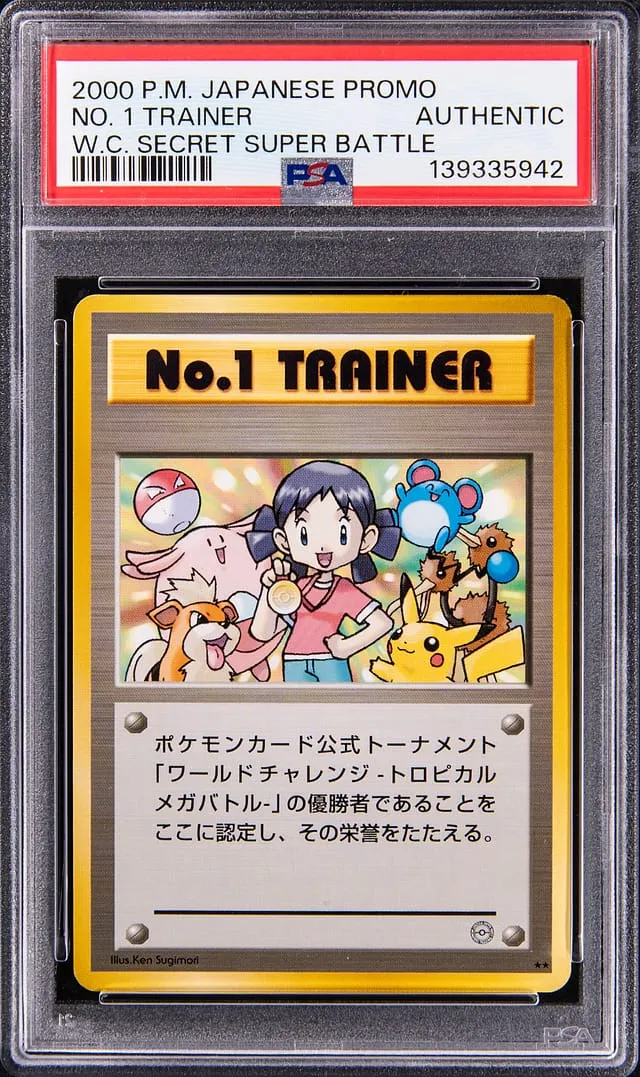
2000 No. 1 Trainer Secret Super Battle Sale at Goldin
A 2000 Pokémon Japanese No. 1 Trainer Secret Super Battle PSA Authentic sold for $27,280 at Goldin. Here’s what it means for trophy card collectors.
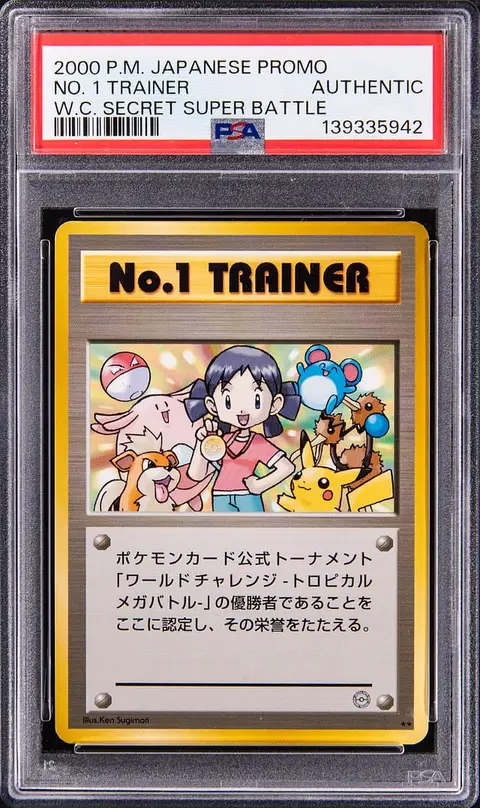
Sold Card
2000 Pokemon Japanese Promo World Challenge Secret Super Battle No. 1 Trainer - PSA Authentic
Sale Price
Platform
Goldin2000 Pokemon Japanese Promo World Challenge Secret Super Battle No. 1 Trainer – PSA Authentic
On February 16, 2026, a 2000 Pokémon Japanese Promo World Challenge Secret Super Battle No. 1 Trainer, graded PSA Authentic, sold at Goldin for $27,280. For a card that almost never surfaces publicly, this is an important data point for high‑end Pokémon collectors who track true scarcity more than population reports.
What exactly is this card?
Let’s break down the basics of this piece:
- Game / IP: Pokémon TCG
- Year: 2000
- Language / Region: Japanese
- Type: Trophy promo (tournament prize card)
- Event: World Challenge / Secret Super Battle
- Card name: No. 1 Trainer
- Grading company: PSA (Professional Sports Authenticator)
- Grade: Authentic (PSA confirms it is real but does not assign a numerical condition grade)
“No. 1 Trainer” trophies are not standard set cards. They were awarded to top finishers at invite‑only events, often with extremely low print runs and event‑specific text. The “World Challenge Secret Super Battle” variants belong to the early era of Pokémon’s competitive scene in Japan and sit in the same general trophy tier as other legendary early‑2000s No. 1/2/3 Trainer and Pikachu trophy cards.
Why this card matters to collectors
In Pokémon, a few broad categories tend to define the top of the market:
- Early‑era base set holos (Charizard, Blastoise, etc.)
- Key ex/Gold Star/illustrator‑focused chase cards
- Trophy cards – ultra‑limited prizes from official tournaments
This No. 1 Trainer sits firmly in that third group.
Trophy status and true scarcity
Trophy cards differ from pack‑pulled cards in two main ways:
- How they were distributed: Given to winners or finalists at official events, not available in booster packs.
- How many exist: Often measured in tens, not hundreds or thousands.
Surviving copies are further reduced by:
- Loss or damage over 20+ years
- Cards remaining in private collections in Japan
- Owners who are uninterested in grading or selling
That’s why, even though this example is only labeled PSA Authentic rather than a numbered grade, it still attracts serious attention. In this segment of the market, collectors often prioritize owning any verified copy over holding out for a perfect 10.
Era and historical context
This card comes from the early WotC‑era (Wizards of the Coast era) of Pokémon, when organized play and tournament structures were still being formalized in Japan and abroad. The “Secret Super Battle” branding ties into a cluster of highly regarded Japanese events whose prizes are now among the rarest Pokémon cards in existence.
Within the broader trophy landscape, No. 1 Trainer cards are often viewed as:
- Direct symbols of tournament victory
- Artifacts that document the earliest years of competitive Pokémon
- Key building blocks for collectors who specialize in Japanese promos and event history
Market context and recent sales
Because true trophy cards are so thinly traded, “comps” (comparable recent sales used as informal price references) are limited.
Based on public auction records and private‑sale chatter up through early 2026:
- High‑grade early‑2000s Japanese No. 1 Trainers from major events commonly land in the mid‑five to low‑six‑figure range when they surface, depending heavily on:
- The specific event (e.g., Secret Super Battle vs. later regional events)
- Grade and eye appeal
- Provenance (known collector histories)
- Lower graded or Authentic‑only copies typically trade at a significant discount to high‑grade PSA 9/10 examples, but still command strong prices due to the underlying scarcity.
For this PSA Authentic example at $27,280:
- The realized price is on the lower end of what long‑time trophy watchers might expect for a No. 1 Trainer from this era, but:
- The Authentic label can cap broader bidder participation compared to a clean numeric grade.
- Condition details (surface, edges, potential alterations) are not captured in a single headline.
- Even at this level, the sale reaffirms that early Japanese trophy cards remain a distinct market tier above most modern chase cards.
In other words, this auction gives the hobby another data point but not a full price map. With items this rare, each sale is its own event rather than a repeatable, chartable pattern.
Understanding PSA “Authentic” for rare trophies
For newcomers, PSA’s Authentic designation can be confusing. It means:
- PSA has confirmed the card is genuine.
- PSA has chosen not to assign a number grade. This could be due to prior alteration, heavy wear, trimming, or at the submitter’s request.
In ultra‑scarce categories like trophy cards, some collectors:
- View Authentic as an acceptable or even preferable label when the priority is provenance and verification over technical grade.
- Focus on eye appeal (how the card actually looks) and the event history it represents.
So while an Authentic label would dramatically hurt the market value of a more common card, its impact is less straightforward here. Rarity and trophy status do a lot of heavy lifting.
What this sale suggests about the current trophy market
Using this Goldin sale on February 16, 2026 as a reference point, a few themes stand out:
- Liquidity remains thin but healthy at the high end. When a true trophy piece appears, there is still meaningful bidding depth, even for non‑numeric grades.
- Collectors continue to differentiate between pack hits and event trophies. Despite a cooling trend in some modern segments, early Japanese trophies still clear strong five‑figure numbers.
- Condition nuance matters. A PSA 8–10 copy of a similar early trophy can sell for a multiple of this realized price. The Authentic label keeps this price in check relative to known high‑grade results.
For anyone tracking the segment, this sale doesn’t break records, but it does:
- Reaffirm a floor of serious money for early No. 1 Trainer trophies.
- Provide a new reference point for Authentic and lower‑grade examples.
Takeaways for collectors and small sellers
A few practical observations if you’re navigating this part of the market:
- Expect sparse comps. You will not find weekly sales of early No. 1 Trainers. Each transaction is more like a case study than a price trend.
- Know the event. Details such as “World Challenge,” “Secret Super Battle,” and the year matter. Some events carry more historical weight and hobby recognition than others.
- Grade isn’t everything, but it still matters. Trophy buyers will accept non‑gem copies when the card is almost unobtainable, yet numeric 8–10 grades can still multiply values.
- Documentation and provenance help. Any photos, event records, or prior ownership history can support a card’s standing in this niche.
Where this fits in a broader Pokémon collection
For most collectors, a 2000 Japanese World Challenge Secret Super Battle No. 1 Trainer is a grail‑tier card—something to appreciate and study, even if it sits outside realistic budget ranges.
From a collecting standpoint, it pairs naturally with:
- Other early Japanese trophy and prize cards (No. 1/2/3 Trainer, trophy Pikachu, etc.)
- 1990s–early 2000s Japanese promos that trace the history of organized play
- High‑end WotC‑era chase cards for collectors who want to bridge pack‑pulled and event‑issued pieces
For the broader hobby, this $27,280 Goldin sale on February 16, 2026 is another reminder that early Japanese trophies continue to be treated as historical artifacts of the game, not just high‑priced singles.
As always, it’s best to view results like this as context, not instructions. Each trophy card has its own story, condition, and timing—and that’s part of what keeps this corner of the hobby so compelling.