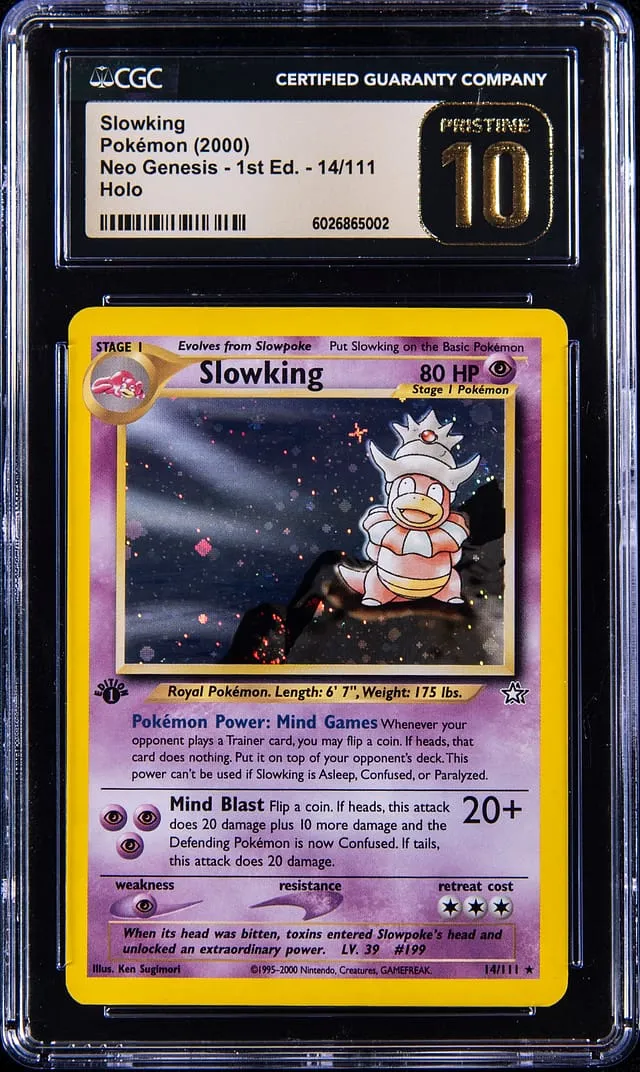
2000 Neo Genesis Slowking CGC Pristine 10 Sale
Goldin sold a 2000 Pokémon Neo Genesis 1st Edition Holo Slowking CGC Pristine 10 (Pop 3) for $42,700. See what this means for vintage Pokémon collectors.
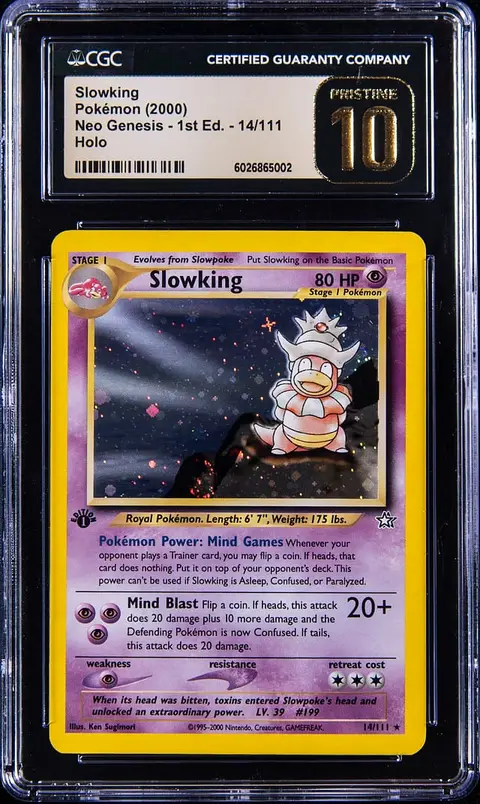
Sold Card
2000 Pokemon Neo Genesis 1st Edition Holo #14 Slowking - CGC PRISTINE 10 - Pop 3
Sale Price
Platform
GoldinA first‑generation Johto holo in a modern, pristine holder just made a quiet statement at auction.
On March 9, 2026, a 2000 Pokémon Neo Genesis 1st Edition Holo #14 Slowking graded CGC Pristine 10 sold at Goldin for $42,700. For a card that spent years in the shadow of Neo Genesis headliners like Lugia and Feraligatr, this is a meaningful data point for serious Pokémon collectors.
Card profile: 2000 Neo Genesis Slowking #14
Let’s start with the basics:
- Character: Slowking (Johto region, Gen 2)
- Year: 2000
- Set: Pokémon Neo Genesis (English, Wizards of the Coast era)
- Card number: #14/111
- Edition: 1st Edition
- Finish: Holofoil
- Grading company: CGC (Certified Guaranty Company)
- Grade: Pristine 10
- Population: Pop 3 in CGC Pristine 10 at the time of sale
- Attributes: No auto, no serial number, no patch – the key premium is condition and 1st Edition holo status
This is not a rookie card in the sports sense, but in Pokémon terms it is the first English Slowking holo in a main set and part of the very first Johto expansion printed in English.
Why Neo Genesis matters
Neo Genesis is the first English set to introduce Pokémon from Gold & Silver (Gen 2). For many collectors, it marks the bridge between the original Kanto era and the wider Pokémon world.
Key reasons Neo Genesis is historically important:
- First Johto set in English: Introduced starters like Totodile, Cyndaquil, Chikorita, plus Lugia and many fan favorites.
- Wizards of the Coast era: Cards printed under WotC have a distinct nostalgia and print style that newer sets don’t replicate.
- Early holo difficulty: Many 1st Edition Neo Genesis holos are notoriously tough to grade due to print lines, edge chipping, and centering.
Within that context, Slowking is a second‑tier cover star: not as chased as Lugia, but a recognizable, lore‑rich Pokémon with a steady collector base.
What makes this copy special: CGC Pristine 10, Pop 3
CGC uses a detailed sub‑grade system (centering, corners, edges, surface). A Pristine 10 is one step below their Perfect 10 and indicates virtually flawless condition.
Why this grade matters:
- Extreme condition scarcity: Neo Genesis 1st Edition holos rarely survive in true gem‑level condition, let alone at the very top of any grading scale.
- Pop 3 status: A population ("pop") report is a count of how many copies exist at each grade. Pop 3 in CGC Pristine 10 means there are only three examples graded this high by CGC, with none higher in this specific label.
- Vintage + modern grade scale: Applying an ultra‑strict, modern grading standard to a 2000 WotC holo amplifies the rarity.
Put simply, plenty of Slowking cards exist, but only a handful can honestly claim this level of condition.
Market context: where does $42,700 fit?
The Goldin sale on March 9, 2026 closed at $42,700 USD. To understand that number, it helps to think in layers:
Set and character tier
Neo Genesis is a premier vintage set, but Slowking is a secondary holo compared with Lugia and the starters. That typically leads to a pricing hierarchy: Lugia at the top, then key starters and fan favorites, then supporting holos like Slowking.Grade and label premium
Collectors sometimes pay a significant premium moving from a strong "gem mint" (PSA 10, CGC 9.5, BGS 9.5) into the true top‑of‑scale labels (CGC Pristine, BGS Black Label, etc.). These are often collected as condition trophies.Relative scarcity across graders
Even if we don’t have perfect cross‑company data, WotC Neo Genesis holos are generally:- Much more common in mid‑grades
- Noticeably harder in PSA 10
- Extremely thin in any "pristine/black label" tier
Against that backdrop, a five‑figure result for a pop‑3 Pristine 10 falls into the realm of high‑end but explainable pricing for a top‑tier condition piece. It reflects:
- The combination of WotC nostalgia + 1st Edition stamp + holofoil + ultra‑high grade
- The fact that top‑pop (highest‑grade) examples in vintage Pokémon often behave as their own micro‑market
Because truly comparable CGC Pristine 10 or equivalent "perfect" Slowking sales are sparse, this result functions more as a marker than a simple average comp. In other words, it tells us what an elite collector was willing to pay for this exact card, in this exact grade, at this time.
Comparing to closely related versions
Direct, identical‑card comps (same card, same grade, same grading company) are limited for this population. Instead, collectors typically look at a mix of nearby data points:
Lower‑grade 1st Edition Slowking holos
Historically, strong PSA 10 or CGC 9.5 copies of Neo Genesis holos sell for a fraction of the pristine‑tier price, reflecting both higher population and more accessible condition targets.Other Neo Genesis holo Pristine/Black‑label results
Occasional record sales for cards like 1st Edition Lugia in top‑tier labels have shown that collectors will pay a steep multiple to secure the best example available, even when lower gem‑mint copies are relatively more abundant.
This Slowking sale appears consistent with that broader pattern: a large jump from standard gem mint into the realm of near‑perfect condition.
Why collectors care about this card
Several factors work together here:
WotC vintage status
Released in 2000, Neo Genesis is now firmly in the "vintage" or at least early‑era category. Cards from this period are tied closely to childhood memories for many collectors.Johto nostalgia
Gold & Silver (Gen 2) has its own dedicated nostalgia wave, especially among collectors who grew up with Game Boy Color and the second generation of the anime.Artwork and holo treatment
Slowking’s Neo Genesis art has the characteristic WotC holo layer and layout that many collectors associate with early Pokémon packs and binders.Condition‑driven collecting
Some collectors now build "set runs" focusing only on the single highest‑graded copy they can find for each card. A pop‑3 Pristine 10 Slowking is an obvious target for that style of collection.Grading trends
CGC has gained traction in the Pokémon community, especially among collectors who value sub‑grades and more granular condition descriptions. This has given top‑grade CGC Pokémon cards a clearer identity in the market.
What this sale might signal
Rather than viewing $42,700 as a prediction of future prices, it’s more useful to see this Goldin result as:
- Evidence of strong demand for top‑of‑the‑scale WotC Neo Genesis holos, even beyond the usual headliners.
- A benchmark for future CGC Pristine 10 (and comparable) Slowking auctions.
- A reminder that, in vintage Pokémon, small changes in grade at the very top can mean large changes in price.
For collectors, this sale reinforces a few practical takeaways:
- Condition still drives the top end. The gap between a nice copy and an almost perfect copy continues to widen for key early‑era cards.
- Non‑cover stars can still matter. Even supporting Pokémon from flagship sets can command strong prices when paired with the right attributes.
- Auction context matters. High‑visibility houses like Goldin tend to bring out serious bidders for rare condition pieces.
How to think about similar cards in your collection
If you own Neo Genesis holos—Slowking or otherwise—there are a few questions worth considering:
Raw vs graded:
If your card is raw (ungraded) and appears clean, sending it to a reputable grader (PSA, CGC, BGS) can help clarify where it fits on the condition spectrum.Centering, surface, and print lines:
Early WotC holos commonly show print lines and edge wear. Checking these carefully under good light will set realistic expectations before grading.Edition and language:
1st Edition English Neo Genesis typically carries a premium over Unlimited and non‑English versions, especially in higher grades.Market research:
Looking at "comps" (recent comparable sales) across multiple platforms provides context. When comps are thin at the very top of the scale, the range of possible outcomes grows wider.
Closing thoughts
The March 9, 2026 Goldin sale of a 2000 Pokémon Neo Genesis 1st Edition Holo #14 Slowking – CGC Pristine 10 (Pop 3) at $42,700 is a focused snapshot of where high‑end vintage Pokémon collecting sits today: selective, condition‑driven, and still anchored in the earliest sets of the franchise.
It doesn’t mean every Slowking is suddenly worth five figures. It does highlight how much collectors are willing to differentiate between a great card and an almost flawless one—especially when that card comes from one of the hobby’s foundational sets.
For anyone building a Neo Genesis run, or simply tracking the evolution of WotC Pokémon, this sale is a data point worth bookmarking.