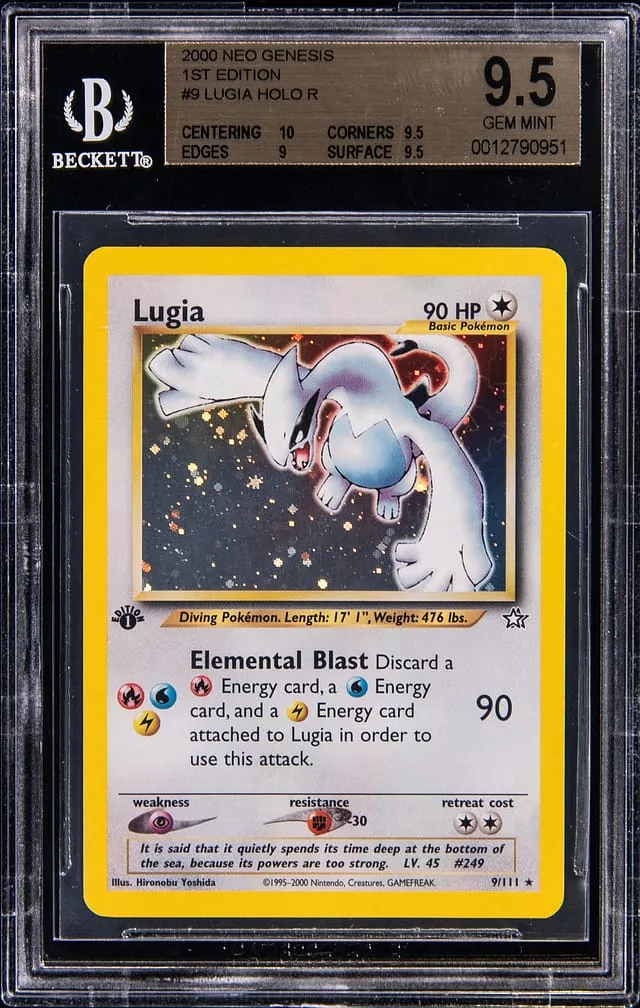
2000 Neo Genesis Lugia BGS 9.5 sells for $19,520
Goldin sold a 2000 Pokémon Neo Genesis 1st Edition Holo Lugia BGS 9.5 for $19,520. See how this result fits recent comps and vintage Pokémon trends.
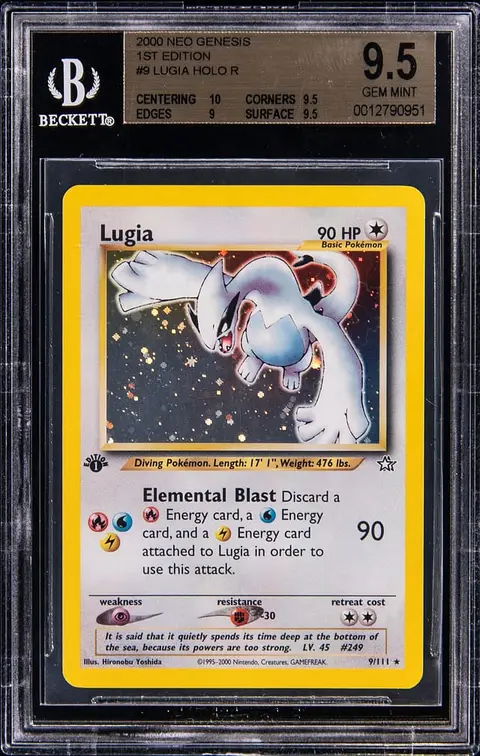
Sold Card
2000 Pokemon Neo Genesis 1st Edition Holo #9 Lugia - BGS GEM MINT 9.5
Sale Price
Platform
Goldin2000 Pokémon Neo Genesis 1st Edition Holo Lugia BGS 9.5 Sells for $19,520 at Goldin
The 2000 Pokémon Neo Genesis 1st Edition Holo #9 Lugia is one of the cornerstone cards of the post–Base Set era. On May 11, 2026, a BGS GEM MINT 9.5 copy sold at Goldin for $19,520, offering a useful data point for collectors tracking high-end Lugia prices.
In this breakdown, we’ll look at what this card is, why it matters, and how this sale fits into recent market activity.
Card overview
- Card: Lugia
- Year: 2000
- Set: Pokémon Neo Genesis (1st Edition)
- Card number: #9
- Finish: Holofoil
- Edition: 1st Edition (the first print run, marked with the 1st Edition stamp)
- Grading company: Beckett Grading Services (BGS)
- Grade: GEM MINT 9.5
- Type of card: Key issue / early-era chase card, often treated as Lugia’s flagship appearance
While Pokémon doesn’t use the term “rookie card” in the same way sports cards do, many collectors view Neo Genesis Lugia as the defining early-era Lugia card. It functions similarly to a flagship rookie: first major TCG appearance, central to the character’s card history, and heavily targeted by long-term collectors.
Why this Lugia matters to collectors
A headliner of the Neo era
Neo Genesis marked Pokémon’s transition from the original Kanto generation to Johto. For many who grew up with Gold & Silver on Game Boy or the second-generation anime, Lugia is the signature legendary.
Within Neo Genesis, Lugia #9 stands out because:
- It’s a marquee legendary from a historically important set.
- The 1st Edition holo print run is significantly tougher than Unlimited.
- Centering, print lines, and holo scratching from the era make high grades harder than they might look at first glance.
For collectors who focus on vintage and early WotC (Wizards of the Coast) Pokémon, this card regularly sits in the same conversation as key chase cards from Base Set, Neo Revelation, and Neo Destiny.
Vintage / early WotC profile
This card comes from what most collectors call the vintage or early WotC era (late 1990s to early 2000s). Cards from this period typically have:
- Smaller original print runs than modern reprint-heavy sets
- Tougher condition sensitivity due to factory issues and storage
- Strong nostalgia demand from collectors who were kids when these sets released
Neo Genesis in particular also has well-known quality-control quirks. That’s one reason 9.5-level copies are meaningfully rarer than lower grades.
The role of grading: BGS 9.5 GEM MINT
This specific card is graded BGS GEM MINT 9.5 by Beckett Grading Services.
BGS subgrades (centering, corners, edges, surface) can significantly impact perceived desirability. Some 9.5 copies are effectively “true gem” (9.5+ in all subs), while others lean on a strong trio of subs and one weaker area. While the sale listing’s full subgrade breakdown wasn’t included in the prompt, collectors usually pay closer attention to:
- True gem or better (all subgrades 9.5 or higher)
- Presence of any 10 subgrades
Those nuances often explain why two BGS 9.5 copies can sell at noticeably different numbers.
Market context and recent sales
When collectors talk about comps, they mean recent comparable sales—same card in the same or closely related grade. Comps help frame current price levels, even though they’re never a guarantee of future value.
For Lugia Neo Genesis 1st Edition Holo, the price ladder usually looks something like this:
- PSA 10 GEM MINT: Historically at the very top of the market, with auction results that can be many multiples of 9 and 9.5 copies when demand spikes.
- BGS 9.5 GEM MINT: Typically priced around the higher end of the PSA 9 / low end of the PSA 10 band, depending on subgrades and timing.
- PSA 9 / BGS 9: The most commonly traded high-grade tier, often used as a reference point for collectors entering the card at a lower buy-in.
Across major marketplaces and auction houses over the last couple of years, BGS 9.5 and PSA 9 copies have generally settled into a band below the peak boom-era prices seen around 2020–2021, but still well above pre-boom levels. As the market has cooled and then stabilized, we’ve seen:
- More differentiation by card quality (centering, holo cleanliness, subgrades)
- More spread between auction and fixed-price listings, especially during lower-attention months
Within that context, the $19,520 Goldin result for this BGS 9.5 fits into a range that makes sense for a high-end, gem-mint example of a flagship WotC legendary. It’s neither an outlier crash nor an obvious runaway record; instead, it reads as a solid, data-anchored sale in line with a more mature, post-boom market.
Because sales can vary based on timing, marketing, and subgrades, it’s normal to see some spread among BGS 9.5 sales. Individual copies can land above or below this number without contradicting the general range.
Population and scarcity considerations
Pop report is short for population report—the grading company’s count of how many copies exist at each grade.
For Neo Genesis Lugia 1st Edition:
- Total graded population across PSA and BGS is meaningful, but not huge compared to modern ultra-printed sets.
- The number of true gem or equivalent top-end copies (PSA 10, BGS 9.5 with strong subs, BGS 10) is a small fraction of the total.
The card is not impossible to find in lower grades, but high-grade 1st Edition holos are where the scarcity really shows. That’s why collectors track BGS 9.5 and PSA 10 sales so closely—those tiers act as reference points for the rest of the grade ladder.
How this sale fits the broader Lugia market
The Goldin sale on May 11, 2026, adds another important comp for high-grade Lugia collectors. For people actively tracking this card:
- It helps refine expectations for BGS 9.5 compared with PSA 9 and PSA 10.
- It illustrates that demand for key WotC-era legendaries remains steady, even without a major news catalyst.
There hasn’t been a single piece of shocking Lugia-related hobby news driving this particular result. Instead, this sale reflects the more normal drivers of the modern Pokémon market:
- A continued base of nostalgic collectors who want cornerstone WotC cards
- A focus on condition and grading tiers
- Selective bidding on strong copies through established auction houses
Takeaways for collectors and small sellers
If you’re new to the card or thinking about selling or upgrading:
- Use this $19,520 BGS 9.5 sale at Goldin (May 11, 2026) as one of several comps, not the only data point.
- Consider grade, subgrades, eye appeal, and edition (1st Edition vs Unlimited) when you compare prices.
- Remember that auctions, fixed-price listings, and private deals can all land at different numbers even for the same grade.
For long-term Lugia or WotC-era collectors, this result reinforces what the market has been signaling for some time: Neo Genesis Lugia 1st Edition Holo remains one of the key non–Base Set anchors of vintage Pokémon, and high-grade examples still command serious attention when they surface at major houses like Goldin.
As more sales accumulate, figoca will continue tracking how results like this BGS 9.5 landing at $19,520 shape the price landscape for one of the hobby’s most recognizable legendary cards.