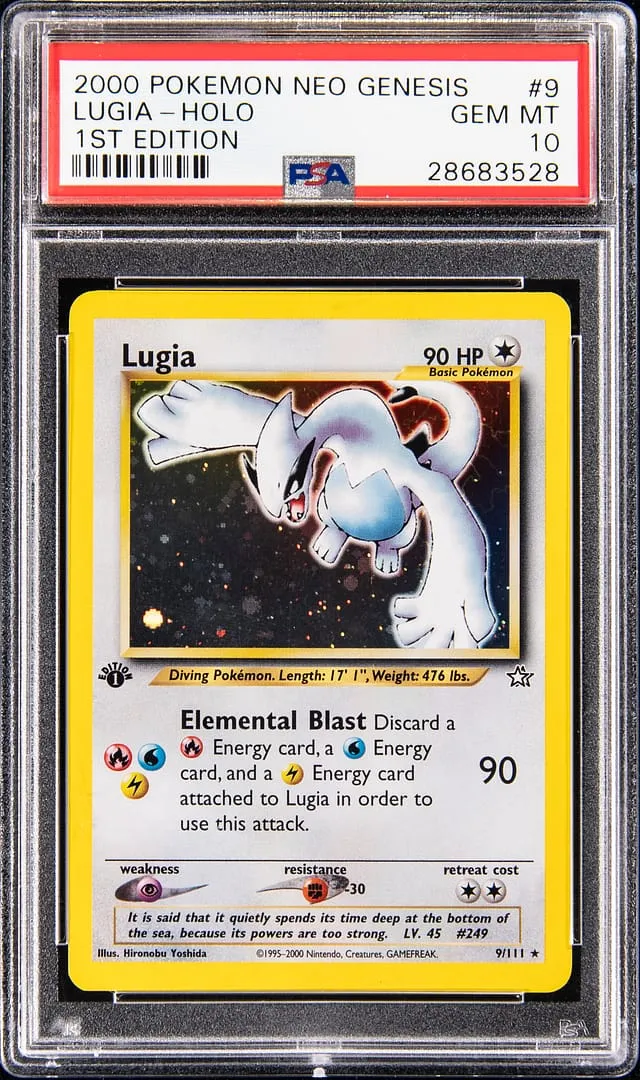
2000 Neo Genesis 1st Ed Lugia PSA 10 sells for $146K
Goldin sold a 2000 Pokémon Neo Genesis 1st Edition Holo Lugia PSA 10 for $146,400. See what this WOTC-era grail means for collectors.
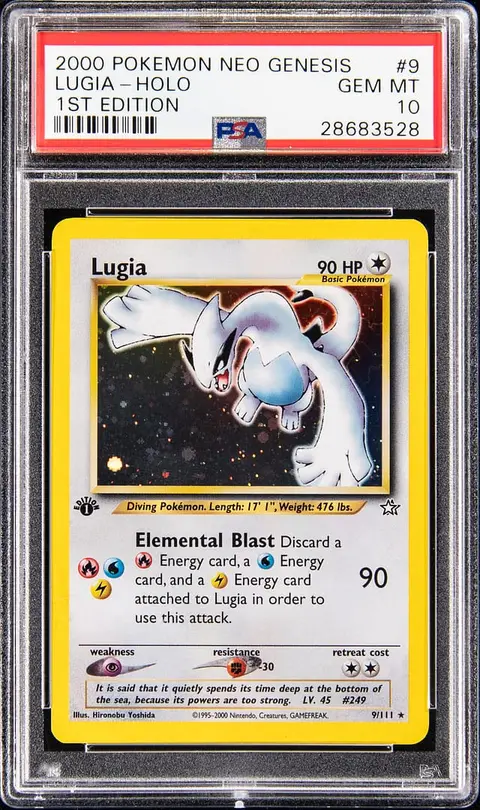
Sold Card
2000 Pokemon Neo Genesis 1st Edition Holo #9 Lugia - PSA GEM MT 10
Sale Price
Platform
Goldin2000 Pokémon Neo Genesis 1st Edition Holo Lugia PSA 10 Sells for $146,400
On April 27, 2026, Goldin closed a major sale for one of the most studied Pokémon cards of the WOTC (Wizards of the Coast) era: a 2000 Pokémon Neo Genesis 1st Edition Holo #9 Lugia graded PSA GEM MT 10. The final price landed at $146,400.
For many collectors, this card sits near the top of the non–1st Edition Base Set food chain. It blends early-era nostalgia, real-condition scarcity, and a well-documented market history.
The card at a glance
- Character: Lugia
- Set: 2000 Pokémon Neo Genesis (English)
- Edition: 1st Edition
- Card number: #9
- Finish: Holographic (Holo)
- Grading company: PSA (Professional Sports Authenticator)
- Grade: GEM MT 10
- Era: Early WOTC, post–Base Set
- Key issue / rookie: Widely treated as Lugia’s key early English holo, often called its “rookie-style” chase card.
This is not a serial-numbered, signed, or patch-style card like you’d see in sports. Its importance comes from the combination of:
- Being a marquee holo in the first Neo-era set.
- Carrying the 1st Edition stamp.
- The difficulty of finding it in true gem mint condition.
Why Neo Genesis Lugia matters
A flagship from the Neo era
Neo Genesis was the first main set released after the original Base/Jungle/Fossil run. For many returning collectors, it marks the bridge between the earliest Pokémon era and the more complex, late-WOTC designs.
Within that set, Lugia #9 quickly became a headliner:
- It features a full holo background that is notoriously prone to print lines and surface defects.
- Centering issues and production quality made high-grade copies hard to come by, even fresh from packs.
- Lugia itself became one of the most popular Legend/cover Pokémon of the Game Boy era.
The result: even as grading populations grew, Gem Mint 10 copies stayed relatively scarce compared with overall demand.
Early WOTC era = condition bottleneck
Cards from this time were:
- Printed in large quantities overall.
- Often handled, shuffled, and played with.
- Produced with quality-control quirks that show up under PSA’s standards.
That combination means plenty of raw Lugia cards exist, but true PSA 10 examples remain a small subset, which is reflected in the price gap between grades.
Market context and recent sales
Instead of guessing, it’s helpful to look at how this card has behaved across different grades and over time.
PSA 10 vs lower grades
In the hobby, you’ll often hear collectors talk about “comps,” short for comparable recent sales of the same or very similar cards. While exact numbers move over time, the pattern for Neo Genesis 1st Edition Lugia has been consistent:
- PSA 10: Commands a major premium due to scarcity and the difficulty of the grade.
- PSA 9: Still a strong card, but typically at a fraction of the 10 price.
- PSA 8 and below: Much more accessible, with a wide range depending on eye appeal.
The $146,400 Goldin result fits into a long-running story where PSA 10s are treated as a distinct tier of collectible, not just “one grade higher.” Condition separates a display piece from a true trophy for many high-end set builders and character collectors.
How this Goldin sale fits in
Goldin’s April 27, 2026 sale confirms a few ongoing themes:
- Early WOTC grails still command six-figure attention at the top grade levels.
- PSA 10 Neo Genesis Lugia remains one of the key non–Base Set headliners, alongside cards like 1st Edition Shining and other Neo-era chase holos.
- The spread between PSA 10 and the next tier down continues to act as a reminder that condition is the main driver once a card is established as historically important.
It’s worth noting that markets move. This sale should be viewed as one data point in a broader range rather than a permanent benchmark. But it does reinforce how the hobby currently values this specific combination of card, set, edition, and grade.
Collector significance
Key reasons collectors chase this card
- Iconic artwork and character: Lugia is strongly associated with the Game Boy era and Pokémon Silver, and carries “cover Pokémon” status for a large generation of fans.
- Set importance: Neo Genesis is a foundational post-Base set. Many collectors see a 1st Edition Lugia as a centerpiece alongside 1st Edition Base holos.
- Condition challenge: The holo pattern and print quality issues make PSA 10s a genuine achievement.
- Set-building: High-end WOTC set builders often treat this card as one of the defining stops on the Neo Genesis checklist.
Where this sits in the broader hobby timeline
This card falls into what many describe as the early vintage/early WOTC window. It’s not 1999 1st Edition Base Charizard-level iconic for the general public, but inside the hobby it is widely recognized as one of the most important non-Base Set English cards.
As more collectors who grew up with the Game Boy and Neo era return to the hobby, this card often becomes:
- A nostalgia anchor for their childhood.
- A target for high-end character collectors who focus just on Lugia.
- A point of comparison when talking about other six-figure Pokémon grails.
What this means for different types of collectors
For newcomers
- You do not need a PSA 10 1st Edition Lugia to enjoy the card.
- Lower grades (PSA 7–9, or even raw copies) offer the same artwork and history at very different price points.
- Use sales like this as reference points, not goals you must hit.
For returning collectors
- This sale underlines how some of the cards you may remember from childhood have developed distinct tiers based on condition and edition.
- If you still own a Neo Genesis Lugia, consider:
- Its condition under bright light.
- Whether grading could help you understand where it sits in the current landscape.
For active hobbyists and small sellers
- Treat the $146,400 Goldin sale as an upper-end data point when looking at comps.
- When checking your own Lugia cards:
- Study centering, print lines, and surface scratches closely.
- Compare estimated grade ranges to recent sales in that specific grade.
- Remember that grade and eye appeal drive wide price bands even within the same set and card number.
Takeaways from the Goldin auction
The April 27, 2026 Goldin result for a 2000 Pokémon Neo Genesis 1st Edition Holo #9 Lugia in PSA GEM MT 10 reinforces a few key themes in today’s Pokémon market:
- The top of the WOTC market continues to favor established, early-era key issues.
- Condition remains the dividing line between a nostalgic card and a flagship, six-figure example.
- Neo Genesis Lugia has firmly cemented itself as one of the core non–Base Set grails of the English TCG.
For collectors watching the market, this sale is another clear signal of how the hobby currently values early-era, gem mint, first edition holo stars.
figoca helps collectors, hobbyists, and small sellers track important sales and understand how key cards fit into the bigger picture of the trading card market.