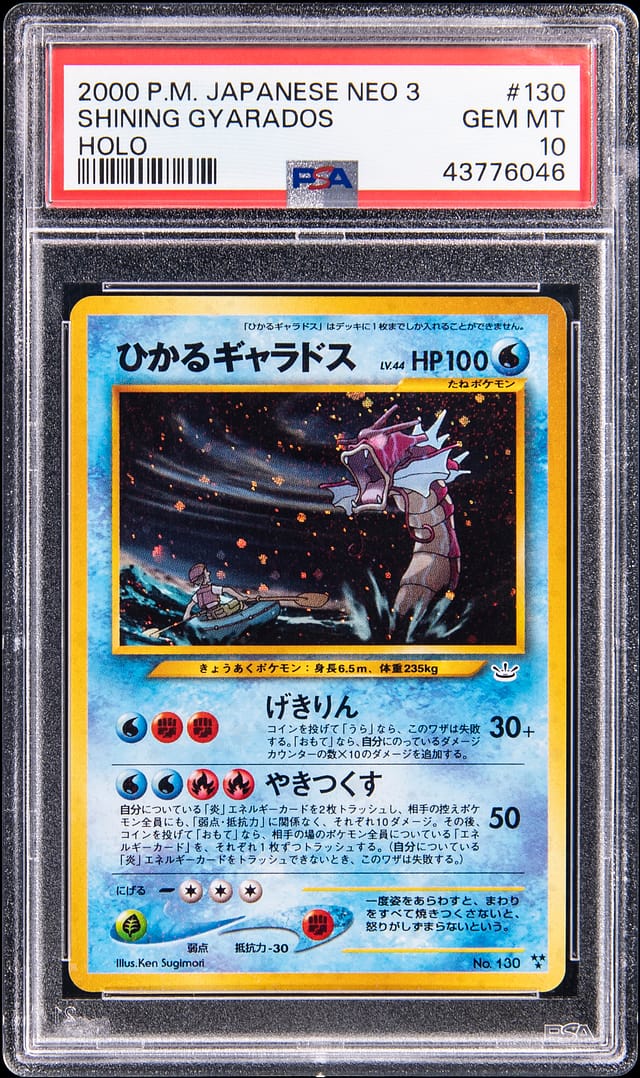
2000 Japanese Shining Gyarados PSA 10 sells for $42,700
Goldin sells a 2000 Pokémon Japanese Neo 3 Shining Gyarados PSA 10 for $42,700. A key data point for Neo-era Shining cards and high-end Pokémon collectors.
Sold Card
2000 Pokemon Japanese Neo 3 Holo #130 Shining Gyarados - PSA GEM MT 10
Sale Price
Platform
Goldin2000 Pokémon Japanese Neo 3 Holo #130 Shining Gyarados PSA 10 Sells for $42,700
On May 25, 2026, Goldin closed a notable sale for one of the most important cards of the Neo era: a 2000 Pokémon Japanese Neo 3 Holo #130 Shining Gyarados, graded PSA GEM MT 10, which realized $42,700.
For collectors who focus on vintage and early WOTC (Wizards of the Coast)–era Pokémon, this is a key data point for one of the hobby’s most recognizable “Shining” cards.
The card at a glance
- Card: Shining Gyarados
- Character: Gyarados (Shining variant)
- Year: 2000
- Language/Region: Japanese
- Set: Pokémon Neo 3 (Japanese equivalent of Neo Revelation)
- Card number: #130
- Rarity / variant: Shining holo (sparkling/alternate-color Pokémon with unique holo treatment)
- Grading company: PSA (Professional Sports Authenticator)
- Grade: GEM MT 10 (PSA’s highest standard grade)
- Attributes: Non-serial-numbered, no autograph, no patch – value is driven by art, rarity, era, and condition
This is not a “rookie card” in the sports sense, but it is a key issue for Gyarados collectors and for anyone building out a high-end early Pokémon run. In the Japanese Neo 3 release, Shining Gyarados sits alongside Shining Magikarp as one of the set’s chase cards.
Why Shining Gyarados matters to collectors
Several factors combine to give this card long-term importance in the Pokémon hobby:
Early-era Shining Pokémon
Neo-era Shining cards were among the first official Pokémon cards to feature alternate-colored (shiny) Pokémon, long before shiny hunting became a mainstream concept in the games. That historical context gives them a special place in many collections.Iconic artwork and storytelling
The Shining Gyarados illustration is widely regarded as one of the most cinematic scenes in Pokémon TCG history. The card shows a red Gyarados erupting from a stormy sea, with a tiny boat and trainer dwarfed by the chaos. Even for collectors who don’t focus on Gyarados, this piece of art is a Neo-era touchstone.Japanese Neo 3 vs. English Neo Revelation
While the English Neo Revelation Shining Gyarados is more familiar to many Western collectors, the Japanese Neo 3 version predates and parallels it, and is essential for set and language collectors. Condition-sensitive surfaces and print characteristics from this era make top grades harder to achieve.Era and scarcity in grade
The card is from the early 2000s, which many in the hobby think of as the tail end of “vintage” or early WOTC. Cards were often played or stored casually, and high-grade survivors are much thinner on the ground than modern chase cards printed in today’s huge quantities.
PSA 10 population and grade scarcity
Instead of looking only at raw population numbers, it’s more helpful to think in terms of relative scarcity:
- PSA 10 (GEM MT) examples of Japanese Neo-era holos are noticeably harder to find than modern ultra-modern cards. Centering, print lines, and surface issues often hold them back.
- Within the Shining subset of Neo 3, Gyarados is one of the more targeted cards, so demand for the highest grade tends to outstrip supply.
Even without quoting a specific pop count, the market behavior around recent PSA 10 sales tells us that collectors treat this as a genuinely scarce grade, not a commodity.
Market context: how does $42,700 fit in?
The Goldin sale at $42,700 on May 25, 2026 (UTC) adds another datapoint to a fairly thin high-end sales record for this card.
When looking at “comps” (short for comparable sales – recent, similar items that help frame value), collectors tend to review:
Same card, same grade:
Previous PSA 10 sales of the 2000 Japanese Neo 3 Shining Gyarados have been sporadic, often occurring through large auction houses or established marketplaces. Results have generally landed in the mid five-figure range, with hammer prices and buyer’s premium combining into totals broadly in line with this latest sale, depending on timing and broader Pokémon sentiment.Same card, lower grades:
PSA 9 copies usually sell at a significant discount to PSA 10, often falling into the low-to-mid four-figure to low five-figure range, depending on eye appeal, auction venue, and timing. PSA 8 and below tend to cater more to set builders and character collectors than to high-end condition-focused buyers.English counterparts and related Shining cards:
The English Neo Revelation Shining Gyarados and other Neo-era Shining cards (like Shining Magikarp) often trade more frequently, providing a broader reference band. These can help frame how collectors value language, art, and rarity relative to one another.
Placing the $42,700 Goldin result alongside those comps, this sale is consistent with what the market has been willing to pay for a strong PSA 10 example in a reputable auction setting. It does not represent an outlier spike far beyond prior known ranges, but it reinforces the card’s status in the upper tier of Neo-era Pokémon pricing.
What might be driving demand right now
Without leaning on speculation, a few steady factors help explain why this card continues to perform well:
Mature demand for early WOTC-era Pokémon
Collectors who grew up with Neo sets are now in their peak collecting years. Many are upgrading from raw or mid-grade copies to true “keeper” pieces like PSA 10s.Art-driven collecting
As the Pokémon market has matured, more collectors base their targets on artwork and nostalgia rather than strictly on playability or checklists. Shining Gyarados consistently appears on short lists of “best Pokémon artworks of all time,” which supports long-term interest.Preference for graded condition benchmarks
In the higher end of the hobby, certified grading acts as a common language. A PSA 10 gives buyers and sellers a shared expectation of quality, and iconic cards in that top grade often see more competition in auction.Reputable auction venue
Goldin’s branding and marketing to a cross-section of sports, TCG, and pop culture collectors can bring additional bidders to niche high-end cards. That visibility can help a strong copy realize fair market interest.
What this sale means for collectors
For different segments of the hobby, this result sends slightly different signals:
For long-term Neo collectors:
The sale confirms that top-grade Shining Gyarados remains a stable cornerstone card rather than a passing trend. If you already own one, this is another data point supporting its relevance in the broader Neo market.For newer or returning collectors:
A $42,700 PSA 10 can feel far out of reach, but the same artwork is available across lower grades and in different languages. Understanding why this particular copy commands a premium (grade, scarcity, nostalgia, artwork) can help you make more informed choices with more modest targets.For small sellers:
This result underscores the importance of condition and authentication. Raw Neo-era holos can vary dramatically in value depending on whether they would likely grade as an 8, 9, or 10. Pre-screening and selectively grading your better-condition vintage cards can open up higher-end outcomes, even if not at this level.
How to use this sale as a reference point
When you look at this Goldin sale as a reference, keep a few practical habits in mind:
Compare like to like
Use this result primarily as a benchmark for PSA 10 Japanese Neo 3 Shining Gyarados. Applying it directly to English copies, different grades, or raw cards can lead to misleading expectations.Check multiple recent comps
One strong sale is informative, but not definitive. Reviewing several recent results across auction houses and marketplaces gives a clearer picture of the current range.Account for timing and venue
Major auctions like Goldin often bring out high-visibility bidders, which can lift realized prices relative to quieter venues. When comparing, note both where and when the other sales occurred.Separate price from personal enjoyment
While high-end sales make headlines, the core reason this card endures is the combination of nostalgic impact and artwork. Many collectors are happy with well-loved copies that fit their budget, and this sale doesn’t change that.
Closing thoughts
The May 25, 2026 Goldin auction of the 2000 Pokémon Japanese Neo 3 Holo #130 Shining Gyarados in PSA GEM MT 10 at $42,700 reinforces the card’s status as a Neo-era pillar. Rather than signaling a sudden shift, it fits into a pattern of steady respect for early Shining cards in top grade.
For anyone tracking key Pokémon TCG pieces from the early 2000s, this is a data point worth bookmarking. It highlights how nostalgia, artwork, and grade scarcity continue to shape the market — and why Shining Gyarados remains one of the defining cards of its era.