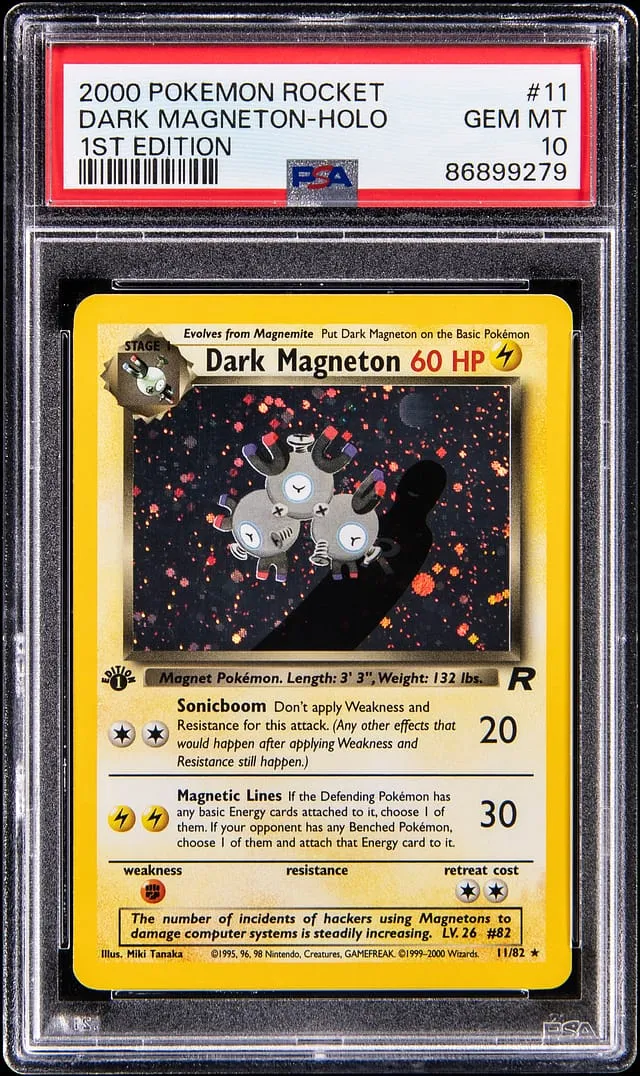
2000 Dark Magneton PSA 10 Team Rocket sale analysis
A $25,620 Goldin sale for a 2000 Team Rocket 1st Edition Dark Magneton PSA 10 shows continued strength for high-grade vintage Pokémon holos.
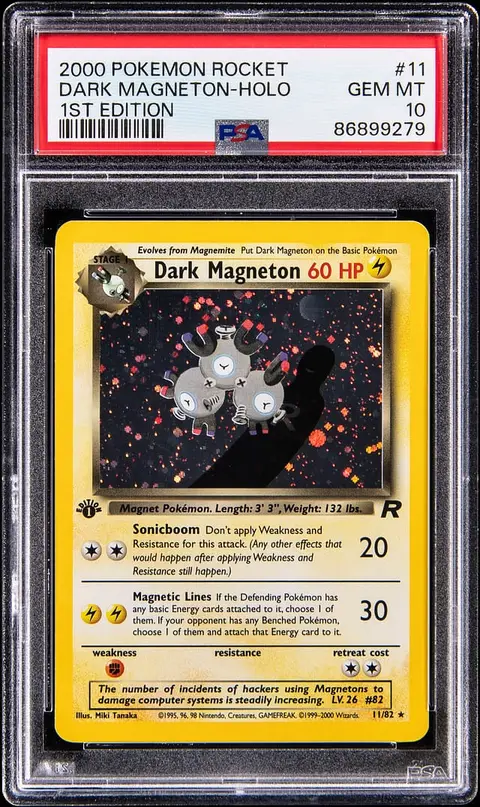
Sold Card
2000 Pokemon Team Rocket 1st Edition Holo #11 Dark Magneton - PSA GEM MT 10
Sale Price
Platform
Goldin2000 Pokémon Team Rocket 1st Edition Holo #11 Dark Magneton in PSA 10 just changed hands at Goldin on 2026-05-04 for $25,620. For a non‑Charizard holographic from the Team Rocket set, that is a meaningful result and a reminder of how much attention early‑era Pokémon holos still command when they surface in top grade.
Card overview
- Card: 2000 Pokémon Team Rocket Dark Magneton
- Set: Team Rocket (English), 1st Edition
- Card number: #11
- Rarity: Holographic rare
- Stamp: 1st Edition
- Grading company: PSA (Professional Sports Authenticator)
- Grade: GEM MT 10
- Sale: $25,620 via Goldin, closing 2026-05-04 (UTC)
Dark Magneton is part of the original English Team Rocket expansion released in 2000. The card features Magneton under the “Dark” treatment that defined the set—darker artwork and a Team Rocket affiliation. While it is not a rookie card in the sports sense, it is a key issue for character and set collectors who focus on pre‑e–Series WOTC (Wizards of the Coast) Pokémon.
Why this card matters to collectors
1. Team Rocket 1st Edition: a WOTC cornerstone
Team Rocket was the third main English Pokémon TCG expansion with 1st Edition stamps (after Base Set and Fossil/Jungle). It introduced “Dark” Pokémon and the villain‑centric theme that many collectors remember vividly.
Among WOTC‑era sets, Team Rocket 1st Edition has a few traits that matter today:
- It’s firmly vintage (1999–2002 era), printed well before modern reprint waves.
- Holographic cards from this era were played, shuffled, and stored in binders, so high‑grade examples are much less common than raw copies.
- The Dark theme and the iconic black Team Rocket borders give the holos a different look from Base/Jungle/Fossil, which many set builders and nostalgia‑driven collectors chase.
2. Dark Magneton’s reputation
Dark Magneton is not a cover card like Dark Charizard or Dark Blastoise, but it has a few things going for it:
- It’s a holographic rare from the 1st Edition print run.
- Magneton is one of the original Kanto Pokémon, so it sits in that core nostalgia group even if it is not a top‑tier mascot.
- Within the set, it is a necessary piece for anyone attempting a fully graded Team Rocket holo run in 1st Edition.
In other words, this sale is less about character stardom and more about set completion and condition rarity.
Grading, population, and scarcity
The headline detail here is the grade: PSA GEM MT 10. PSA 10 means the card meets PSA’s top standard for centering, corners, edges, and surface—essentially a pack‑fresh appearance with no visible flaws under normal viewing.
For vintage WOTC holos, this is not easy to achieve because:
- Silvering and print lines on the holo foil are common.
- Edge chipping on dark borders shows immediately.
- Many surviving copies have binder dents or light scratches.
Population reports (often shortened to “pop report”, a published count of how many copies PSA has graded at each grade) for Team Rocket holos typically show a steep drop‑off at PSA 10 compared to PSA 9. Even without quoting specific numbers, the pattern across WOTC holos is clear: PSA 9s are obtainable; PSA 10s can be genuinely scarce.
That scarcity in top grade is what this $25,620 result is pricing in.
Market context and recent sales
Because individual sales data can move quickly, it’s helpful to talk about patterns rather than chase every short‑term spike.
When looking at comps (short for “comparables,” meaning similar recent sales used for context), a few consistent themes show up for this card and close variants:
- Lower grades (PSA 8–9): These have traded at substantially lower prices than PSA 10, often at a fraction of five‑figure territory. The gap between 9 and 10 is large for vintage WOTC holos, and Dark Magneton is no exception.
- Raw copies (ungraded): Typically sit far below graded copies and show wide condition variance. Many raw Dark Magneton holos would not grade near a 10 due to surface wear and edge issues.
- Non‑1st Edition or Unlimited versions: The same artwork in Unlimited print tends to sell for significantly less than the 1st Edition counterpart, especially at higher grades.
Within that landscape, $25,620 for a PSA 10 1st Edition is toward the strong end of what collectors have been willing to pay for non‑marquee holo rares. It reflects:
- Ongoing demand for high‑end WOTC 1st Edition holos.
- A willingness among advanced set collectors to pay a premium for true top‑pop, condition‑sensitive cards.
While other Team Rocket headliners (notably Dark Charizard) have had more widely publicized record sales, this result shows healthy depth beneath the very top of the pyramid.
How this sale fits into the broader Pokémon market
Vintage focus vs. modern waves
The TCG market over the last few years has seen large swings in modern and ultra‑modern sealed product, promos, and chase cards. Vintage WOTC holos, however, have tended to follow a different rhythm:
- They react less sharply to short‑term hype.
- They are strongly tied to nostalgia and to the finite nature of surviving, gradable copies.
- Supply at PSA 10 is slow to change; new 10s appear, but not in large waves.
This Dark Magneton sale at Goldin underscores that serious collectors are still targeting early‑era, high‑grade holos, even when the broader hobby conversation moves on to newer sets.
Set builders and niche demand
Unlike a star mascot that attracts broad attention, Dark Magneton relies more on:
- Set builders aiming for complete 1st Edition Team Rocket holo sets in uniform grade.
- Character collectors who go after Magneton across languages and eras.
- Grade‑focused collectors who want a representative PSA 10 holo from each early set.
These segments are smaller than the Charizard crowd, but they are often patient and deliberate. When a PSA 10 example appears in a major auction house—Goldin in this case—they know it might be a while before the next one surfaces.
What collectors can take away from this sale
Without making any predictions, there are a few practical lessons here for collectors, returnees, and small sellers:
Condition still rules for WOTC holos. The gap in realized prices between PSA 9 and PSA 10 for vintage holos can be massive. Careful pre‑grading evaluation (centering, surface, edges, corners) matters if you’re deciding what to submit.
Non‑headline holos can command serious prices in elite grade. Dark Magneton is not the face of the franchise, yet in PSA 10 1st Edition it just crossed five figures. Set context and grade scarcity matter as much as character popularity.
Auction house visibility matters. A sale at a large, hobby‑visible platform like Goldin can draw more eyes and more bidders than a one‑off fixed‑price listing, especially for niche but high‑end pieces.
Comps should be grade‑ and version‑specific. When you look up recent sales to price your own card, be sure you’re comparing:
- 1st Edition to 1st Edition (not Unlimited), and
- PSA 10 to PSA 10 (not to 9s or raw copies).
Mixing these can lead to misleading expectations.
Final thoughts
The $25,620 sale of the 2000 Pokémon Team Rocket 1st Edition Holo #11 Dark Magneton in PSA GEM MT 10 at Goldin on 2026-05-04 is a useful data point for anyone tracking the health of high‑end vintage Pokémon.
It reinforces that:
- Early WOTC 1st Edition holos remain a central focus of serious collectors.
- Condition rarity at PSA 10 continues to be rewarded.
- Even outside the headline characters, strong demand exists for key set cards when they surface in elite condition.
For collectors and small sellers, keeping an eye on these kinds of auction results can help ground your expectations around what top‑grade vintage Pokémon can realistically achieve in today’s market—without needing any hype to make the case.