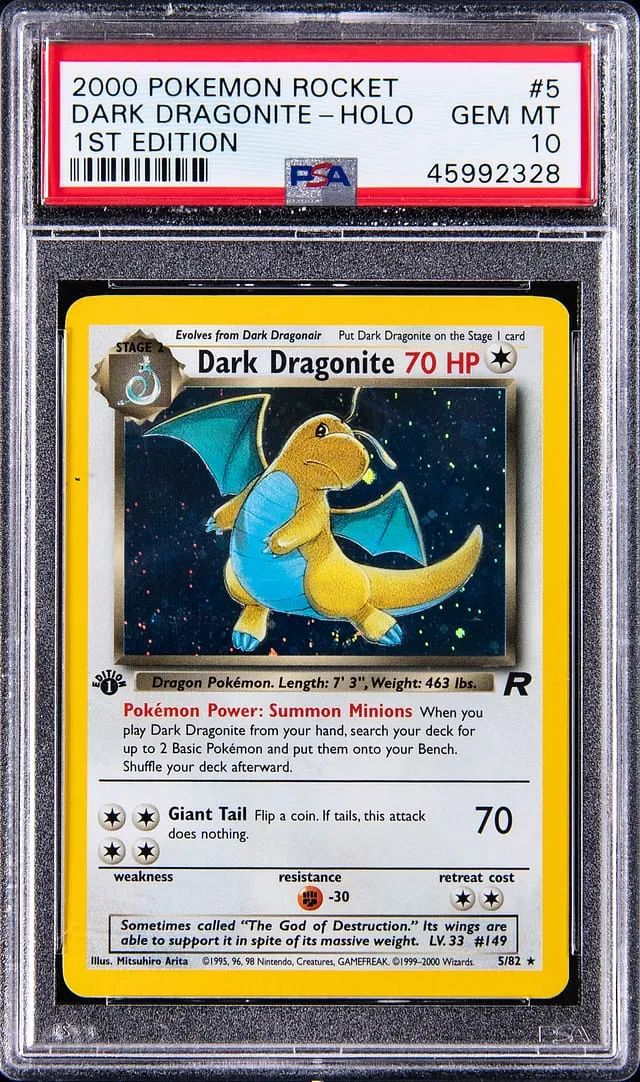
2000 Dark Dragonite PSA 10 Team Rocket Sale at Goldin
A 2000 Pokémon Team Rocket 1st Edition Holo Dark Dragonite PSA 10 sold for $19,155 at Goldin. See how this result fits recent WotC Pokémon sales.
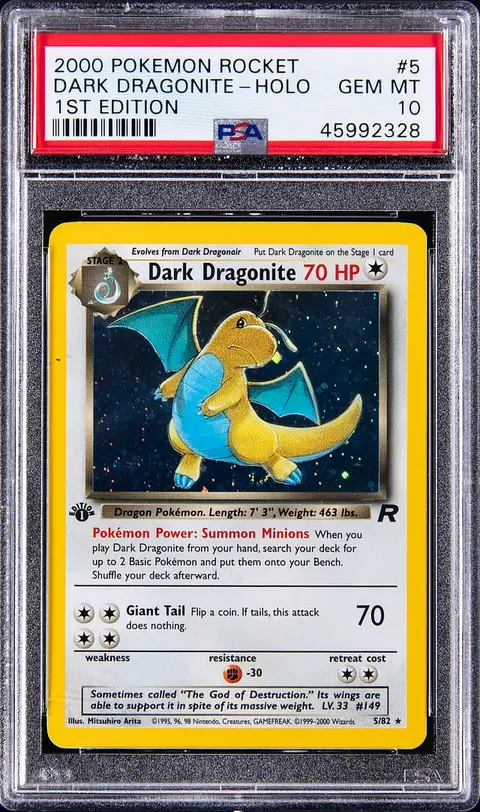
Sold Card
2000 Pokemon Team Rocket 1st Edition Holo #5 Dark Dragonite - PSA GEM MT 10
Sale Price
Platform
Goldin2000 Pokémon Team Rocket 1st Edition Holo #5 Dark Dragonite in PSA 10 just changed hands at Goldin on March 23, 2026 for $19,155. For a late‑WotC (Wizards of the Coast) era chase card, that’s a meaningful data point for collectors who track high‑end Pokémon.
Card snapshot
- Character: Dark Dragonite
- Year: 2000
- Set: Pokémon Team Rocket (English)
- Edition: 1st Edition
- Card number: #5
- Variant: Holographic (Holo)
- Publisher era: WotC
- Grading company: PSA (Professional Sports Authenticator)
- Grade: GEM MT 10 (PSA’s highest standard grade)
- Key issue? Yes – one of the headline holos from the Team Rocket set and a key Dark‑era Dragonite.
This is not a rookie card in the sports sense, but within Pokémon it is considered a core, early Dragonite appearance from a beloved villain‑focused expansion.
Why this card matters to collectors
1. Team Rocket set appeal
The English Team Rocket set is remembered for several things:
- It was the first English set to introduce Dark Pokémon, tying directly into the Team Rocket storyline.
- It features a dark, grittier take on fan‑favorite species like Charizard, Blastoise, and Dragonite.
- The 1st Edition print run (marked by the 1st Edition stamp) is widely understood to be more limited than Unlimited, and is the version most long‑term collectors target.
Within that context, Dark Dragonite Holo #5 is one of the set’s more important cards. Dragonite has had steady, long‑running collector demand thanks to its role in the original video games, the anime, and its status as a pseudo‑legendary Pokémon from the Kanto era.
2. Early‑era Holo Dragonite
Dragonite’s earliest key English cards come from:
- Fossil (notably the non‑holo rare and holo versions)
- Team Rocket’s Dark Dragonite
These early WotC holos are what many collectors consider the “foundation” of Dragonite collecting. They pre‑date the explosion of modern alternate arts and secret rares, and they carry strong nostalgia for players who grew up with the 1999–2001 era of the TCG.
3. The PSA 10 factor
While PSA population reports ("pop reports"—public counts of how many copies exist in each grade) can change over time, PSA 10 examples of early WotC holos generally remain scarcer than lower grades because:
- Print quality and centering were less consistent in the early 2000s.
- Holographic surfaces are prone to scratching and print lines.
- Many copies were handled by kids rather than sleeved immediately.
As a result, PSA GEM MT 10 is treated by many collectors as the “trophy grade” for this kind of card. It often commands a multiple over PSA 9 or raw (ungraded) copies.
Market context and recent sales
When collectors talk about “comps”, they mean comparable recent sales used for context, not guarantees of value. For this card, useful comps include:
- Other PSA 10 copies of 2000 Team Rocket 1st Edition Dark Dragonite (Holo)
- The same card in PSA 9 and PSA 8, to understand the grade premium
- Closely related Dragonite cards from the same era in high grades
Across major marketplaces and auction houses, PSA 10 Dark Dragonite 1st Edition has historically:
- Sold at a clear premium to PSA 9, often several times higher than 9s depending on auction dynamics, timing, and visibility.
- Shown some variability from sale to sale, reflecting the relatively small number of high‑grade transactions at the top of the market.
This $19,155 result on Goldin sits in the upper tier of what has been seen for this card in Gem Mint condition in recent periods, though actual realized prices can vary with:
- How prominently an auction house features the card in its catalog
- Overall sentiment in the Pokémon market at that particular time
- Bidding competition among a small group of focused Dragonite, Team Rocket, or WotC specialists
Rather than reading any single sale as a prediction, many experienced collectors log these realized prices over time to build their own sense of where the card tends to cluster.
Understanding the price in context
A few angles that collectors and small sellers might consider when looking at a result like this:
1. Early‑era vs. modern ultra‑rares
Compared to modern chase cards—like alternate arts, gold rares, or low‑printed secret rares—WotC holos like Dark Dragonite carry:
- Deep nostalgia: rooted in the first wave of Pokémon’s global popularity.
- Known age: 20+ years of history in the hobby.
- Established grading patterns: Collectors have years of PSA population and pricing data to examine.
That said, they are not “unlimited” in demand. Interest can and does ebb and flow, and high‑end results tend to be driven by a limited number of determined bidders.
2. Grade spread and accessibility
If you like this card but a PSA 10 is out of reach, lower grades often provide more accessible entry points:
- PSA 9: Usually offers strong eye appeal with minor flaws and has historically traded for a fraction of PSA 10 prices.
- PSA 8 and below: Often targeted by collectors who focus on the artwork and nostalgia more than the registry or top‑grade chase.
Watching sales across the grade ladder helps build a realistic view of how condition influences realized prices.
3. Role of the auction house
This specific copy closed at Goldin on March 23, 2026. Larger auction houses:
- Aggregate high‑end inventory, which can bring more eyes and deeper bidder pools to marquee items.
- Provide consistent, public realized prices that many collectors reference as benchmarks.
Those factors can sometimes support stronger outcomes for high‑profile cards, especially when they are presented alongside other premium WotC and early‑era Pokémon pieces.
Collector significance going forward
From a purely collecting standpoint, this card continues to check important boxes:
- Era: Early WotC, firmly in what many consider Pokémon’s “classic” period.
- Set: Team Rocket, with its distinctive dark theme and villain storyline.
- Character: Dragonite, a long‑standing fan favorite with consistent demand.
- Grade: PSA 10 GEM MT, representing the top of the condition spectrum for this issue.
For registry builders—collectors who compete to build high‑grade set runs tracked by grading companies—owning a PSA 10 Dark Dragonite 1st Edition Holo can be a key piece of a top‑tier Team Rocket set.
For character collectors, it stands as one of the most recognizable early Dragonite artworks, sitting alongside the Fossil and later e‑Series iterations.
Takeaways for new and returning collectors
If you are newer to the hobby or returning after a break, here are a few practical observations from this sale:
- Condition matters a lot. The jump from PSA 9 to PSA 10 can be significant, especially for popular WotC holos.
- Track multiple comps over time. One auction result, whether higher or lower than you expected, is most useful when viewed within a broader timeline of sales.
- Focus on what you enjoy. Data can inform your decisions, but nostalgia and personal preference often guide which cards collectors hold long‑term.
The $19,155 Goldin result for a 2000 Pokémon Team Rocket 1st Edition Holo #5 Dark Dragonite – PSA GEM MT 10 is another reference point in the evolving story of early‑era Pokémon. Whether you chase top‑graded examples or simply enjoy the artwork in a well‑loved binder copy, this card remains a central piece of Dragonite and Team Rocket history.