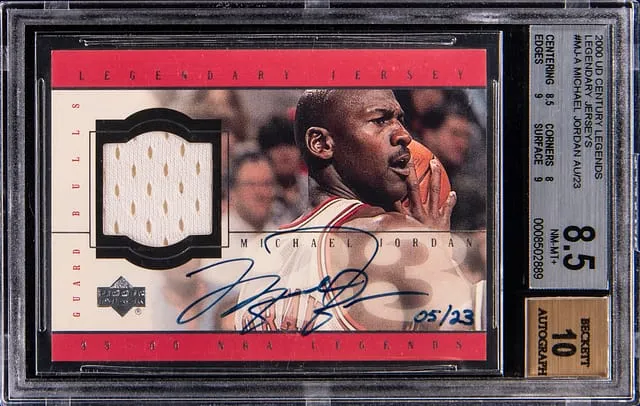
2000-01 MJ Legendary Jerseys Auto /23 Sells for $106K
Figoca looks at the $106,600 Goldin sale of a 2000-01 Upper Deck Century Legends Michael Jordan Legendary Jerseys Autographs card serial-numbered to 23.
Sold Card
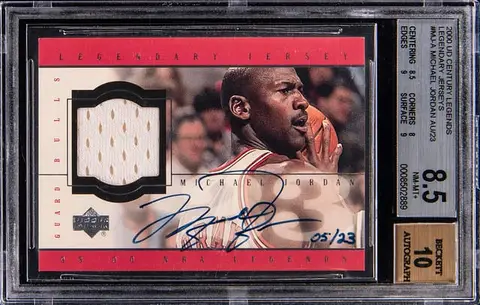
2000-01 Upper Deck Century Legends Legendary Jerseys Autographs #MJ-A Michael Jordan Signed Relic Card (#05/23) - BGS NM-MT+ 8.5, Beckett 10
Sale Price
Platform
GoldinA low‑numbered Michael Jordan autograph relic from the early 2000s just changed hands, giving collectors another data point on one of the more respected post‑playing‑days Jordan issues.
On May 10, 2026, at Goldin, a 2000-01 Upper Deck Century Legends Legendary Jerseys Autographs #MJ-A Michael Jordan Signed Relic Card, serial‑numbered 05/23 and graded BGS NM-MT+ 8.5 with a Beckett 10 autograph, sold for $106,600.
In this breakdown, we’ll walk through what this card is, why collectors care about it, and how this sale fits into the broader Jordan auto and game‑used market.
Card overview: what exactly sold at Goldin
Card: 2000-01 Upper Deck Century Legends Legendary Jerseys Autographs
Card number: #MJ-A
Player: Michael Jordan
Team (pictured): Chicago Bulls (retrospective “Legends” theme)
Serial numbering: 05/23 (only 23 copies produced)
Attributes:
- On-card autograph (Jordan signed directly on the card surface)
- Game-used jersey relic embedded in the card
- Legendary insert from a premium Upper Deck “Legends” product
Grading details:
- Card grade: BGS 8.5 (NM-MT+, Near Mint-Mint Plus)
- Autograph grade: Beckett 10 (Gem Mint auto)
This is not a rookie card—Jordan’s true rookies are from 1984-85 Star and 1986-87 Fleer—but it is a key early‑era certified autograph and relic. For many collectors, that combination of on-card signature, game-used material, and a low print run makes it function as a “grail‑type” Jordan from the post‑playing years.
Set context: 2000-01 Upper Deck Century Legends
Upper Deck Century Legends was designed as a retrospective product, celebrating greats across basketball history. The Legendary Jerseys Autographs subset is where the product gets especially serious for high‑end collectors:
- Short print run: This Jordan is numbered to just 23 copies, echoing his jersey number. For a flagship legend like Jordan, /23 is meaningfully scarce.
- On-card auto + relic: In an era when sticker autographs were already becoming common, having Jordan’s signature directly on the card alongside a game-used jersey swatch adds weight.
- Turn-of-the-millennium timing: Early 2000s Jordan autos still feel closer to his playing days than many later issues. They sit in a bridge era between vintage/90s inserts and today’s ultra-modern patch autos.
Within the broader Jordan market, this card isn’t as widely recognized as the 90s PMG (Precious Metal Gems) or key inserts, but among autograph and relic-focused collectors it’s considered a serious, low-population piece.
Why collectors care about this particular Jordan
Several factors help this card stand out:
1. Ultra-low serial numbering (/23)
While modern products routinely feature cards numbered to 25, 10, or even 1, early 2000s on-card Jordan autos with game-used pieces and such a tight print run remain relatively scarce. The 05/23 serial indicates one of only 23 copies made.
For collectors looking beyond rookies, Jordan autos numbered to his jersey number are often treated as “core PC” (personal collection) targets.
2. On-card autograph with Beckett 10 grade
An autograph grade of 10 from Beckett tells us the signature is strong—no smudging, no noticeable fading, and fully within the signing area. That matters because:
- Jordan’s pen pressure and ink flow varied over the years.
- Some early 2000s autos can show streaking or light spots.
Pairing a strong auto grade with a solid overall card grade (BGS 8.5) positions this copy cleanly in the “high-end, but not so perfect you never want to handle it” category.
3. Game-used jersey relic
The embedded jersey piece ties the card back to Jordan’s on-court career. For many collectors, game-used material feels more tangible than a photo alone, especially when paired with a clean on-card signature.
When you put all of this together—short print, on-card auto, game-used piece, and a respected early 2000s Upper Deck product—you have a card that fits very well in a serious Jordan collection even though it isn’t from his rookie era.
Market context: how does $106,600 fit in?
The realized price at Goldin was $106,600.
Because this is a low‑population card with only 23 copies made, public sales are naturally sparse. That means we don’t see frequent auction results the way we do for, say, 1986 Fleer Jordan rookies, which trade regularly in most grades.
Instead, we rely on:
- Occasional appearances at major auction houses (Goldin, PWCC, Heritage, etc.).
- Any traceable private sales that leak into market discussions.
For closely related Jordan cards—early 2000s on-card autos with game-used relics and tight serial numbering—the trend over the last few years has generally been:
- Strong upside from the mid‑2010s into the 2020–2021 boom.
- Some retracement afterward as the broader market cooled.
- More recently, stabilization for truly scarce, on-card Jordan autos with a premium story and tight numbering.
Within that framework, a six‑figure price for this BGS 8.5 /23 copy is consistent with how the market has been treating:
- Other low‑numbered, high‑grade Jordan on-card autos.
- Comparable game-used autograph issues from the early 2000s.
Because each copy may differ slightly (centering, surface, jersey piece quality), and because the total population is so small, it’s hard to call this sale strictly “high” or “low” compared to an exact price band. Instead, it fits into the upper tier of Jordan auto‑relic pricing where:
- Scarcity supports values.
- Condition and presentation matter.
- Individual auction performance can still swing a bit based on timing and bidder interest.
Grading and scarcity: what does a BGS 8.5 / auto 10 mean here?
For modern and early‑modern cards, collectors often lean heavily on the pop report (short for population report), which shows how many copies have received each grade from a grading company.
Even without exact pop numbers in front of us, we can draw some fair conclusions:
- With only 23 copies total, the absolute number of graded examples will be low.
- High-grade copies with a 10 auto are especially desirable for collectors who are picky about presentation.
BGS 8.5 is typically considered:
- A very respectable grade for thicker, memorabilia-style cards, which often have edge and corner challenges right out of the pack.
- A level where eye appeal can still be excellent, particularly if subgrades (centering, corners, edges, surface) are balanced.
For cards like this, many collectors prioritize:
- Authenticity and strength of the autograph.
- Overall presentation and scarcity.
- Incremental grade differences (8.5 vs 9) as a secondary factor, especially if the price break between grades gets very large.
Collector takeaways
For newer and returning collectors trying to understand this sale, a few practical points:
This isn’t a rookie, but it is a key Jordan auto-relic.
If you’re mapping the Jordan landscape, this card sits in the high‑end autograph and memorabilia lane, not the rookie lane.Short print plus on-card auto matters.
When you hear collectors talk about “SP” (short print) or “true scarcity,” they’re often referring to cards like this—limited production, key player, no obvious direct replacement.Comps will be thin.
“Comps” are comparable recent sales used for price context. For a /23 card, there simply aren’t many clean comps, especially in the same grade. That’s normal for this kind of piece.Auction context matters.
This sale happened through Goldin on May 10, 2026, which routinely attracts serious high‑end basketball bidders. That audience can help surface the stronger end of current demand.Think tiers, not exact dollar predictions.
Instead of fixating on whether this should be $10,000 higher or lower, it’s more useful to note the tier: this is a six‑figure Jordan auto‑relic in a stabilized, collector‑driven segment of the market.
How this compares to other Jordan options
For someone building a Jordan-focused collection, this sale highlights the trade-offs between different categories:
Rookie cards (1984-85 Star, 1986-87 Fleer):
- Higher transaction volume and more grading data.
- Wide grade and price ladder, from well-used copies to high‑grade centerpieces.
90s inserts and parallels (e.g., PMG, Jambalaya, etc.):
- Often non-autographed but highly chased for design and rarity.
- Very condition-sensitive and visually distinctive.
Autograph and relic issues like this 2000-01 Century Legends card:
- Emphasis on on-card signatures, game-used material, and low serial numbering.
- Fewer public sales and a more “thin” market—each auction can be its own event.
This Goldin result reinforces that premium, low‑print Jordan autos with clean presentation continue to command strong attention, even as the overall hobby becomes more selective.
Final thoughts
The $106,600 sale of the 2000-01 Upper Deck Century Legends Legendary Jerseys Autographs #MJ-A Michael Jordan Signed Relic Card (#05/23), graded BGS 8.5 with a Beckett 10 autograph, underscores how:
- Early 2000s on-card Jordan autos with game-used pieces and tight numbering remain an important lane for serious basketball collectors.
- Scarcity and card quality still matter in a market that has largely cooled from peak hype.
- Thin supply means each auction result becomes a meaningful reference point rather than just another comp.
For collectors tracking Jordan’s long-term market, keeping tabs on sales like this—especially at established houses such as Goldin on dates like May 10, 2026—helps build a clearer picture of where the most coveted MJ autograph relics are currently settling.