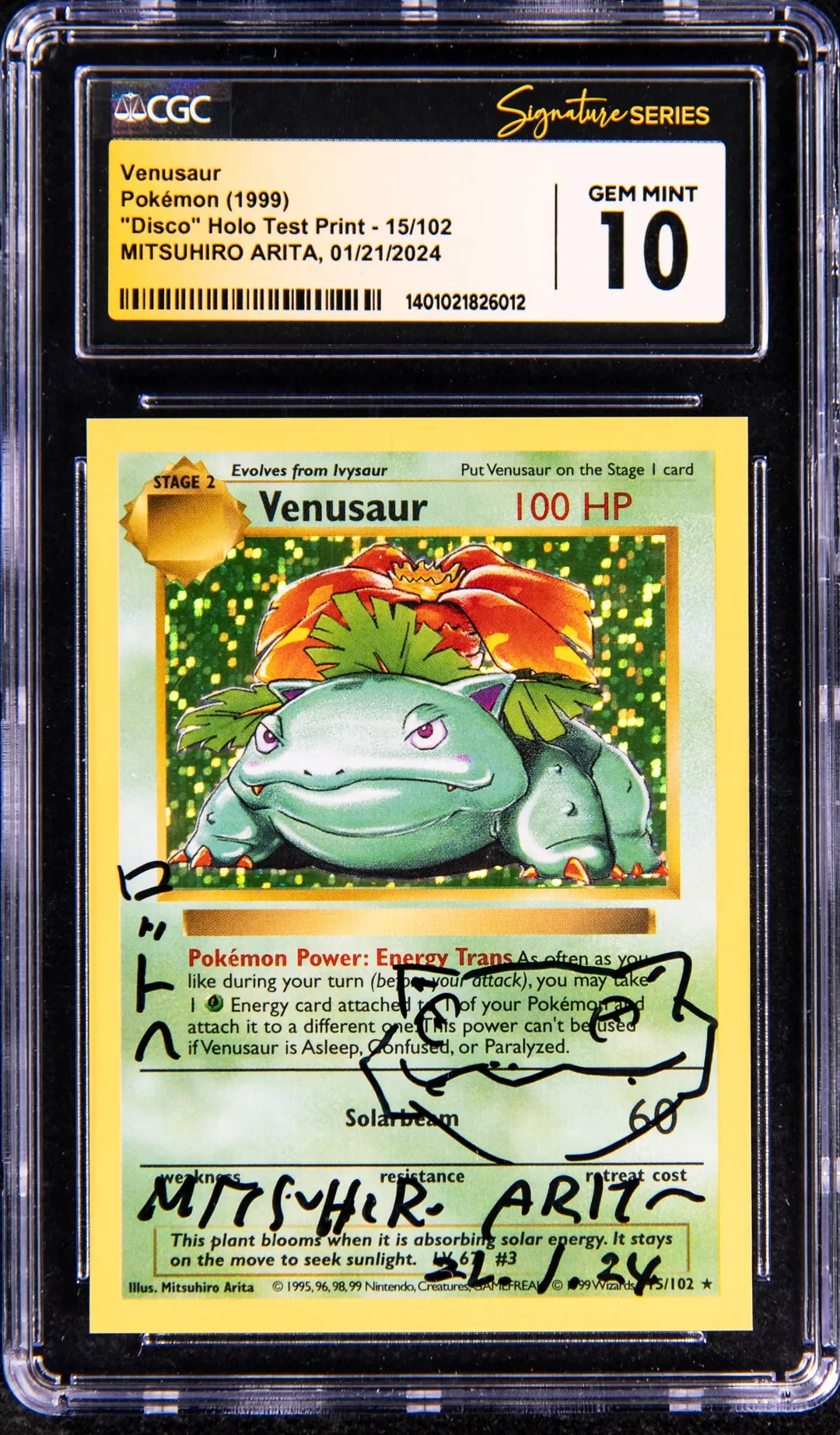
1999 Venusaur Disco Holo Test Print Sells for $16K
A CGC 10 Mitsuhiro Arita-signed 1999 Venusaur Disco Holo Test Print sold for $16,134 at Goldin. Here’s what that means for Pokémon collectors.
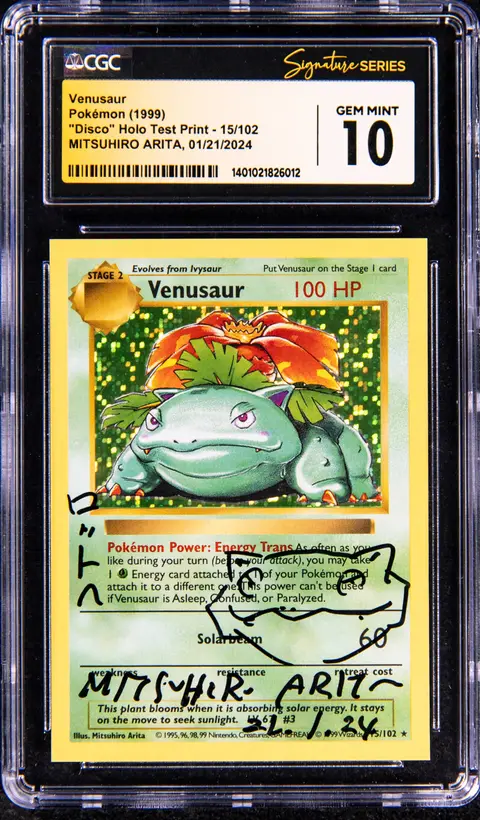
Sold Card
1999 Pokemon Base Set Disco Holo Test Print #15 Venusaur, Signed, Sketched by Mitsuhiro Arita - CGC Signature Series GEM MINT 10
Sale Price
Platform
Goldin1999 Pokémon Base Set Disco Holo Test Print Venusaur Sets a Benchmark at Goldin
On February 16, 2026, Goldin closed a notable sale for a niche but important piece of Pokémon TCG history: a 1999 Pokémon Base Set Disco Holo Test Print #15 Venusaur, signed and sketched by illustrator Mitsuhiro Arita, graded CGC Signature Series GEM MINT 10. The card realized $16,134 USD.
For collectors who focus on rarity, test prints, and artist-signed pieces, this sale is a useful data point in an area of the market that doesn’t trade often, but attracts serious attention when it does.
What exactly is this Venusaur?
Let’s break down the card step by step:
- Character: Venusaur
- Year: 1999 (Base Set era)
- Set / Type: Pokémon Base Set "Disco Holo" Test Print
- Card number: #15 (matching the classic Base Set Venusaur numbering)
- Attributes:
- Test print / experimental holofoil treatment
- Signed by Mitsuhiro Arita (original illustrator of Base Set Venusaur)
- Sketched by Arita on the card (hand-drawn art, not printed)
- Grading company: CGC (Certified Guaranty Company)
- Grade: CGC Signature Series GEM MINT 10
- Signature Series indicates CGC authenticated the autograph and sketch
- GEM MINT 10 is CGC’s highest standard numeric grade
This is not a standard pack-pulled Base Set Venusaur. It’s a pre-production or experimental printing (often called a "test print") with a distinctive disco-style holofoil pattern, combined with a certified on-card signature and sketch.
Why test prints and Arita autos matter
Test prints sit in an interesting corner of the hobby. They are usually:
- Very limited in number
- Not distributed through normal booster packs
- Often used internally during production, experimentation, or proofing
For Pokémon, test prints from the Base Set era are especially watched because they sit at the very beginning of the TCG’s global boom. They connect directly to:
- The first generation of Pokémon
- The original Wizards of the Coast production period
- The earliest visual identity of the game
Layered on top of that is Mitsuhiro Arita’s role. He illustrated many of the most iconic early cards, including Base Set Charizard, Blastoise, and Venusaur. His signature and sketches have become a collecting lane of their own, similar to on-card autographs in sports cards.
Arita-signed and sketched cards typically command:
- A meaningful premium over unsigned copies
- Additional interest from collectors who focus on the artist rather than just the card
CGC Signature Series GEM MINT 10: why the grade and label matter
CGC has built a strong footprint in Pokémon and TCG grading. A few details are important here:
- Signature Series: CGC witnesses and authenticates the signing event (or proves chain of custody), then encapsulates the card with a special label. This removes a lot of doubt about whether a signature is genuine.
- GEM MINT 10: A high-end grade that suggests:
- Clean surfaces
- Sharp corners
- Strong centering
On a test print that may have unusual handling or origins, a GEM MINT 10 is not guaranteed, so it sits at the very top tier for condition.
Market context and price landscape
Because this is a niche test print, exact “like-for-like” comparables (comps) are limited. In the hobby, "comps" are recent, confirmed sales of the same or very similar items that help set expectations for value.
Across major auction archives and marketplace records, you’ll see more frequent data points for:
- Standard Base Set Venusaur (1st Edition, Shadowless, Unlimited) in PSA or CGC 9–10
- Arita-signed standard Base Set Venusaur and Charizard
- Other specialty items like Artist Proofs, signed prints, and different test or promo cards from the same era
But true Disco Holo or similar Base Set test prints—especially signed and sketched with a top grade—show up far less often. When they do, the realized prices typically:
- Clear standard graded copies by a wide margin
- Behave more like art pieces or prototypes than like conventional TCG singles
In that context, the $16,134 sale at Goldin sits in a tier consistent with other high-end Arita-illustrated, early-era Pokémon pieces with strong provenance and presentation. Rather than being an outlier in a consistent price ladder, it’s one of the relatively few concrete public data points for this very specific type of card.
How this sale fits into broader Pokémon trends
Pokémon from the late-1990s—often grouped as the "vintage" era—generally benefits from:
- Established nostalgia from original players and collectors
- Finite supply, especially for unusual items like test prints
- Ongoing interest in the franchise across games, anime, and new TCG sets
Within that landscape:
- Base Set remains the foundational era. Its characters and artworks are instantly recognizable, even to casual fans.
- High-end niche pieces have moved toward an art-collectible lane. Test prints, art cards, and signed/sketched cards are often treated more like original art or production history than like simple game pieces.
This Venusaur test print checks those boxes:
- Direct link to the original Base Set
- Unique production style (disco holo)
- Signed and sketched by the original artist
- Authenticated and preserved in a high-grade slab
Collector takeaways
For newcomers, this sale underscores a few themes that are helpful when exploring beyond standard set cards:
Not all 1999 Venusaur cards are the same. Test prints, promos, and signed copies can differ dramatically in rarity and price from regular pack-pulled versions.
Artist-signed and sketched cards form their own segment. As with sports card autographs, an authenticated signature can transform how a card is collected and evaluated.
Data is thinner at the top end. When you look at niche, high-end pieces like this Disco Holo test print, there will always be fewer comps. That makes each public sale—like this Goldin result on February 16, 2026—especially useful as a reference point.
Context matters more than headlines. A price like $16,134 can look high or low depending on what you are comparing it to. For standard Base Set Venusaur, it’s far above most graded copies. For unique test prints and original-artist items from 1999, it fits into a growing pattern of collectors prioritizing scarcity, provenance, and art.
How small collectors and sellers can use this information
If you’re a smaller collector or seller, you don’t need to own a test print to learn from this sale:
- Pay attention to provenance. Knowing where a card came from—especially for oddities and pre-production items—matters a lot.
- Track niche segments over time. High-end signed or test print cards might not trade every month, but when they do, each sale helps you understand the direction of that part of the market.
- Think in tiers. Standard Base Set, stamped promos, signed copies, and test prints all sit on different rungs of the ladder. Understanding those tiers makes it easier to price and prioritize your own collection.
The 1999 Pokémon Base Set Disco Holo Test Print #15 Venusaur, signed and sketched by Mitsuhiro Arita and graded CGC Signature Series GEM MINT 10, is a strong example of how deep a single card can go: early-era history, experimental printing, original-artist involvement, and top-tier grading all in one slab.
For figoca users, this Goldin sale on February 16, 2026 is a reference point worth bookmarking whenever you’re evaluating rare test prints, high-end Arita signatures, or other early Pokémon art pieces that blur the line between card and collectible art.