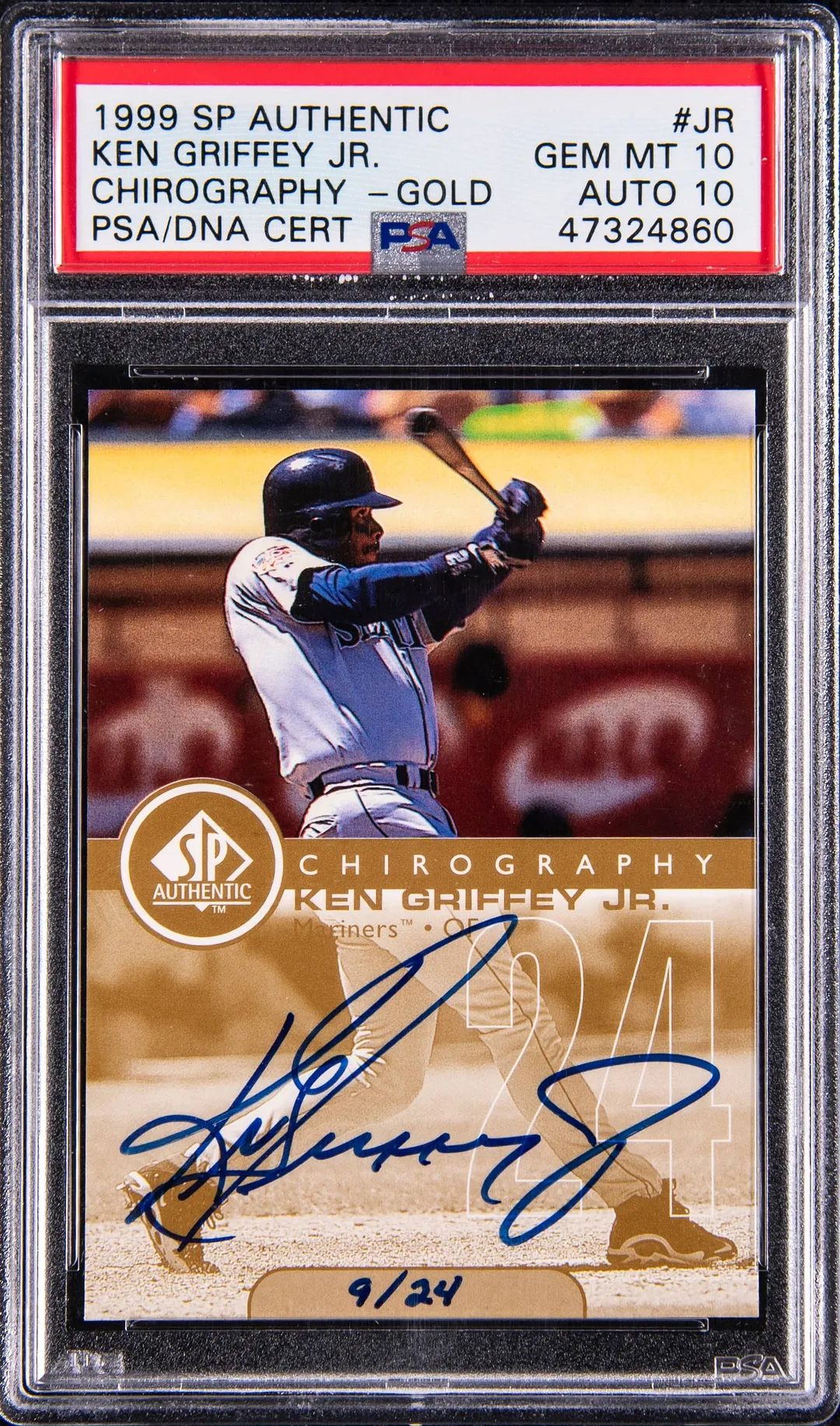
1999 SP Authentic Griffey Jr. Gold Auto PSA 10 Pop 1 Sale
Breakdown of the $301,950 Goldin sale for the 1999 SP Authentic Chirography Gold Ken Griffey Jr. PSA 10/10 Pop 1 on-card autograph.
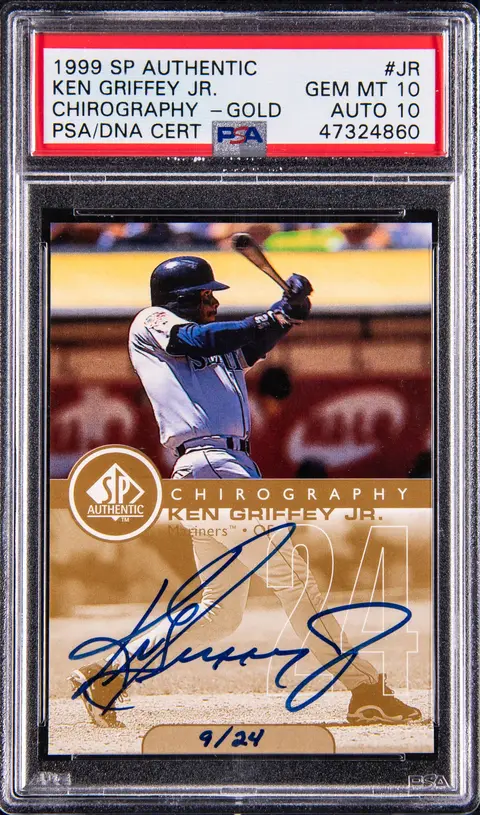
Sold Card
1999 Upper Deck SP Authentic Chirography Gold #JR Ken Griffey Jr. Signed Card (#09/24) - PSA GEM MT 10, PSA/DNA GEM MT 10 - Pop 1
Sale Price
Platform
Goldin1999 Upper Deck SP Authentic Chirography Gold #JR Ken Griffey Jr. Signed Card (#09/24) - PSA GEM MT 10, PSA/DNA GEM MT 10 - Pop 1 Realized Price: $301,950
Sold at auction by: Goldin
Sale date (UTC): 2026-02-08
For many Griffey collectors, 1990s on-card autographs sit at the sweet spot where nostalgia, scarcity, and design all intersect. The 1999 Upper Deck SP Authentic Chirography Gold #JR Ken Griffey Jr. is a textbook example—and this specific copy pushes that idea as far as it can go.
In this article, we’ll walk through what this card is, why it matters in the Griffey and 1990s autograph landscape, and how the recent $301,950 sale at Goldin fits into the broader market.
The card at a glance
- Player: Ken Griffey Jr.
- Team: Seattle Mariners
- Year: 1999
- Set: Upper Deck SP Authentic – Chirography Gold
- Card number: #JR
- Parallel: Gold, serial-numbered 09/24 (only 24 copies produced)
- Autograph: On-card (signed directly on the card’s surface)
- Grading:
- Card: PSA GEM MT 10 (highest standard PSA grade)
- Autograph: PSA/DNA GEM MT 10 (highest grade for the signature)
- Population: Pop 1 – the only example in the PSA population report at this dual 10 level at the time of sale.
This isn’t a rookie card—Griffey’s key rookies are from 1989 (notably 1989 Upper Deck #1)—but within the 1990s premium autograph lane, SP Authentic Chirography Gold is treated as a true chase card.
Why SP Authentic Chirography Gold matters
SP Authentic in the late 1990s helped define what a “premium, serial-numbered, on-card autograph” looked and felt like in baseball.
A few key reasons collectors care about Chirography Gold:
Low serial numbering – At /24, the Gold parallel is exceptionally limited for a late-1990s mainstream product. For context, many 1990s inserts and parallels were printed far more heavily.
On-card autograph – The signature is on the card itself rather than on a sticker later applied to the card. Many collectors prioritize on-card autos for aesthetics and authenticity.
Era and aesthetic – 1990s SP Authentic has a distinct, clean look that pairs well with bold blue ink. For Griffey, whose autograph is widely regarded as one of the best-looking in the hobby, this matters.
Established star, not prospect risk – By 1999, Griffey Jr. was already a proven superstar. These autos were printed for fans of a generational player, not as speculative prospect tickets. That difference affects how collectors treat long-term desirability.
In short, this card sits in the “key veteran on-card auto” category for the decade.
Grading, scarcity, and why Pop 1 matters
When collectors talk about a “pop report,” they’re referring to the grading company’s population report—a count of how many copies of a specific card exist in each grade.
For this Griffey:
Card grade: PSA 10 (GEM MT)
This means PSA found virtually no flaws: sharp corners, clean edges, strong centering, and a clean surface.Autograph grade: PSA/DNA 10 (GEM MT)
A grade of 10 for the autograph indicates a bold, well-centered, smear-free signature.Pop 1 at this dual 10 level
As of the time of the sale, PSA’s population report shows this as the only copy with both a PSA 10 card grade and PSA/DNA 10 auto grade. That doesn’t mean it’s the only copy of the card, but it’s the only one that has reached this maximum dual grade.
Given the card is already limited to 24 copies, a Pop 1 PSA 10/10 example is effectively the top of the pyramid for this issue.
Market context: where does $301,950 fit?
This card sold at Goldin on 2026-02-08 (UTC) for $301,950.
When looking at price context, collectors typically check “comps”—recent comparable sales of the same card, or closely related versions, to understand the going range.
For this card specifically, public sales data is very thin:
- The Gold parallel is only /24, so examples do not surface often on major auction platforms.
- Dual 10 graded examples (card 10 / auto 10) are even rarer; at Pop 1, this exact grading combo has no direct prior public comp.
Where we can find some directional context is in related categories:
- Other 1990s on-card Griffey autographs from premium brands (SP Authentic, Upper Deck, and similar), especially low-numbered parallels, have shown strong results over the past few years, particularly in high grades.
- High-end Griffey cards and autos—including rare refractors, low-numbered inserts, and early certified autographs—have seen consistent interest from dedicated player collectors and broader 1990s insert/autograph specialists.
Within that landscape, a Pop 1 /24 Gold on-card auto in PSA 10 with a 10 auto grade naturally sits near the top tier of Griffey’s late-90s autograph portfolio. The $301,950 result reflects that premium position.
Because this is a one-of-one in the PSA pop report at this grade level, it functions as a kind of price discovery event: it helps set a reference point for how the market collectively values the absolute best version of this specific card.
How this fits into the Griffey and 1990s market
Ken Griffey Jr. has a unique place in the hobby:
- Era icon: Griffey is arguably the defining face of 1990s baseball cards, from the 1989 Upper Deck rookie through his run of inserts and autos.
- Hall of Fame and milestones: His Hall of Fame status and milestone career lines have long since removed any performance uncertainty. That typically makes his market more stable and collector-driven rather than speculative.
- Cross-generational appeal: Collectors who were kids in the early 1990s are now seasoned hobbyists with more discretionary income, often returning to pick up the cards they could never afford growing up.
In parallel, the broader 1990s insert and autograph market has matured significantly:
- Short-printed inserts and autographs from this decade, once overshadowed by modern low-serial cards, are now more widely recognized for their relative scarcity and historical importance.
- Premium Griffey cards from the late 1990s have been a focal point of that trend.
This sale fits that narrative: it shines a light on how the market is valuing truly elite, low-serial, on-card autographs of established Hall of Famers from the 1990s.
What collectors and small sellers can take from this
A few practical takeaways, without drifting into prediction or advice:
True scarcity plus top grade can matter more than print era.
Even though 1999 isn’t “vintage,” a /24, Pop 1 GEM MT 10/10 card is genuinely scarce in a way that resonates with advanced collectors.High-end 1990s autos are not interchangeable.
A common 1990s auto with higher print runs behaves very differently from a carefully numbered, premium-brand issue like SP Authentic Chirography Gold.Grading strategy is important for rare, condition-sensitive cards.
With thin stock, foil, and dark backgrounds, 1990s premium cards can be difficult in high grade. That’s part of why a PSA 10/10 example commands attention.Context is crucial when reading big sales.
This $301,950 result at Goldin on 2026-02-08 reflects a very particular combination: low serial number, iconic player, recognized brand, and Pop 1 dual 10 status. It should be compared primarily to similarly scarce, similarly graded Griffey or 1990s star autos, not to mass-produced autographs.
Final thoughts
The 1999 Upper Deck SP Authentic Chirography Gold #JR Ken Griffey Jr. auto is one of those cards that quietly defined what 1990s premium baseball could be: limited, on-card, and focused on a generational talent.
This specific copy—numbered 09/24 and graded PSA GEM MT 10 with a PSA/DNA GEM MT 10 autograph, Pop 1—represents the top of the mountain for the issue. Its $301,950 sale at Goldin on 2026-02-08 (UTC) provides a clear datapoint for how the modern hobby values truly best-in-class examples from the late-1990s autograph boom.
For Griffey collectors, it stands as a reference piece. For 1990s specialists, it’s another sign that the era’s most important autographs are firmly established as key cards in the long-term baseball card story.