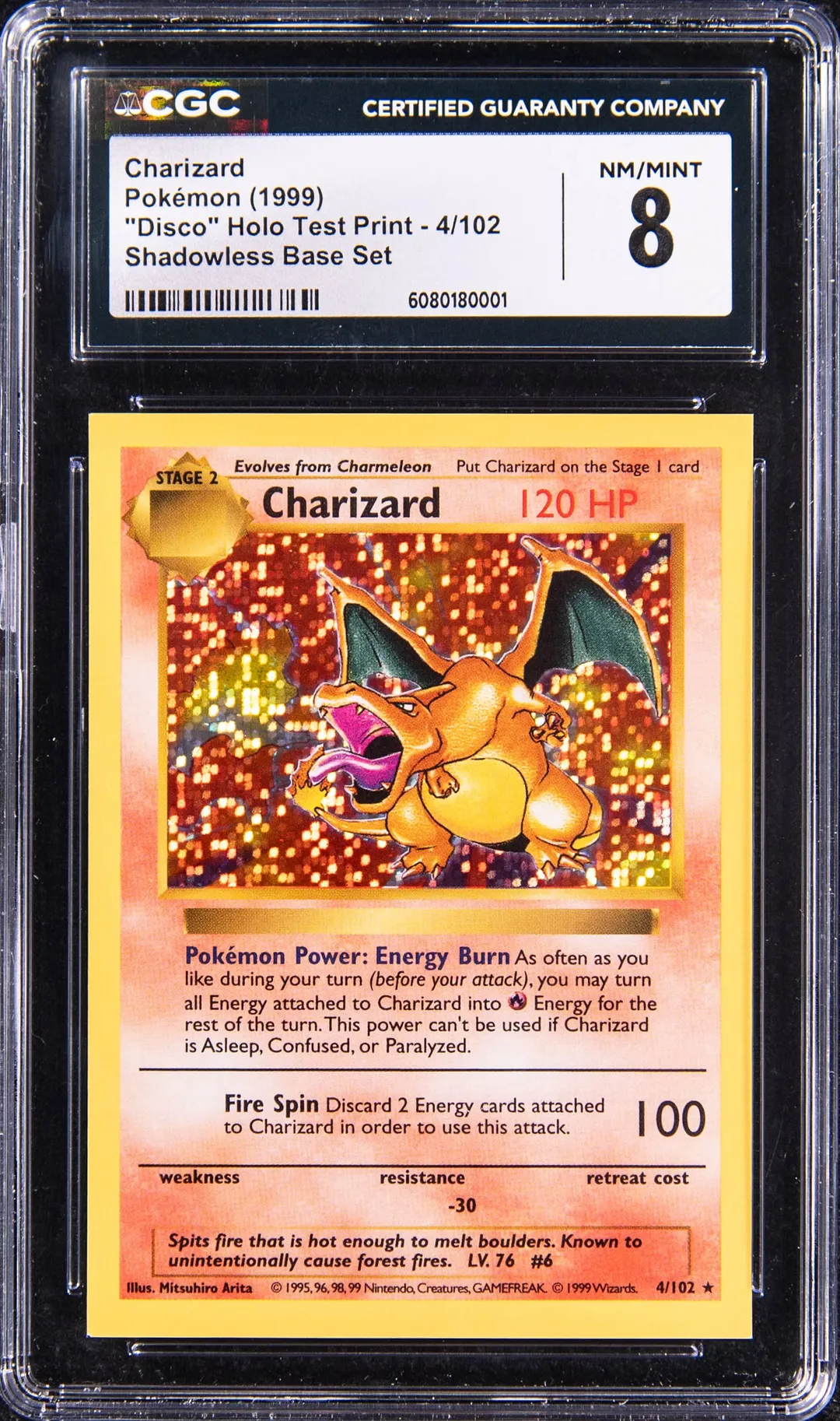
1999 Shadowless Disco Holo Test Print Charizard Sale
Goldin sold a 1999 Shadowless Disco Holo Test Print #4 Charizard CGC 8 for $38,440. See what this rare test print means for Pokémon collectors.
Sold Card
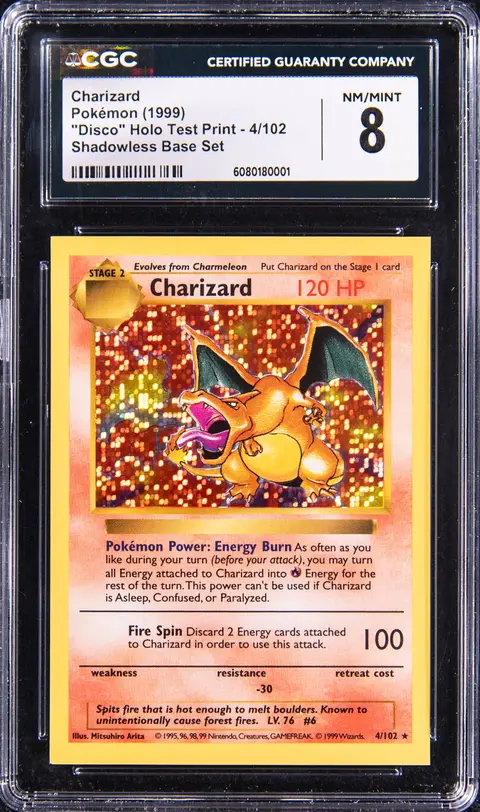
1999 Pokemon Base Set Shadowless Disco Holo Test Print #4 Charizard - CGC NM-MT 8
Sale Price
Platform
Goldin1999 Pokemon Base Set Shadowless Disco Holo Test Print #4 Charizard - CGC NM-MT 8 Sells for $38,440
On February 16, 2026, Goldin auctioned a card that sits at the intersection of early Pokémon history and true test-print rarity: a 1999 Pokémon Base Set Shadowless Disco Holo Test Print #4 Charizard, graded CGC NM-MT 8, closing at $38,440.
Because information on these experimental pieces is scattered and often locked up in older hobby discussions and grading notes, it’s helpful to walk through what this card is, why collectors care, and how this sale fits into the broader market for early Charizard oddities.
What exactly is this Charizard?
Let’s break down the title and why each part matters:
- Year: 1999
- Game/Property: Pokémon TCG (Trading Card Game)
- Character: Charizard
- Set lineage: Base Set / Shadowless era
- Type: “Disco Holo” test print – an experimental foil/finish pattern, not a pack-issued production card
- Designation: “#4 Charizard” – mirroring the familiar 4/102 numbering from Base Set Charizard, but used here for a test print format
- Variant: Shadowless-style layout (no drop shadow behind the image box, an early print run characteristic)
- Grading company: CGC Trading Cards
- Grade: CGC 8 (NM-MT – Near Mint to Mint)
This is not a normal 1999 Base Set Charizard you’d find from a booster pack. It’s a test print: an internal or pre-production piece used to test a particular foil/ink/finish concept, here often referred to in the hobby as “disco holo” because of its distinctive, patterned shine.
Because test prints weren’t part of standard distribution, they sit in a very small, quirky niche of the market alongside things like sample cards, “no name” errors, and other production anomalies. They are usually scarce, inconsistently documented, and heavily dependent on hobby knowledge to fully understand.
Why collectors care about Disco Holo / test print Charizards
Charizard already sits at the top of the Pokémon hierarchy. Combine that with:
- Base Set era: 1999 Base Set is the original North American Pokémon release. Within that:
- Shadowless cards represent an earlier print run, generally scarcer than unlimited Base.
- Test print status: Test prints are not “chase cards” in the normal sense; they’re more like production artifacts. They appeal to collectors who care about:
- printing history
- oddball variants
- documenting how the TCG was produced
- Disco holo finish: The experimental foil pattern makes this card visually and technically distinct from standard holo Charizards.
In hobby terms, this is a key issue within the test-print lane, rather than a flagship rookie or a pack-pull grail. For collectors building:
- early Pokémon print history collections
- Charizard “character run” collections (every major variant of Charizard)
- or niche error/test print binders
…this card fills a very specific, hard-to-replace slot.
How does a CGC 8 fit into condition and grading context?
CGC uses a 10-point grading scale. A CGC 8 (NM-MT) indicates:
- light edge or corner wear
- minor surface scratches or print lines
- overall clean centering and presentation
For a normal, mass-produced Base Set Charizard, a CGC/PSA/BGS 8 is considered solid but not elite. For a test print, however, a few different realities come into play:
- Tiny population: Test prints are produced in very low numbers. Population reports (the grading company’s count of how many copies they’ve graded) for this exact Disco Holo Test Print Charizard are typically very small.
- Survivorship bias: Many test prints were never meant for general circulation. The ones that survive may have handling wear or storage marks that cap their grade.
- Relative focus on authenticity: For some collectors, the fact that the card is authentic and encapsulated by a major grading company can matter as much as, or more than, the specific numerical grade.
So while an 8 isn’t “gem mint,” for this kind of card it sits in a respectable tier where condition is strong enough for display, but the value still leans heavily on rarity and status as a test print.
Market context: where does $38,440 fit in?
The hammer price on Goldin was $38,440. Precise, apples-to-apples comps (comparable sales) for this exact Shadowless Disco Holo Test Print #4 Charizard in CGC 8 are very limited. That’s typical with test prints: the market doesn’t see them come up often, and grading distributions are uneven.
Given that scarcity, it’s more useful to compare this sale against:
- Other high-end, non-test Charizards, such as:
- 1st Edition Base Set Charizard in PSA 9 and 10
- Shadowless Charizard holos in high grade
- Other known test prints and pre-production Pokémon pieces when they surface.
Recent years have shown that:
- Top-tier, pack-issued Charizards (especially 1st Edition Base PSA 10) can command six-figure or higher prices in strong markets.
- Less conventional items—test prints, prototypes, unique errors—tend to have irregular sale histories. One sale can stand alone for years.
Against that backdrop, $38,440 places this card in a niche but clearly high-end lane:
- It’s well below the very top Charizard grails, which is expected; most collectors still prioritize pack-issued 1st Edition and trophy cards at the absolute top of the hierarchy.
- It’s strong for a non-production test piece, reflecting the combination of Charizard demand plus historical curiosity among advanced collectors.
Because the data set around Disco Holo test prints is small, it’s more accurate to say this sale confirms that the market recognizes these as serious collectibles, rather than to label it definitively high or low against an established benchmark.
Record and historical context
Within the broader Charizard market, the highest-profile sales are still:
- 1st Edition Base Set holo Charizard in gem mint grades
- trophy and prize cards with extremely small print runs
This Disco Holo Test Print isn’t chasing those records, but it does contribute to a secondary narrative:
- As core Charizard prices stabilized after the most intense 2020–2021 spikes, collector attention expanded to historical oddities—test runs, sample cards, and unusual print variants.
- Test prints like this help document how early Pokémon was engineered and refined. For some, that historical angle is as important as the character itself.
What this means for collectors and small sellers
For active hobbyists and small sellers, a one-off sale at this level isn’t a template, but it does offer a few practical takeaways:
Documentation matters.
- With test prints, clear identification—grading labels, auction descriptions, and provenance—adds confidence.
- If you think you’ve found an oddball or test-print-style card, it’s worth researching carefully and, when warranted, submitting to a major grader for authentication.
Niche markets can be deep, not broad.
- The buyer pool for a Disco Holo Test Print Charizard is much smaller than for a regular Base Set Charizard—but those buyers may be willing to compete aggressively when a card they rarely see comes to auction.
Price references (comps) are often thin.
- For mainstream cards, comps—recent, similar sales—give a fairly tight price range.
- For test prints, you might only have one or two historical sales, sometimes in different grades or with different grading companies. Expect more variance, and think in terms of ranges and narratives instead of a single “true value.”
Early-era Pokémon remains a foundation.
- Whether it’s standard holos, 1st Editions, or test prints, 1999–2000 Pokémon continues to be the focal point for many collectors.
- Cards that tell part of that early story—particularly Charizard cards—tend to draw sustained interest.
Final thoughts
The February 16, 2026 Goldin sale of the 1999 Pokémon Base Set Shadowless Disco Holo Test Print #4 Charizard - CGC NM-MT 8 at $38,440 underscores how diverse the high-end Pokémon market has become.
This isn’t just another Charizard holo; it’s an experimental piece that sits between design lab and finished product. For collectors who enjoy the production side of the hobby—how cards were tested, refined, and ultimately printed—it’s a meaningful artifact from the earliest days of Pokémon’s rise.
As always, any purchase decision should be guided by your own research, collecting goals, and comfort level. But as a data point, this sale adds another chapter to the ongoing story of how the hobby values history, rarity, and character all at once.