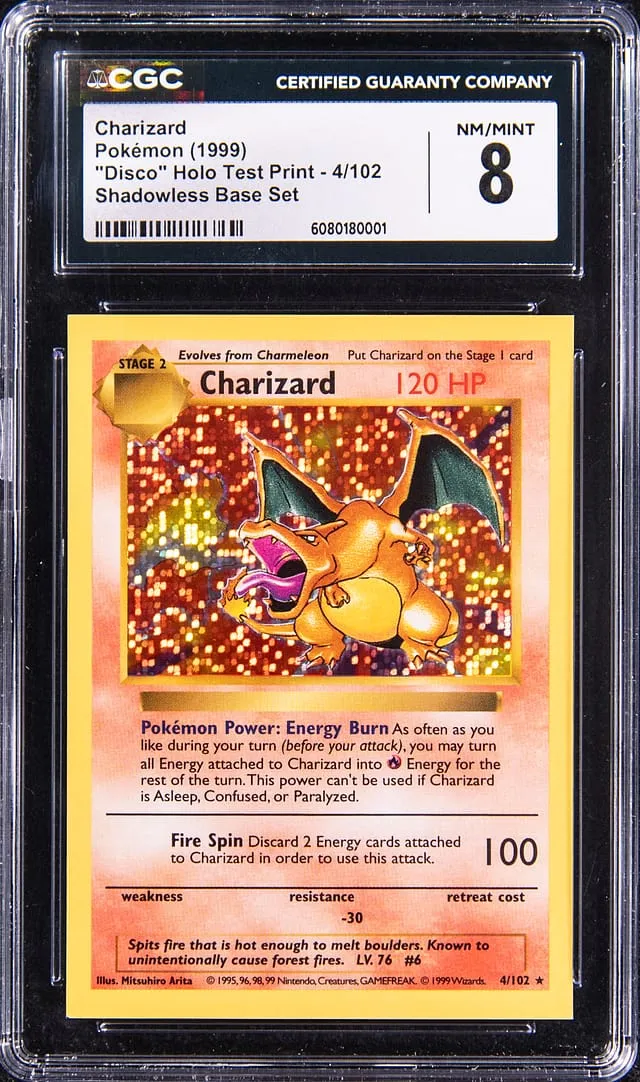
1999 Shadowless Disco Holo Test Charizard Sale
Breakdown of the 1999 Pokémon Shadowless Disco Holo Test Print Charizard CGC 8 sale for $38,440 at Goldin on February 16, 2026.
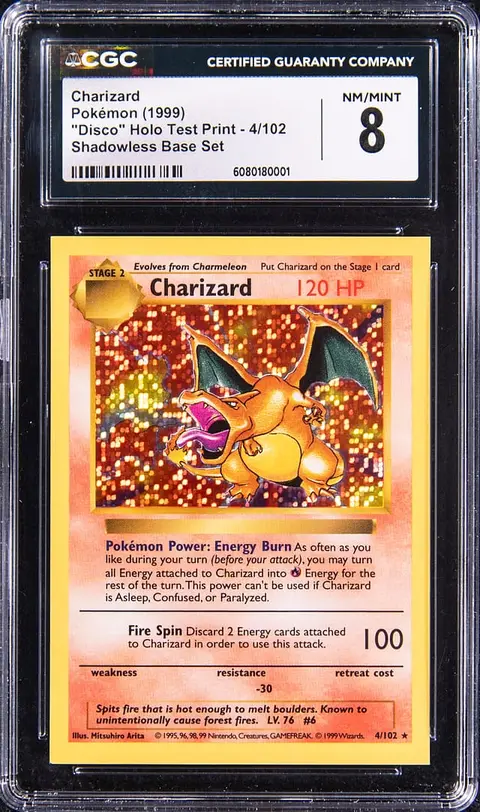
Sold Card
1999 Pokemon Base Set Shadowless Disco Holo Test Print #4 Charizard - CGC NM-MT 8
Sale Price
Platform
Goldin1999 Pokémon Base Set Shadowless Disco Holo Test Print #4 Charizard – CGC NM-MT 8 is not a card most collectors will ever see in person, let alone add to a box or binder. This is a pre-production test print from the earliest days of English Pokémon, combining three layers of rarity: Base Set, Shadowless, and an experimental “Disco Holo” foil treatment.
On February 16, 2026, Goldin auctioned this copy for $38,440, graded CGC 8 (Near Mint–Mint). For a niche test print, that’s a meaningful number that tells us a lot about how the market currently values ultra-rare, pre-release Pokémon pieces.
What exactly is this card?
Let’s break down the full title:
- Year: 1999
- Franchise: Pokémon TCG (Trading Card Game)
- Character: Charizard
- Set era: Base Set, Shadowless layout
- Type: Pre-production Disco Holo Test Print
- Card number: #4 (matching the standard Base Set Charizard number)
- Grading company: CGC (Certified Guaranty Company)
- Grade: NM-MT 8 (Near Mint–Mint)
This is not a pack-pulled, tournament-legal card. It’s a test print – a card printed in extremely small quantities so the printer and publisher could evaluate layout, colors, and foil patterns before final production.
What does “Shadowless Disco Holo Test Print” mean?
- Shadowless: Early English Base Set printings have no drop shadow behind the card’s main art box. Shadowless cards are scarcer and earlier than the more familiar “Unlimited” Base Set print run.
- Disco Holo: A hobby nickname for a test foil pattern that looks more like a scattered, reflective confetti than the smooth or starlight-style holo used on the released Base Set Charizard. It’s a visual clue that this card was never meant for final packs.
- Test Print: Produced in tiny quantities for internal evaluation. These are part of production history rather than regular set checklists.
Because of that, this Charizard sits in the same conceptual bucket as other pre-production or prototype pieces: things like sample cards, color tests, or logo placement experiments that survive from the production floor rather than from booster packs.
Grading details: CGC NM-MT 8
CGC has become a major grader for Pokémon, especially for niche variants like test prints and error cards, thanks to detailed labeling and subgrades on many labels. A CGC 8 generally indicates:
- Clean presentation
- Light wear on corners or edges
- Small surface or print defects
For a fragile, experimental foil pattern from 1999, a straight 8 presents well, even if it’s below gem-mint territory.
Market context: how does $38,440 compare?
Public sales data for Disco Holo Test Print Charizards is extremely thin. These cards surface rarely, and when they do, they often move privately or in one-off feature auctions at major houses like Goldin, Heritage, or PWCC.
Because of this, traditional “comps” – recent comparable sales used as a reference point – are limited. Instead of a long list of recent prices, we’re looking at a short trail of appearances and a lot of context:
- Regular 1999 Base Set Shadowless Charizard (pack-issued, not test prints) in top grades routinely sells for strong five-figure numbers in PSA 10, and mid–four to low–five figures in PSA 9, depending on centering and eye appeal.
- Non-test pre-production and error Charizards from the same era – things like “Sample” stamps or notable misprints – have also reached healthy five-figure prices, especially when slabbed by PSA, BGS, or CGC and clearly labeled.
- Other Pokémon test prints and prototypes from late-1990s Wizards of the Coast production have sold in the high four to mid-five figure range, depending on how recognizable the Pokémon is and how visually distinct the test is.
Placed against that background, the $38,440 result sits in a reasonable middle ground: well above most niche oddities, but below the very top record-setting 1st Edition Base Set Charizard sales in PSA 10 that have crossed six figures in more exuberant parts of the cycle.
With so few known public transactions, it’s more accurate to treat this sale as a data point, not a full price history. For now, it helps anchor expectations for future Disco Holo test print Charizard offerings, especially in the mid-high grade range.
Why collectors care about this card
1. Charizard as an icon
Charizard is the flagship character of the early Pokémon TCG. For many 1990s and 2000s kids, this was the card that represented the game itself.
That matters because hobby demand tends to cluster around flagship characters and rookies. In sports, that’s iconic rookie cards. In Pokémon, it’s early printings of core characters like Charizard, Pikachu, and key legendaries.
2. Base Set and the Shadowless era
1999 Base Set is the starting line for English Pokémon cards, and the Shadowless print run represents one of the earliest, smallest slices of that history. Shadowless Charizard is already a hobby pillar; combining that layout with an experimental foil treatment turns this test print into a kind of alternate history version of the most famous card in the game.
3. Pre-production and test print appeal
Test prints appeal to a specific type of collector:
- Production-history collectors who enjoy seeing how a card evolved.
- Error and oddity collectors who chase misprints, off-center cuts, and prototypes.
- High-end Charizard specialists who want every notable variant of the card, from Base to later commemorative issues.
Because they were never meant to be distributed, these cards rarely have a large known population. There may be just a handful of copies that have survived and been authenticated.
4. Era: vintage Pokémon
1999 Base Set is firmly vintage within the Pokémon TCG. That era is characterized by:
- Smaller original print runs compared to modern reprints and special sets
- Cards that were actually played with and handled by kids
- A lot of surviving copies in lower grades, with higher-grade examples and exotic variants disproportionately scarce
That context helps explain why even a niche test print can command a meaningful price once authenticated by a major grader and brought to a large auction platform.
Recent hobby environment
A few broader trends help frame this sale:
- Stabilization after the COVID boom: After a huge run-up in 2020–2021, prices for many base-level items cooled and then stabilized. Scarce and historically important pieces, like test prints and prototypes, have generally held buyer interest better than mass-printed cards.
- Growing comfort with CGC slabs: As CGC has expanded its footprint in the Pokémon space, more collectors are comfortable bidding aggressively on non-PSA slabs, especially when the label clearly identifies a complex variant.
- Charizard demand remains consistent: Even when the broader market grows quieter, high-end Charizard cards typically maintain attention and liquidity. That doesn’t guarantee outcomes, but it does mean new discovery sales like this get watched closely.
What the $38,440 sale at Goldin tells us
Because this is a thinly traded item, each public sale helps:
- Establish a rough reference range for test print Charizards in mid-high grade
- Highlight CGC’s role in authenticating and labeling off-standard Pokémon pieces
- Showcase collector appetite for unique production-history artifacts from the earliest days of the game
It’s worth stressing that a single auction result is not a promise of future returns. Thin markets can move sharply with each new appearance, depending on who shows up to bid and how many similar copies surface.
From a collecting perspective, though, this Goldin sale on February 16, 2026 underscores something simple but important: when you combine Base Set, Shadowless layout, Charizard, and a clear pre-production story, you get a card that serious Pokémon collectors stop to study.
Takeaways for different types of collectors
Newer or returning collectors
- Use this sale as a window into how deep Pokémon variants can go. Beyond 1st Edition or Shadowless, there are test prints, samples, and prototypes that many checklists never list.
- If you are early in your journey, you don’t need test prints to build a meaningful collection. Instead, think of them as the outer edge of the Charizard universe.
Active hobbyists
- When you look at comps (recent comparable sales used to gauge price), be cautious with one-off items like this. One or two auction prices are a signal, not a full trend.
- Pay close attention to the label language from graders. “Disco Holo Test Print” is very different from a typical holo misprint or a normal Shadowless card.
Small sellers
- If you ever encounter unusual foiling or obvious pre-production quirks, consider professional authentication. Correct identification can be the difference between being treated as a “damaged card” or as a historical oddity.
- For rare and complex items, major auction houses like Goldin can put your card in front of the right bidders and provide marketing that smaller platforms may not match.
Final thoughts
The 1999 Pokémon Base Set Shadowless Disco Holo Test Print #4 Charizard – CGC NM-MT 8, sold for $38,440 at Goldin on February 16, 2026, is a snapshot of how the hobby values the rarest corners of Pokémon history.
It’s not a typical chase card you’ll find in a collection bought at a yard sale or pulled from a forgotten binder. It’s a reminder that behind every mass-produced set, there’s a layer of experimentation and testing that occasionally escapes the production floor and becomes one of the most intriguing categories in the hobby.
For collectors, it offers a clear message: even after decades of grading and research, there are still new stories—and new variants—to discover in 1999 Pokémon.