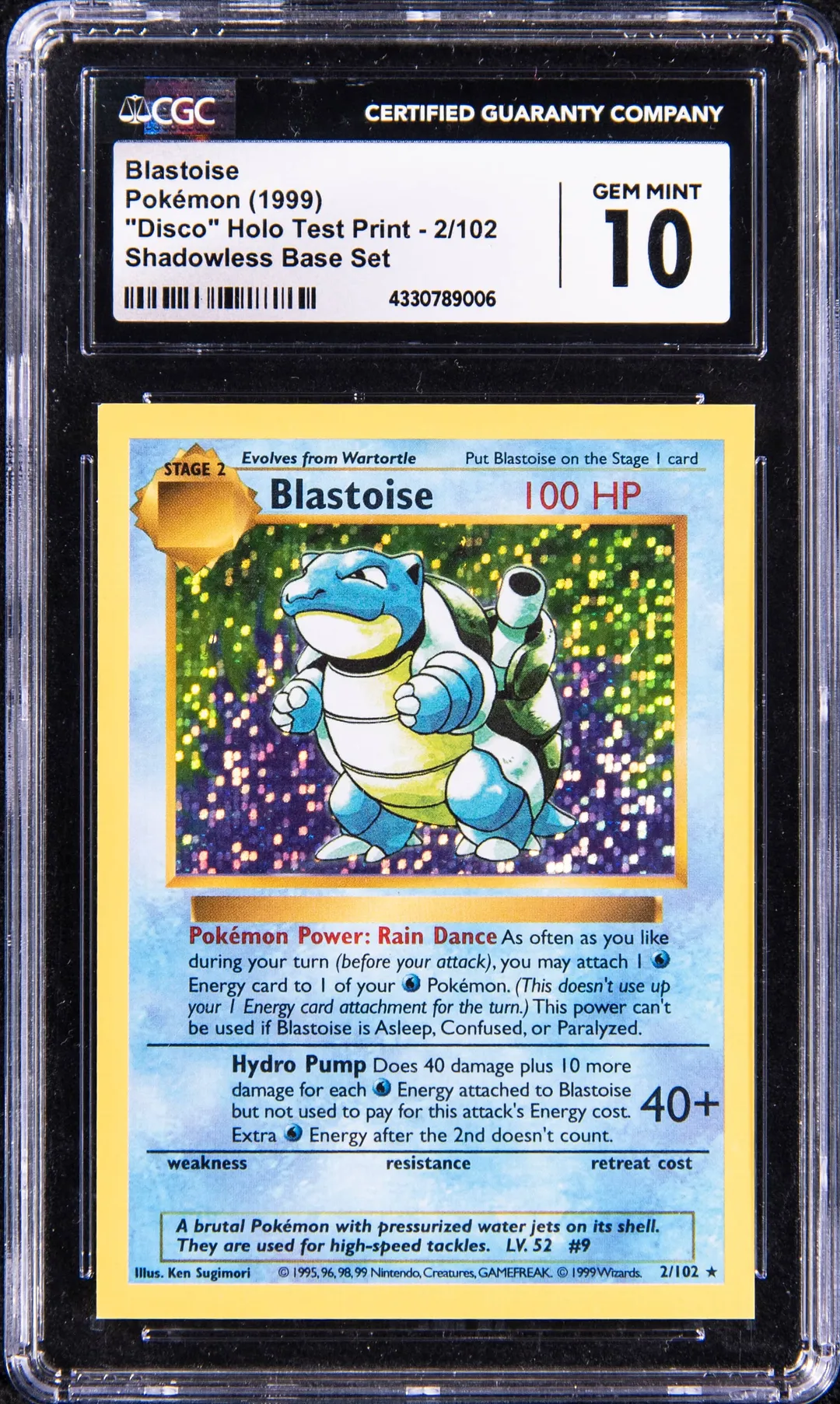
1999 Shadowless Disco Holo Test Blastoise CGC 10 Sale
Goldin sold a 1999 Pokémon Shadowless Disco Holo Test Print #2 Blastoise CGC 10 (Pop 3) for $19,840 on 2/16/26. Here’s the price context and collector story.
Sold Card
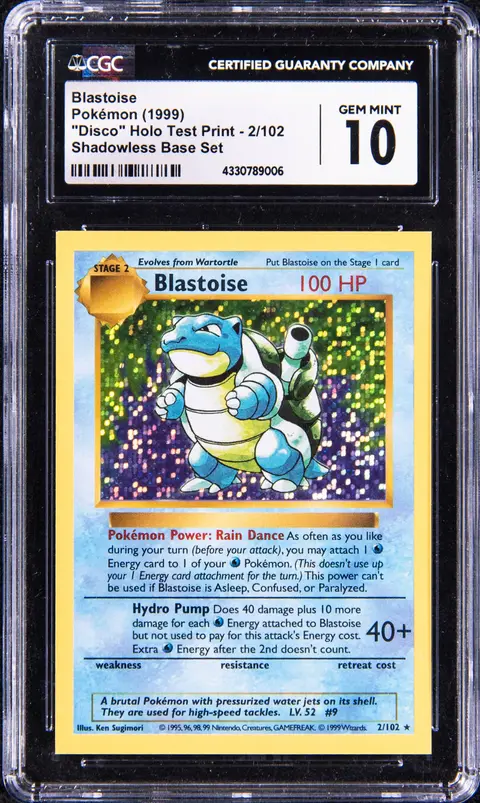
1999 Pokemon Base Set Shadowless Disco Holo Test Print #2 Blastoise - CGC GEM MINT 10 - Pop 3
Sale Price
Platform
GoldinA CGC GEM MINT 10 copy of the 1999 Pokémon Base Set Shadowless “Disco Holo” Test Print #2 Blastoise just closed at Goldin on 2/16/26 for $19,840, marking another notable data point for one of the hobby’s more unusual pre-production pieces.
This card in a nutshell
• Year and set: 1999 Pokémon Base Set, Shadowless test print • Character: Blastoise • Variant: “Disco Holo” Test Print #2 (pre-production, experimental foil pattern) • Card type: Test print / prototype-style, not a pack-pulled base set card • Grading: CGC GEM MINT 10 • Population: Pop 3 (only three copies graded CGC 10 at the time of sale) • Auction house: Goldin • Sale date: 2/16/26 (UTC) • Sale price: $19,840
What is the “Disco Holo” Blastoise test print?
This Blastoise is not a standard 1999 Base Set card. It’s a pre-production test print, sometimes grouped with the broader family of English-language Blastoise test and prototype cards used by printers and licensors to trial layouts, foil patterns, and production methods.
The “Disco Holo” nickname comes from the distinctive holofoil pattern, different from the normal Base Set foil. Test prints like this typically never saw pack distribution. Instead, they were produced in very limited numbers to evaluate design and manufacturing techniques. That combination of early date, iconic character, and non-public distribution is why they sit in a niche between a true prototype and an oddball parallel.
Key attributes that matter to collectors
• Early era: 1999 Base Set era cards sit firmly in what many call the hobby’s vintage or early WotC era for Pokémon – the foundation of English-language Pokémon TCG collecting. • Blastoise: Alongside Charizard and Venusaur, Blastoise is one of the three anchor starters from Base Set. Anything unusual from this trio tends to attract long-term collector interest. • Test print status: Because these cards weren’t released in packs and were produced in small runs, they function more like printing proofs or internal test pieces than traditional chase cards. • Shadowless connection: The “Shadowless” era marks the early print run of Base Set without the drop shadow around the art box. Even though this piece is a test print, its layout and era tie back to that early, more limited production window.
Grading, population, and why CGC 10 matters
CGC graded this card GEM MINT 10, their top standard grade. CGC’s pop report (population report – a count of how many copies exist in each grade) lists only three copies in CGC 10 at the time of this sale, making this a Pop 3 in the highest grade.
For niche items like test prints, population data can be tricky. Some copies may be raw (ungraded) or split across grading companies such as PSA, BGS, or SGC. However, a Pop 3 in CGC 10 confirms that top-graded examples are genuinely thin on the ground.
Market context and recent sales
Because this is a specialized test print and not a widely traded pack card, the pool of public auction results is small compared to standard Base Set Blastoise or Charizard cards. Instead of a long history of identical comps (comparable sales used to benchmark price), we typically see sporadic sales across different grading companies, sometimes with slightly different test-foil variants.
From recent public data and prior offerings of similar Blastoise test and prototype pieces, a few themes emerge:
• Premium over standard Blastoise: Even strong grades of regular Shadowless or 1st Edition Blastoise sell for substantially less than the rarest test or prototype items. The $19,840 result sits comfortably above high-grade standard release Blastoise cards but below the very top tier of Pokémon grails such as Charizard 1st Edition PSA 10. • Grade sensitivity: When a card has only a handful of top-grade examples, each sale can move the perceived “range” for the card. A CGC 10 result like this will often sit above 9.5/9 copies and ungraded examples by a clear margin. • Thin data: With so few sales, we don’t yet have a dense price history. Instead of a clear trend line, we see a handful of data points clustered in the mid-to-high five-figure range for the most desirable test or prototype Blastoise pieces in top grades.
Within that context, $19,840 feels like a strong but not outlandish realization for a Pop 3 CGC 10 specimen. It reflects the card’s scarcity, its early Pokémon status, and the continued willingness of collectors to pay a premium for unusual pre-production items.
Why collectors care about this card
- Early WotC-era history
The 1999 Base Set era is where English-language Pokémon collecting truly began. Anything that sheds light on how those cards were developed and produced—test prints, prototypes, and printer’s proofs—helps tell the story of how the brand took shape.
- Blastoise as a flagship starter
While Charizard usually dominates headlines, Blastoise has a respected lane of its own. From childhood nostalgia to the presence on Base Set packaging, Blastoise is a familiar face for both returning collectors and long-time hobbyists.
When nostalgia and rarity intersect, demand tends to be resilient. Test print Blastoise cards, especially with unique holo patterns, sit right at that intersection.
- Test prints as a niche collecting lane
Many collectors start with standard set-building—Base Set, Jungle, Fossil, etc.—and then move into more specialized lanes:
• Error cards (misprints and miscuts) • Pre-release and staff promos • Prototypes and test prints
Test prints reward hobbyists who like production history: they show the experimentation that happens before a set hits the shelves. They also tend to be inherently low-population, since they weren’t meant for mass distribution.
- Ultra-low supply
Unlike pack-issued cards, where thousands of copies may exist in various grades, test prints are limited from the start. Even if more raw copies surface, reaching a GEM MINT 10 grade is never guaranteed. That’s especially true for foil-heavy pieces that are prone to scratching and print defects.
How this sale fits into the current Pokémon market
The broader Pokémon market has cooled from peak pandemic-era highs, with many standard chase cards retracing to more sustainable levels. At the same time, a few segments have remained comparatively steady:
• Truly scarce items (low pop and low absolute supply) • Early WotC-era rarities and unusual printings • High-grade examples of historically important cards
This $19,840 sale aligns with that pattern. Instead of chasing the loudest headliners, some collectors are focusing on cards that combine early-era significance, demonstrable rarity, and a clear narrative.
Important nuance for newer collectors
If you’re newer to the hobby, there are a few things to keep in mind when looking at a number like $19,840:
• This is not a typical Base Set Blastoise: Standard Shadowless or Unlimited Blastoise cards, even in nice grades, trade for much less. Test prints occupy a different tier entirely. • Thin comps make pricing lumpy: Because so few sales exist, each auction can land higher or lower depending on who shows up to bid that week. It’s better to think in terms of approximate ranges than precise values. • Grading company differences matter: A CGC 10, PSA 10, or BGS 10 can each draw slightly different bidders and price levels. Crossovers and regrades can also change the pop landscape over time.
What this sale might signal—without speculation
Instead of guessing about future prices, it’s more grounded to talk about what this sale confirms:
• There is sustained demand for rare, early Pokémon test and prototype pieces. • Collectors continue to differentiate between mass-printed Base Set cards and genuinely limited pre-production items. • A Pop 3 CGC 10 test print Blastoise can command a mid-five-figure price in a mainstream auction environment like Goldin.
For PC-focused collectors (PC meaning “personal collection”), that can help when deciding how to prioritize goals: chasing a handful of rare, historically interesting pieces versus finishing large checklists of more common cards.
Takeaways for different types of collectors
New and returning collectors
• Use this sale as a reminder to read card titles carefully: words like “test print,” “prototype,” or “sample” indicate something very different from standard set cards. • When you see a big price tag, look up the pop report and recent comps to understand whether it’s a common chase or a special case.
Active hobbyists
• If you already collect early WotC variants, this sale gives an updated benchmark for where rare pre-production Blastoise pieces can land in a strong auction. • It’s a useful reference point when evaluating raw or lower-grade test prints: even with thin data, you can orient around known high-grade results.
Small sellers
• If you handle collections with oddball or unfamiliar holo patterns, it’s worth slowing down and researching before bulk-moving them. • Clear labeling—“test print,” “prototype,” “sample,” etc.—helps buyers understand what they’re looking at and makes it easier to compare to known public sales like this Goldin result.
Conclusion
The 1999 Pokémon Base Set Shadowless Disco Holo Test Print #2 Blastoise in CGC GEM MINT 10 is a niche card with an outsized story. Its $19,840 sale at Goldin on 2/16/26 doesn’t signal a broad wave for every Base Set Blastoise, but it does underline collector respect for rare, early, and historically interesting pieces.
For anyone building a Pokémon collection with an eye toward history as much as checklists, this card is a helpful case study in how scarcity, era, and narrative all come together in the modern market.