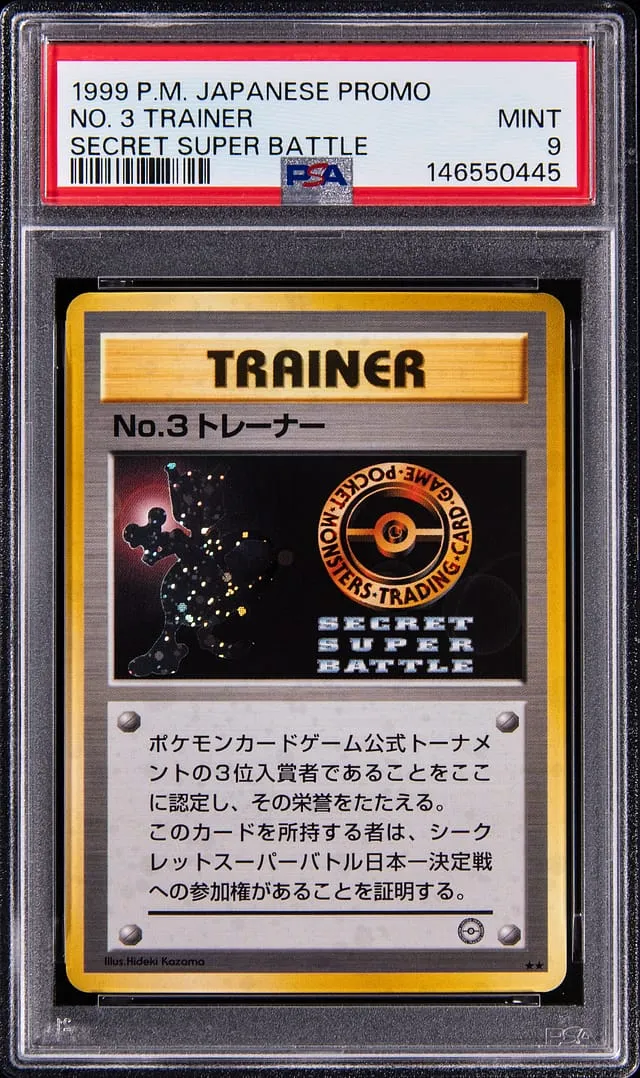
1999 Secret Super Battle No. 3 Trainer PSA 9 Sale
Goldin sold a 1999 Pokémon Japanese Secret Super Battle No. 3 Trainer PSA 9 for $201,300. A key result for vintage Japanese trophy cards.
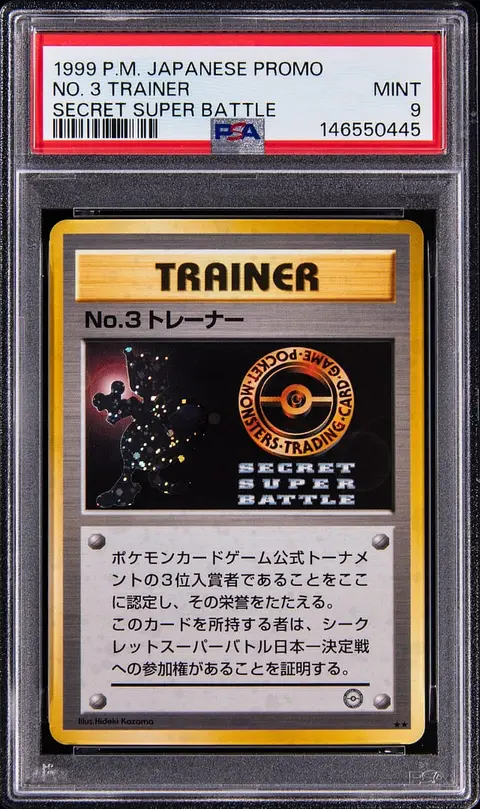
Sold Card
1999 Pokemon Japanese Promo Secret Super Battle No. 3 Trainer - PSA MINT 9
Sale Price
Platform
Goldin1999 Pokemon Japanese Promo Secret Super Battle No. 3 Trainer – PSA 9 Sells for $201,300
On March 9, 2026, Goldin closed a major vintage Pokémon sale: a 1999 Pokémon Japanese Promo Secret Super Battle No. 3 Trainer, graded PSA MINT 9, realized $201,300.
For a niche, text‑heavy promo from 1999, that’s a serious result—and it says a lot about how the market now treats the earliest Japanese trophy and prize cards.
Card Profile: What Exactly Sold?
- Card: Secret Super Battle No. 3 Trainer
- Game: Pokémon Trading Card Game
- Year: 1999
- Language/Region: Japanese
- Type: Trophy/prize promo card
- Event: Secret Super Battle (Japan, 1999)
- Publisher: Media Factory (original Japanese Pokémon TCG publisher)
- Grading Company: PSA (Professional Sports Authenticator)
- Grade: PSA MINT 9
- Rookie / key issue? Not a “rookie” in the sports sense, but a key trophy card from the earliest competitive era of Pokémon.
The Secret Super Battle promos (No. 1, No. 2, and No. 3 Trainer) were awarded to top finishers in invitation-only tournaments in Japan. They were never sold in packs. Instead, they functioned as high‑level trophies for elite players.
The No. 3 Trainer is typically understood to have been awarded to third-place finishers, making it part of the same family as the better-known No. 1 Trainer prize cards. Exact print numbers aren’t fully documented, but estimates and surviving graded populations point to very low original distribution.
Why Collectors Care About Secret Super Battle Promos
From a collector’s point of view, this card checks several important boxes:
Trophy & prize pedigree
Trophy and prize cards are cards you could only obtain by performing well in a tournament, not by opening packs. That makes them closer to sports award memorabilia than typical trading cards.Early competitive Pokémon history
The 1999 Secret Super Battle events represent the formative years of organized Pokémon play in Japan. Cards tied to that era have become historical artifacts of the game.Vintage, not modern
This is a 1999 card—squarely in the “vintage” Pokémon era alongside Base, Jungle, Fossil, and early promos. Vintage trophy cards combine age, low supply, and competitive history.Cultural and aesthetic appeal
While not as instantly recognizable as a Base Set Charizard, the Secret Super Battle cards have distinct artwork and the iconic Trainer design that high‑end Pokémon collectors seek out. For many advanced collectors, these are more important than most pack-pulled chase cards.Population scarcity
PSA’s population report (a census of how many copies they’ve graded at each grade) for SSB No. 3 Trainer has historically been tiny, with very few Mint or better copies. Even without quoting exact counts, it’s clear that a PSA 9 is an upper-tier example in a very small graded population.
Market Context: How Does $201,300 Fit In?
A note on data
When collectors talk about “comps”, they mean comparable recent sales that help anchor expectations for value. For rare cards like this, comps are sparse and often spread across different auction houses and private deals.
Specific, up‑to‑the‑week public sales for this exact card and grade are limited, but we can still outline the broader context:
Historic trophy card pricing:
Over the past several years, early Japanese trophies (No. 1/2/3 Trainers, Super Secret Battle, Tropical Mega Battle, University Magikarp, etc.) have consistently realized five- and six‑figure prices in high grades at major houses like Goldin, Heritage, PWCC, and others.Relative position vs. No. 1 Trainer & top trophies:
No. 1 Trainer variants and the absolute rarest trophies (like the 1997–1998 Japanese Pikachu trophy cards) have set headline numbers substantially above this level. In that hierarchy, a No. 3 Trainer at $201,300 falls into what could be described as the upper mid‑tier of the trophy market—not the all‑time record stratosphere, but clearly elite.Grade premium:
For low‑population trophy cards, every bump in grade can be dramatic in price because collectors are essentially competing over a handful of high‑grade copies. PSA 9 often represents the practical top grade many collectors will ever see available publicly, especially when PSA 10 either doesn’t exist or exists in single-digit population.
Given this backdrop, a $201,300 result for a PSA 9 Secret Super Battle No. 3 Trainer is strong but not out of character for high‑end 1990s Pokémon trophies. It reinforces the idea that the market still assigns significant value to early Japanese competitive history.
Comparing to Related Cards and Sales
Because exact public comps for this exact card and grade are thin, it’s useful to compare it to closely related categories:
Other Secret Super Battle Trainers (No. 1 and No. 2):
Historically, the No. 1 Trainer versions have commanded the highest prices, reflecting their top‑finish status and slightly stronger name recognition. No. 2 and No. 3 tend to follow behind, with pricing differences driven by grade and the specific event year.Other 1990s Japanese trophies:
Cards like Tropical Mega Battle promos, early Pikachu trophies, and University promos have also seen large realized prices in high grade. In that context, $201,300 for a PSA 9 SSB No. 3 Trainer is in line with the broader pattern:- Top Pikachu trophies, No. 1 Trainers, and especially one‑off rarities may exceed this.
- Secondary trophies and lower grades generally fall below this level, sometimes by large margins.
Language and region effects:
Although English cards dominate mainstream attention, serious Pokémon trophy collectors often prioritize Japanese cards, since that’s where the game and organized play began. This sale fits that dynamic—Japanese language is not a discount in this lane; it’s part of the appeal.
Overall, the Goldin sale suggests that demand for top‑grade, historically important Japanese promos remains durable, even as the broader market has cooled from its pandemic‑era froth.
Population, Scarcity, and Grade
For rare cards, the pop report (short for population report) is one of the clearest objective signals we have. It tells us how many copies a grading company like PSA has seen and at what grades.
Key points for this card type:
Very low total PSA population:
Only a small number of Secret Super Battle No. 3 Trainer cards have ever been submitted to PSA.Even fewer in Mint condition:
Trophy cards were often handled and carried by players as functional items, not preserved as collectibles from day one. That makes high grades (PSA 8, 9, and especially 10) significantly more difficult to find.PSA 9 as a practical top grade:
For many collectors, PSA 9 in this category is considered effectively “top tier” because the odds of upgrading to a PSA 10—or even finding one for sale—are slim.
This helps explain why a PSA 9 example can attract deep bidding and clear six figures.
Why This Sale Matters to Collectors
From a collector perspective, this Goldin sale on March 9, 2026, is notable for several reasons:
Validation of trophy tier:
It shows that even beyond the most famous names (No. 1 Trainers, Pikachu trophies), secondary trophies like No. 3 Trainers still command major attention and capital when they surface.Ongoing respect for Japanese promos:
Despite shifting trends between vintage, modern, and ultra‑modern “chase” cards, early Japanese promos and trophies retain strong market respect.Signal for condition premiums:
The high result in PSA 9 underscores that collectors are willing to pay up not just for rarity, but for rarity combined with condition.Collector confidence in established history:
In a period where many short‑print modern cards compete for attention, this sale re‑centers the conversation on cards with long, well‑documented pedigrees.
Takeaways for New and Returning Collectors
If you’re newer to this side of the hobby, here are a few practical, non‑financial takeaways from the Secret Super Battle No. 3 Trainer sale:
Not all rarity is equal.
Pack‑pulled “short prints” from recent sets can be scarce, but true trophy cards with limited prize distribution and 25+ years of history sit in a different tier.Context matters more than any single sale.
A $201,300 result is important, but it should be viewed alongside prior trophy card results, pop reports, and long‑term patterns.History and documentation add durability.
Cards that tie into specific events—like the 1999 Secret Super Battle—offer an additional layer of interest beyond just artwork and scarcity.You don’t need a six‑figure budget to participate.
While few collectors will ever target a Secret Super Battle Trainer, understanding why this card is valued can improve how you evaluate more accessible promos and special releases.
Looking Ahead
This Goldin sale doesn’t rewrite the trophy card hierarchy, but it reinforces a multi‑year trend: early Japanese trophy and prize cards remain a cornerstone of the high‑end Pokémon market.
For collectors, keeping track of sales like this helps build a clearer picture of how the hobby values history, scarcity, and condition over time. Whether you’re simply curious or actively building a high‑end Pokémon portfolio, the 1999 Secret Super Battle No. 3 Trainer in PSA MINT 9 at $201,300 will be a useful reference point for future conversations.
figoca will continue tracking these landmark sales so you can better understand where your own collection fits into the broader market—whether you’re holding a classic WotC holo or just starting to explore the world of Japanese promos.