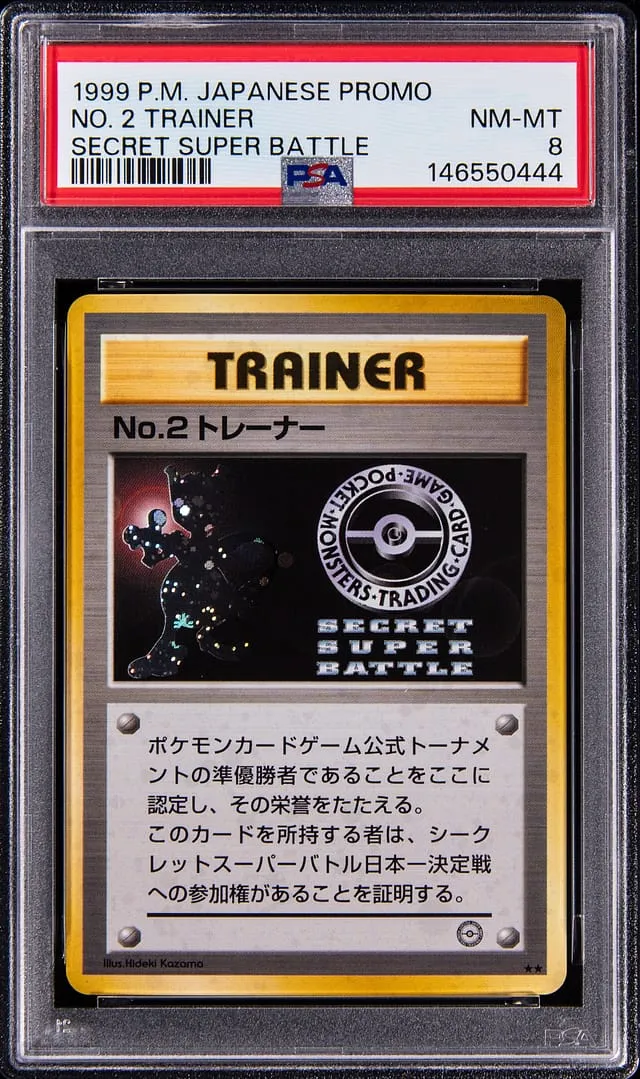
1999 Secret Super Battle No. 2 Trainer PSA 8 Sale
Figoca breaks down the $183,000 goldin sale of the 1999 Pokémon Japanese Secret Super Battle No. 2 Trainer PSA 8 and what it means for trophy cards.
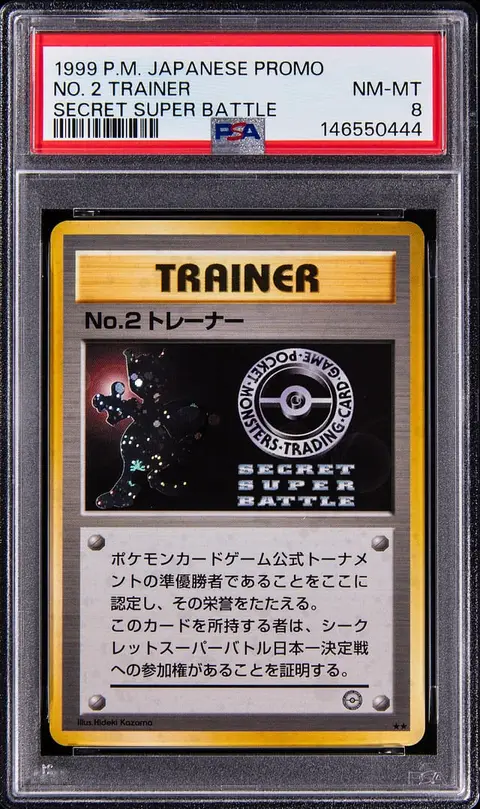
Sold Card
1999 Pokemon Japanese Promo Secret Super Battle No. 2 Trainer - PSA NM-MT 8
Sale Price
Platform
Goldin1999 Pokémon Japanese Secret Super Battle No. 2 Trainer – PSA 8 Sells for $183,000
When a niche, early-era Pokémon promo surfaces in a major auction, serious collectors pay attention. That is exactly what happened at goldin on 2026-03-09, when a 1999 Pokémon Japanese Promo Secret Super Battle No. 2 Trainer graded PSA NM-MT 8 closed at $183,000.
Below is a breakdown of what this card is, why it matters, and how this sale fits into the broader market for high‑end Japanese trophy cards.
Card ID: What Exactly Sold?
Card: 1999 Pokémon Japanese Promo Secret Super Battle No. 2 Trainer
Language/Region: Japanese
Issue Type: Trophy / Prize promo (not pack‑pulled)
Event: Secret Super Battle (Japan, 1999)
Character: Trainer card featuring Mewtwo artwork (illustrator: commonly associated with this run of trophy cards)
Rarity Type: Extremely limited event prize, often classed as a "trophy card" in the hobby
Grading Company: PSA (Professional Sports Authenticator)
Grade: PSA 8 – NM-MT (Near Mint–Mint)
The Secret Super Battle Trainer series (No. 1, No. 2, and No. 3) was awarded to top finishers in a 1999 invitation-only tournament in Japan. These cards were never sold at retail or found in booster packs. Instead, they were distributed only to successful competitors in a very small competitive field.
Because of that structure, collectors typically classify them as trophy cards—cards awarded as prizes at official events, often with print runs in the low dozens rather than thousands.
This particular card is the No. 2 Trainer variant, marking the ranking of the recipient in the event’s hierarchy. While exact print numbers are hard to confirm publicly, the working assumption in trophy-card circles is that only a handful of examples exist in any condition.
Why Collectors Care About Secret Super Battle Trophy Cards
1. Early competitive Pokémon history
The 1999 Secret Super Battle event sits very close to the birth of organized Pokémon play. These trophies document the earliest era of serious competition in Japan, which many collectors view as the cradle of organized Pokémon TCG culture.
Owning one of these cards is less like owning a piece of a set and more like owning a plaque from a historic tournament. The card itself is the trophy.
2. True scarcity and low survival rate
Unlike chase cards that were inserted into booster packs, trophy promos were:
- Printed in very low numbers up front.
- Given directly to players, not to collectors.
- Often stored casually, used as mementos, or even lost.
That combination leads to:
- Very small total population (few known copies in the wild).
- Even smaller graded population—only a subset of surviving copies ever make it to PSA, BGS, or CGC.
In segments like this, collectors pay close attention to the pop report—short for population report, an official tally by a grading company of how many copies of a card exist at each grade. Trophy cards frequently have single‑digit pops across top grading tiers.
3. PSA 8 as a strong grade for a 1999 trophy
In mainstream modern cards, PSA 10 is often the benchmark. For late‑1990s trophy cards, the story is different:
- These cards were handled as awards, not packed fresh into sleeves.
- Even light edge wear or surface scratches can cap the grade.
As a result, PSA 8 (NM-MT) is widely accepted as a high‑end grade for many older trophies, especially if PSA 9s and 10s are in the low single digits—or absent entirely.
Market Context: How Does $183,000 Fit In?
The goldin sale on 2026-03-09 at $183,000 places this PSA 8 firmly in the high-end trophy market. Because this is a very thinly traded card (sales are rare, and the total population is extremely small), pricing often moves in steps rather than smooth trends.
Comparable sales and related cards
For cards like this, comps—short for comparables, meaning other recent sales used as reference—are scarce. Instead of a regular monthly trading pattern, the card may only appear at public auction once every few years in any grade.
When evaluating this sale, advanced collectors typically look at:
- Past sales of Secret Super Battle No. 2 Trainer in other grades (PSA 7, PSA 9, raw).
- Prices for No. 1 Trainer and No. 3 Trainer from the same event, which share the same trophy lineage and visual style but differ in ranking.
- Prices of other Japanese trophy issues of similar age and scarcity (for example, 1997–1999 event trophies like early Tropical Mega Battle or other Super Battle promos).
Across that cluster of cards, public auction history has shown that:
- Lower grades (PSA 5–7) can still command strong five‑ or six‑figure results when they appear, depending on the exact card.
- High‑grade copies (PSA 8 and above) tend to land at a premium when they surface, because they may represent the top of the pop or close to it.
While exact figures vary by event, grade, and timing, a $183,000 result is broadly consistent with where other elite Japanese trophy pieces have landed in recent high‑profile auctions—especially when the card combines:
- 1990s provenance.
- Confirmed competitive origin.
- Extremely low population.
- A major marketplace such as goldin.
The limited public history for this exact grade and card means we cannot map out a clean, year‑by‑year price curve. Instead, it’s more accurate to say this sale reinforces the standing of Secret Super Battle trophies in the top tier of Pokémon rarity, alongside other key Japanese event cards.
How Grading and Population Shape Demand
For this card type, many collectors weigh:
Any graded copy vs. none at all
With few known examples, simply having a PSA‑authenticated copy—regardless of small grade differences—is a significant threshold.Grade distribution, not just the top pop
When the total pop is very low, the presence or absence of a PSA 9 or 10 matters. A PSA 8 can sometimes function as a “practical top grade” in the market if higher grades are one‑of‑one or do not exist.Eye appeal vs. label
For trophy pieces, collectors often look closely at centering, corners, and print quality, even within the same grade. A strong‑looking PSA 8 can be more desirable than a weaker example at the same grade.
Because population reports and census data are dynamic—new submissions occasionally enter the system—serious buyers typically cross‑check the latest PSA stats when evaluating a six‑figure purchase.
What This Sale Signals for the Trophy Segment
1. Continued depth of demand for early Japanese promos
Despite broader hobby cycles and shifts in attention, results like this show that the upper tier of Japanese trophy cards retains active bidding when examples surface through major auction houses. These cards appeal to:
- Long‑time Pokémon historians.
- Cross‑collectors coming from sports or other TCGs who want one or two true centerpiece items.
- Collectors focused specifically on the Japanese side of the franchise.
2. Emphasis on provenance and documentation
Because these cards were event prizes, many collectors place extra value on:
- Clear grading company certification (like a PSA label describing the event and issue).
- Auction catalog descriptions from reputable houses such as goldin.
- Any surviving event documentation or original award materials, when available.
This 2026-03-09 sale benefits from being:
- Sold by a major auction platform with a track record in high‑end TCGs.
- Publicly documented, helping future buyers and sellers benchmark against it.
3. Thin markets and wide spreads
Unlike mass‑printed chase cards where dozens of sales appear every month, trophy promos trade in a thin market—a market where very few transactions happen. In thin markets:
- Single auction results can move perceived value more than in highly liquid segments.
- Individual cards can outperform or underperform prior expectations based on the specific bidder pool present at that moment.
This $183,000 sale is better viewed as an updated reference point rather than a strict, repeatable price.
Takeaways for Different Types of Collectors
New and returning collectors
If you’re just coming back into Pokémon or starting fresh, a six‑figure trophy card might feel remote, but there are still useful lessons:
- Event promos and competition history matter. Cards tied to real tournaments often carry different long‑term significance than regular set cards.
- Scarcity is multi‑layered. Look beyond print runs to how a card was distributed and how many survive in good condition.
- High prices do not automatically make a card better. Many collectors build meaningful collections without ever touching trophies, focusing instead on set cards they love.
Active hobbyists and small sellers
For those buying, selling, or trading more regularly:
- Use results like this as context, not as a direct comp for completely different cards.
- When you see an event promo or trophy‑style card in the wild, check:
- The event and year.
- The language/region.
- Grading pops and recent sales across different grades.
- Document provenance carefully if you handle rare promos. Future buyers may lean on your records the way we lean on past auction catalogs now.
Closing Thoughts
The 1999 Pokémon Japanese Promo Secret Super Battle No. 2 Trainer is one of those cards that lives more in hobby lore than in binders. It marks an early moment in organized Pokémon play, was awarded only to top finishers, and survives today in extremely small numbers.
At $183,000 on goldin’s 2026-03-09 auction, this PSA NM-MT 8 example reinforces how the market continues to treat early Japanese trophy cards: not as speculative lottery tickets, but as historically grounded artifacts from the birth of competitive Pokémon.
As always, this sale should be read as one data point in a small but important record of high‑end Pokémon results—not as a guarantee of any future performance.