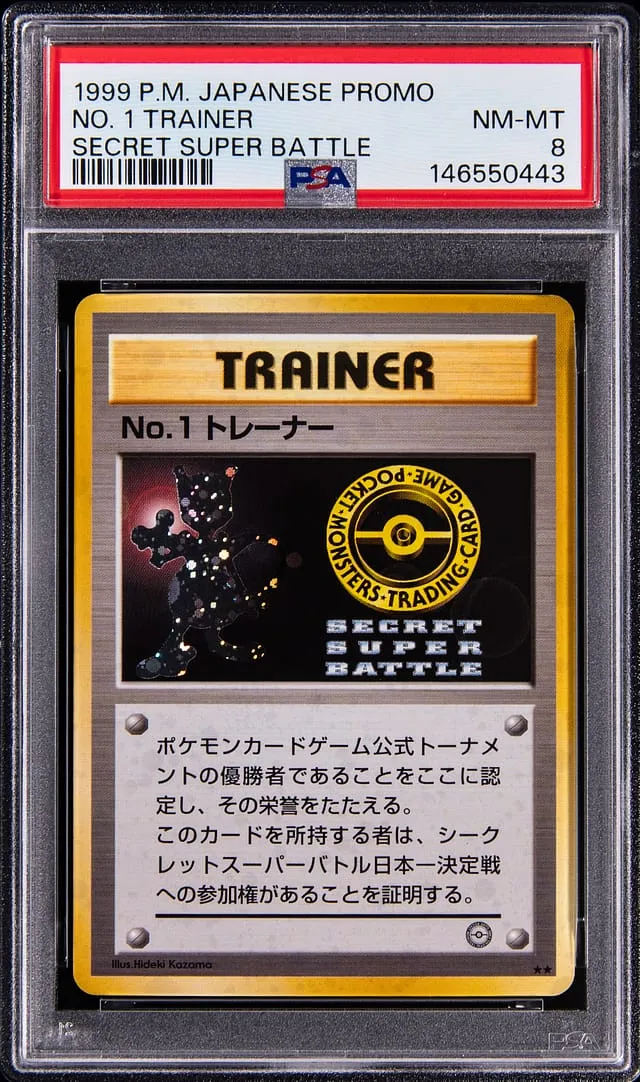
1999 Secret Super Battle No. 1 Trainer PSA 8 Sells
Goldin sold a 1999 Pokémon Japanese Secret Super Battle No. 1 Trainer PSA 8 for $231,800. See where this trophy card sits in today’s market.
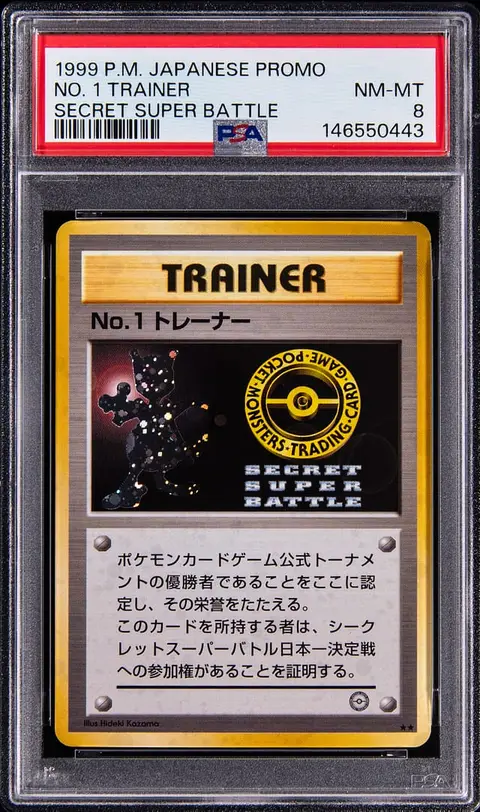
Sold Card
1999 Pokemon Japanese Promo Secret Super Battle No. 1 Trainer - PSA NM-MT 8
Sale Price
Platform
Goldin1999 Pokémon Japanese Promo Secret Super Battle No. 1 Trainer (PSA 8) Sells for $231,800
When a grail-level trophy card moves, the high-end Pokémon market pays attention. On March 9, 2026, Goldin sold a 1999 Pokémon Japanese Promo Secret Super Battle No. 1 Trainer, graded PSA NM-MT 8, for $231,800. For a card most collectors will only ever see in photos, this result offers a useful checkpoint for where the top of the vintage Pokémon market sits today.
What exactly is the Secret Super Battle No. 1 Trainer?
Let’s break down the key details of this card:
- Year: 1999
- Origin: Japanese promo
- Name: Secret Super Battle No. 1 Trainer
- Type: Trophy/Prize card (not a pack-pulled card)
- Distribution: Awarded to winners at the Secret Super Battle tournament in Japan
- Language: Japanese
- Grading company: PSA (Professional Sports Authenticator)
- Grade: NM-MT 8 (Near Mint–Mint)
The “No. 1 Trainer” cards are among the most famous tournament trophy cards in the Pokémon hobby. They were given to top finishers at small, invitation-only events, which means extremely low original distribution. Unlike standard set cards, these were never sold in booster packs.
The Secret Super Battle variant is especially important because it’s tied to a 1999 Japanese tournament series that helped define early competitive Pokémon play. For many collectors, this card sits in the same conversation as Tropical Mega Battle and early Pikachu trophy promos when discussing the true elite tier of Pokémon cards.
Why collectors care so much about this card
Several factors make the 1999 Secret Super Battle No. 1 Trainer a top-tier collectible:
True scarcity, not just low print run
Trophy cards like this were given to a tiny number of players. While exact numbers vary by source, it’s understood that very few copies exist at all, and even fewer have been graded by PSA.Tournament history
This is not a character-based chase like Charizard from Base Set. Instead, it’s a tournament trophy tied to early competitive play, which gives it a different kind of appeal—closer to sports award memorabilia than a typical trading card.Early-era vintage
1999 sits at the heart of what many consider the “early vintage” Pokémon period. Cards from this era, especially Japanese promos, have proven to be among the most stable reference points for serious collectors.Design and status
The No. 1 Trainer naming, winner-specific text, and unique event branding signal status in a way that standard set cards cannot. These were literally built to represent being the best.
Understanding the PSA 8 grade
This copy received a PSA NM-MT 8 grade. PSA’s 10-point scale considers centering, corners, edges, and surface:
- PSA 10: Gem Mint – essentially as close to perfect as realistically possible.
- PSA 9: Mint – very minor flaws only.
- PSA 8: Near Mint–Mint – sharp overall, but with more noticeable minor wear.
For ultra-scarce trophy cards, collectors often prioritize existence over condition. In other words, a PSA 8 in a card like this can still be considered an elite piece, because there simply aren’t many higher-grade examples to chase, and there may not be many chances to buy one at all.
Price context: How does $231,800 compare?
The Goldin sale closed at $231,800 on March 9, 2026. To put that in context:
- Public data for this exact promo in PSA 8 is limited because sales are infrequent. When a card surfaces only every few years, it becomes much harder to define a “typical” price.
- Historically, No. 1 Trainer and other 1990s Japanese trophy cards have sold anywhere from the low six figures into the mid-to-high six figures depending on:
- Specific event (e.g., Secret Super Battle vs. other tournaments)
- Exact card title (No. 1 vs. No. 2 / No. 3 Trainer)
- Grade (PSA 7 vs. 8 vs. 9 vs. 10)
- Timing and auction venue
Because of the low volume of sales, most serious collectors look at a range of results rather than a single comp ("comp" is short for comparable sale, meaning a recent, similar card sale used as a reference point).
Within that framework, a $231,800 result for a PSA 8 copies fits comfortably into the established six-figure territory for top-tier 1999 Japanese trophy cards. It does not represent an obvious outlier; instead, it reads as a credible, data point-level confirmation that high-end interest in these early trophies is still there.
Market structure: Why sales are so sporadic
Trophy cards like the Secret Super Battle No. 1 Trainer behave differently from most other Pokémon cards:
- Tiny population (pop): The “pop report” is the grading company’s count of how many copies exist at each grade. For this card, the total population is understood to be very low across all grades.
- Collector lock-up: Many copies are in the hands of long-term collectors who rarely sell. That means the market only sees a handful of opportunities in any given decade.
- Auction-driven price discovery: Because there are almost no fixed-price listings, major auction houses like Goldin, Heritage, and PWCC often set the most visible reference points.
For most collectors, that means:
- There may be years between comparable public sales.
- When a copy surfaces, it attracts global attention from a small but serious bidder pool.
- Prices can shift more dramatically from one sale to the next than they do for more common chase cards.
How this sale might matter to different types of collectors
Even if this card is far outside your budget, it still has implications for the broader hobby:
For newcomers and returning collectors
- This sale is a reminder that Pokémon has layers of rarity. Base Set Charizard might feel like the pinnacle at first, but above that are promos that were literally never sold in stores.
- It’s a useful reference point for understanding why some cards reach six figures while others, even from the same era, stay far below that. Distribution method and tournament history matter a lot.
For active hobbyists
- The result reinforces that early Japanese trophy promos remain a core reference point for the high-end Pokémon market.
- When you look at mid-tier and entry-level Japanese promos, it can be helpful to know where the absolute top sits. While there’s no direct trickle-down effect you can count on, these high-end sales shape how collectors talk about the entire era.
For small sellers
- You don’t need a trophy card to benefit from understanding this segment. Knowing the language around trophy, prize, promo, and limited distribution cards helps you describe and position the promos you do handle.
- When listing rarer items, clear explanations of where they sit in the hobby hierarchy—even if they’re far below a trophy like this—can help buyers understand what they’re looking at.
The role of Goldin and timing
This sale ran through Goldin, a major auction house known for handling high-value trading cards and memorabilia. For six-figure items, venue matters:
- High-end buyers are accustomed to bidding at dedicated auction platforms.
- Auction houses often provide authentication, marketing, and extended payment options, which can expand the pool of potential bidders.
The sale date of March 9, 2026 (UTC) puts this result in a period where the Pokémon market has moved beyond its early pandemic surge and later cooling phase. In that context, a $231,800 price signals that serious collectors still allocate capital and attention to top-tier 1990s trophy pieces.
Key takeaways
- The 1999 Pokémon Japanese Promo Secret Super Battle No. 1 Trainer is one of the most important trophy cards in the hobby.
- A PSA 8 copy selling for $231,800 at Goldin on March 9, 2026 fits within the long-established six-figure range for top-tier 1990s Pokémon trophies.
- Public sales are rare, so each auction acts as a new data point rather than a routine transaction.
- For most collectors, this card functions less as a target and more as a reference marker for the absolute peak of vintage Pokémon.
At figoca, we track these landmark sales not because everyone is chasing a trophy card, but because understanding the top of the market helps make sense of everything beneath it—from early Japanese promos to modern chase cards and beyond.