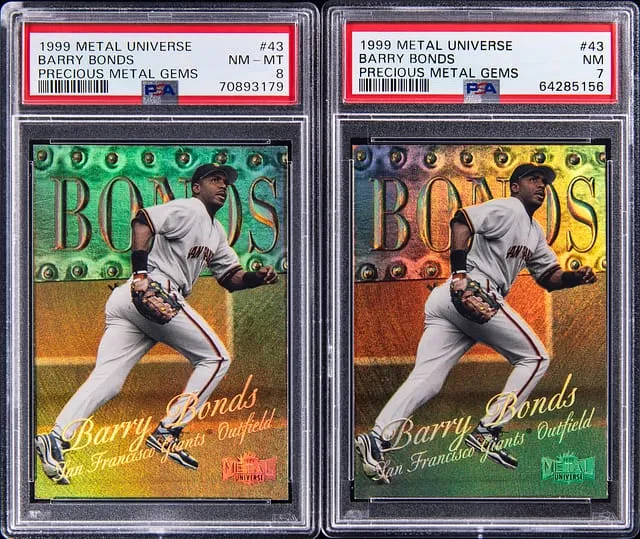
1999 PMG Barry Bonds #43 Pair Sells for $29,402
Goldin sold a PSA-graded 1999 Metal Universe PMG #43 Barry Bonds pair, including #01/50, for $29,402 on March 15, 2026. Here’s the market context.
Sold Card
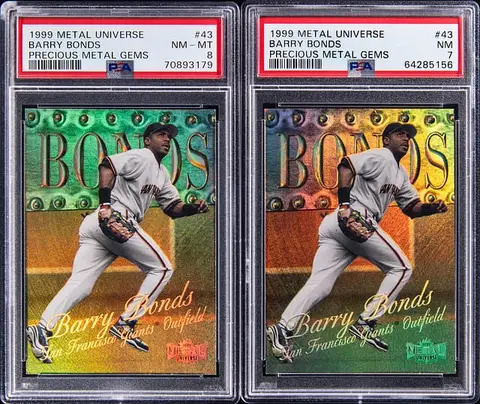
1999 SkyBox Metal Universe Precious Metal Gems (PMG) #43 Barry Bonds (#01/50) PSA-Graded Pair (2)
Sale Price
Platform
Goldin1999 SkyBox Metal Universe is one of those late‑90s sets that quietly turned into a cornerstone of modern baseball collecting. When a Precious Metal Gems (PMG) Barry Bonds surfaces — especially an early‑numbered copy — collectors who follow 90s inserts tend to pay attention.
On March 15, 2026, Goldin sold a PSA‑graded pair of 1999 SkyBox Metal Universe Precious Metal Gems #43 Barry Bonds, featuring the serial‑numbered copy #01/50, for $29,402.
In this post, we’ll walk through what exactly this pair is, why 1999 Metal Universe PMGs matter, and how this sale fits into the wider market for Bonds and 90s insert collectors.
The card at a glance
- Player: Barry Bonds (San Francisco Giants)
- Year: 1999
- Set: SkyBox Metal Universe
- Insert / Parallel: Precious Metal Gems (PMG)
- Card number: #43
- Serial numbering: one copy specifically noted as #01/50 (the first in the print run)
- Quantity in lot: PSA‑graded pair (2 cards)
- Grading company: PSA (Professional Sports Authenticator)
- Auction house: Goldin
- Sale date: March 15, 2026 (UTC)
- Sale price: $29,402
This is not a rookie card (Bonds’ rookies are from 1986), but it is a key late‑career insert from one of the most studied insert/refractor eras in the hobby.
PMGs are serial‑numbered parallels, meaning only 50 copies of this particular Barry Bonds card were produced. Within that small group, the #01/50 adds a layer of collectability: some player and set collectors place a noticeable premium on “first off the line” serial numbers.
The lot description notes this as a PSA‑graded pair, but individual grades were not highlighted in the summary information here. For PMGs, even mid‑range grades can be meaningful, since condition is often rough due to chipping and edge wear on these foiled stocks.
Why 1999 Metal Universe PMGs matter
For anyone newer to the hobby: Precious Metal Gems (PMG) is the name given to a specific run of low‑serial, high‑foil parallels originally made famous in basketball and football during the late 1990s. The baseball versions share much of that DNA:
- Low serial numbers: Only 50 copies for this Barry Bonds PMG.
- Distinctive foil and color treatments: Chipping, scratching, and edge wear are common, which limits high‑grade populations.
- Strong cross‑sport brand: PMG is one of the few insert/parallel names that carries strong recognition across basketball, football, and baseball collectors.
The 1997 Metal Universe PMGs tend to get the most headlines, especially in basketball, but the 1999 baseball PMGs sit in a sweet spot: still scarce, still very 90s in design, and focused on established stars rather than prospects.
Pair that with Barry Bonds — a player whose statistics and hardware are among the most dominant ever — and you get an insert that many player collectors consider one of his crucial non‑rookie cards.
Market context and pricing
When collectors talk about “comps,” they mean recent comparable sales that help anchor expectations for what a card might realistically sell for in the current market.
At the time of this Goldin sale:
- PMG Barry Bonds cards from the late 90s appear infrequently at major auction houses and marketplaces. Exact 1999 PMG #43 comps in PSA holders are scarce, especially in pairs.
- Sales of other Bonds PMGs (different years or grades) often show wide price ranges depending on:
- The specific year and Metal Universe design
- Serial number (jersey number, #01, or “last” can matter to some collectors)
- PSA vs BGS vs SGC grading, and where the card sits on the scale
This $29,402 result for a PSA‑graded pair with the #01/50 example included positions the sale in the upper tier of non‑rookie Bonds inserts. It is not at the level of hobby‑defining records we see for his premier rookies or one‑of‑a‑kind pieces, but it clearly reflects that:
- 90s insert specialists continue to allocate real budget to PMGs.
- Serial numbering and set reputation can drive prices into high four‑ or low five‑figure territory, even without autograph or memorabilia content.
Because public, verified sales data for this exact configuration (PSA‑graded 1999 PMG #43 pair anchored by #01/50) are limited, it’s more accurate to treat this result as a fresh data point than as proof of a stable price level.
Grading, population, and scarcity
For low‑print inserts like PMGs, three layers of scarcity work together:
- Production scarcity – only 50 copies exist by design.
- Survivorship – not all 50 are likely to be in collectible condition today.
- Graded population – only a portion of surviving copies are graded by PSA, BGS, or SGC.
Collectors often refer to a “pop report” (population report), which is a grading company’s public count of how many copies they’ve graded at each grade level. These reports typically confirm that:
- PMGs, especially from the 1990s, have low total populations.
- The distribution often skews toward mid‑grades because of how fragile the cards are.
In that environment, even a PSA‑graded pair without headline grades can become an attractive target for:
- Player collectors trying to lock down any example.
- Set builders chasing the full PMG checklist.
- Investors and high‑end hobbyists who value the PMG brand and low print runs.
Why Barry Bonds still commands attention
Barry Bonds is one of the most polarizing figures in baseball history, but from a strictly performance standpoint, few players match his peak dominance:
- All‑time home run leader.
- Seven MVP awards.
- Era‑defining presence for the San Francisco Giants.
Those factors keep demand alive for his key cards and inserts, even as Hall of Fame debates continue. For collectors who prefer skill and era representation over speculation, Bonds’ late‑90s inserts offer:
- A link to the height of his superstardom.
- Designs and parallels that represent the 90s insert boom.
- Cards that are rare enough to feel special but not impossible to find over a multi‑year hunt.
The 1999 Metal Universe PMG #43 fits squarely into this lane — a serious target for Bonds specialists, and a recognizable brand for cross‑sport PMG fans.
How this sale fits into the broader 90s insert trend
Over the last several years, the hobby has reassessed the 1990s:
- Once dismissed as part of the “junk wax” hangover, the premium inserts and low‑serial parallels from the late 90s have been re‑rated as true scarcity.
- PMGs, Superfractors, Essential Credentials, and similar parallels are now widely seen as core building blocks of modern high‑end collecting.
Within that context, this Goldin sale on March 15, 2026, signals a few things:
- Sustained respect for PMGs – Even outside basketball, the PMG name maintains collector trust and attention.
- Healthy demand for Bonds’ premier inserts – Not every 90s Bonds card commands big prices, but his top‑tier, low‑serial pieces continue to clear strong numbers.
- Serial‑number nuance still matters – The presence of the #01/50 copy in this lot likely contributed to the final hammer price, based on how collectors typically treat special serial numbers.
Takeaways for collectors and small sellers
Whether you’re returning to the hobby or already active, here are some ways to use this sale as context, not as a promise:
- For Bonds collectors: This sale reinforces that his truly scarce, brand‑name inserts sit in a separate tier from mass‑produced base and low‑end parallels.
- For 90s insert fans: 1999 Metal Universe baseball continues to show that it belongs in the conversation next to better‑known basketball releases when it comes to design and scarcity.
- For small sellers: If you’re sitting on 1990s PMGs or similar serial‑numbered inserts, it can be worth checking:
- Current pop reports.
- Recent comps across multiple marketplaces.
- Whether grading might unlock additional demand, especially for stars and Hall of Fame‑caliber players.
As always, treat any single auction — even a notable one like this — as one data point among many. Prices can move with hobby cycles, player news, and broader market conditions.
For now, the 1999 SkyBox Metal Universe Precious Metal Gems #43 Barry Bonds PSA‑graded pair, featuring the #01/50 copy, stands as a clear example of how 90s scarcity, a strong insert brand, and a historically significant player can combine to reach nearly $30,000 at a major auction house.
figoca will continue tracking these kinds of sales so collectors can understand not just the headline numbers, but the context behind them.