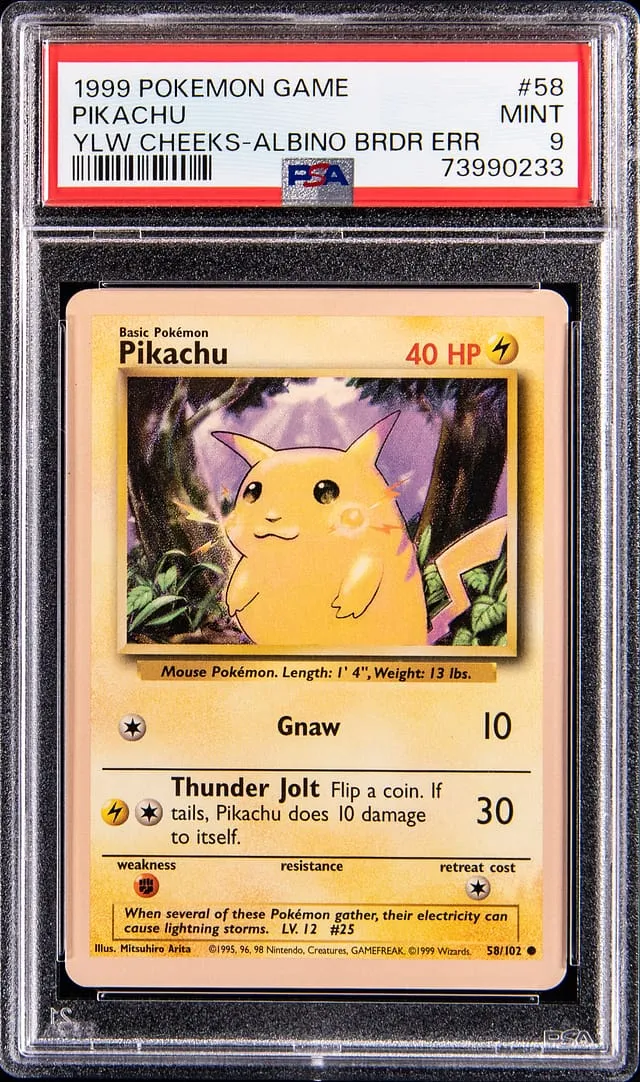
1999 Pikachu Albino Border Error PSA 9 Sells for $15K
Breakdown of the 1999 Pokémon Yellow Cheeks Albino Border Error Pikachu PSA 9 that sold for $15,556 at Goldin on May 18, 2026.
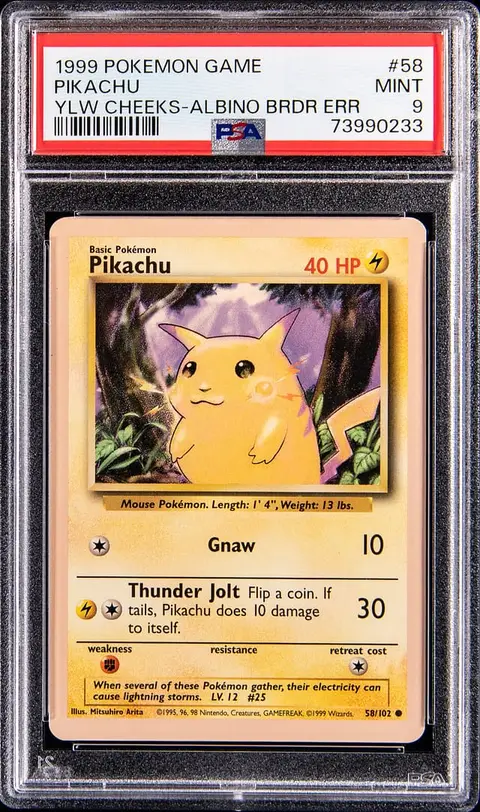
Sold Card
1999 Pokemon Game Yellow Cheeks Albino Border Error #58 Pikachu - PSA MINT 9
Sale Price
Platform
Goldin1999 Pokémon Game Yellow Cheeks Albino Border Error #58 Pikachu in PSA 9 just closed at $15,556 on Goldin (sale date: 2026-05-18). For a niche error from the earliest English Pokémon set, that’s a result worth unpacking.
What exactly is this card?
- Character: Pikachu
- Year & set: 1999 Pokémon Game (Base Set, unlimited print run)
- Card number: #58
- Variant: Yellow Cheeks Pikachu with an “Albino Border” printing error
- Grading company: PSA (Professional Sports Authenticator)
- Grade: PSA MINT 9
This is not a rookie card in the traditional sports sense, but for Pokémon, Base Set Pikachu is as “day one” as it gets. Pikachu is the face of the franchise, and the 1999 Base Set is the foundational English-language release that pulled an entire generation into the hobby.
Yellow Cheeks vs. Red Cheeks – and where this error fits
Most collectors know there are two main English Base Set Pikachu variants:
- Red Cheeks Pikachu: Earlier print; cheeks are a darker red. Considered the more notable early variation and is often chased in PSA 9 and PSA 10.
- Yellow Cheeks Pikachu: Later and far more common print; cheeks match the rest of the yellow body, and this is what most people remember pulling as kids.
The card in this sale is Yellow Cheeks plus an additional “Albino Border” printing error. In error-collector terms, “albino” or “faded” borders describe a misprint where the normal yellow frame around the artwork is unusually pale or washed out due to ink or registration issues at the printer.
These kinds of print anomalies were rarely documented by Wizards of the Coast, so they’re typically tracked by collectors rather than by the manufacturer. That makes precise population data more difficult, but it also means the niche that cares about them tends to be very detail-oriented and condition-conscious.
Grading and condition: Why PSA 9 matters here
A PSA 9 (MINT) grade means the card is extremely clean: sharp corners, strong gloss, and no major print defects beyond the factory error itself. For error cards, this is important because flaws like print lines and edge chipping can be more common on off-register or mis-inked copies.
Because PSA’s published population reports don’t break out most obscure print errors as separate line items, the exact pop (population count) for “Albino Border” Yellow Cheeks Pikachu in PSA 9 is hard to quantify. In practice, most are labeled under the standard card title with an additional error note on the flip.
From a collector’s perspective, that typically means:
- The overall pop of Base Set Pikachu in PSA 9 is relatively high.
- The sub-population with this specific albino border defect is much smaller, driven by submitters who recognize and label the error.
Market context: How does $15,556 fit in?
The realized price at Goldin was $15,556 USD. To get a sense of context, it helps to break the card down into its two main value drivers: Base Set Pikachu and the error designation.
Base Set Pikachu comps
Recent public sales data (across large marketplaces and auction houses) for non-error Base Set Pikachu show roughly:
- Yellow Cheeks, PSA 9: Often in the low hundreds of dollars for clean copies, depending on eye appeal and auction venue.
- Red Cheeks, PSA 9: Typically higher than Yellow Cheeks, but still commonly a three-figure card rather than a five-figure card.
- Top grades (PSA 10) for key variants (like Red Cheeks, 1st Edition) can clear into the thousands, with premium eye appeal or provenance sometimes pushing them higher.
These ranges move over time with the broader Pokémon market, but they give directional context: a standard PSA 9 Base Set Pikachu—Red or Yellow Cheeks—is nowhere near the $15,556 mark.
Error and niche premium
The gap between typical PSA 9 Pikachu comps and this result is almost entirely explained by:
- The Albino Border error designation.
- The specific buyer pool attracted by Goldin.
Error cards in Pokémon can trade very differently from standard cards. Some lightly known errors might add only a modest premium. Others—especially those that are visually obvious, well-documented, and accepted by advanced collectors—can command multiples of a typical copy.
For the Albino Border Yellow Cheeks Pikachu:
- Public sales data for this exact error in PSA 9 is thin to non-existent in major marketplace histories. That usually means the card is either scarce, under-submitted, quietly traded, or all three.
- Without a series of recent, clearly labeled Albino Border sales to compare, we can’t build a tight statistical range. Instead, we can compare to other error-driven premiums in Base Set and across early WotC Pokémon (like stamp shifts, strong miscuts, or notable color misprints), which occasionally show five-figure results when the error is dramatic and the grade is high.
In that context, $15,556 sits firmly in “strong, niche premium” territory, not in the broad Pikachu PSA 9 market. It’s less a comp for standard Pikachu collectors and more a data point for serious error specialists who view these misprints as their own micro-category.
Why collectors care about this card
Several layers of significance stack up here:
- Base Set heritage. 1999 Pokémon Game (Base Set) is the starting line for English-language Pokémon cards. Any unusual variant from this set has built-in historical interest.
- Marquee character. Pikachu is the franchise mascot. While Charizard often leads the high-end chase, Pikachu occupies a different lane: cultural icon more than combat powerhouse. That makes variants and errors of this card particularly collectible.
- Error focus. Print misalignments, ink issues, and border anomalies have become their own sub-hobby. Collectors often build binders or graded runs dedicated entirely to errors across sets.
- Condition plus novelty. A visually distinctive error in PSA 9 checks two boxes: it’s unusual enough to be interesting, but clean enough to be display-worthy.
Taken together, the card is less about raw scarcity in the mass-printed Base Set and more about a very specific intersection: early WotC era, core character, clearly visible print anomaly, and a leading grading company’s Mint label.
What the Goldin sale tells us
The Goldin sale on 2026-05-18 doesn’t rewrite the entire Pikachu market, but it does add a meaningful datapoint for this niche:
- Visibility: Having a labeled Albino Border Pikachu close at a marquee auction house brings more awareness to this specific error. Collectors who previously focused only on Red vs. Yellow Cheeks may now look more closely at printing variations.
- Price anchoring: For future sellers or buyers, $15,556 becomes a known reference point. It’s not a guarantee of future prices, but it sets a publicly verifiable example of what the market was willing to pay at a given time.
- Segmentation: It underlines the gap between standard Base Set Pikachu and specialty error versions. For someone browsing population reports without understanding sublabels and errors, this sale is a reminder that not all PSA 9 Pikachus are valued equally.
How collectors might use this information
A few practical angles for different types of collectors and small sellers:
New or returning collectors:
- Learn to recognize the baseline variants (Red vs. Yellow Cheeks) before diving into print errors.
- When you see unusual color fade, border tones, or print shifts, compare to known scans and seller descriptions. Not every light border is an accepted “error,” but patterns emerge.
Error-focused collectors:
- Keep track of publicly recorded sales like this Goldin result. Even if each error is unique, a cluster of sales helps frame what advanced buyers consider significant.
- Consider documenting your own collection with clear scans and consistent terminology so future buyers understand what they’re looking at.
Small sellers and flippers:
- When sorting raw Base Set Pikachu, slow down on cards with obviously atypical borders or color. It may be worth a closer evaluation before bulk-moving them.
- If you believe you have a similar error, accurate, conservative description is key: over-claiming can damage trust, while clear photos and third-party grading can do the heavy lifting.
Final thoughts
The 1999 Pokémon Game Yellow Cheeks Albino Border Error #58 Pikachu – PSA MINT 9 that sold for $15,556 at Goldin on 2026-05-18 is a textbook example of how the hobby can reward highly specific knowledge.
To a casual observer, it’s “just” a Base Set Pikachu in a Mint grade. To the subset of collectors who chase early WotC misprints, it’s a distinctive, tough-to-replace piece that anchors a focused collection.
As more of these niche errors surface at major auction houses, expect the conversation around Base Set to keep evolving: not just Red vs. Yellow Cheeks, but how far down the rabbit hole of print anomalies the community is willing to go—and what kind of premiums those details can sustain over time.