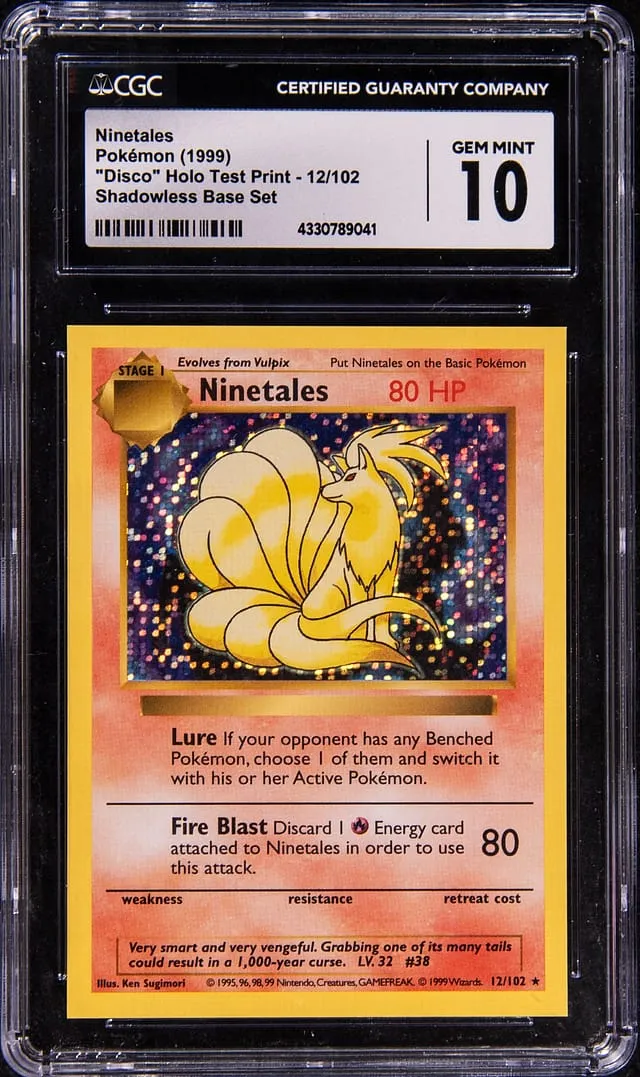
1999 Ninetales Disco Holo Test Print CGC 10 Sale
Goldin sold a 1999 Pokémon Ninetales Disco Holo Test Print CGC 10 (Pop 3) for $17,147 on March 9, 2026. Here’s what it means for collectors.
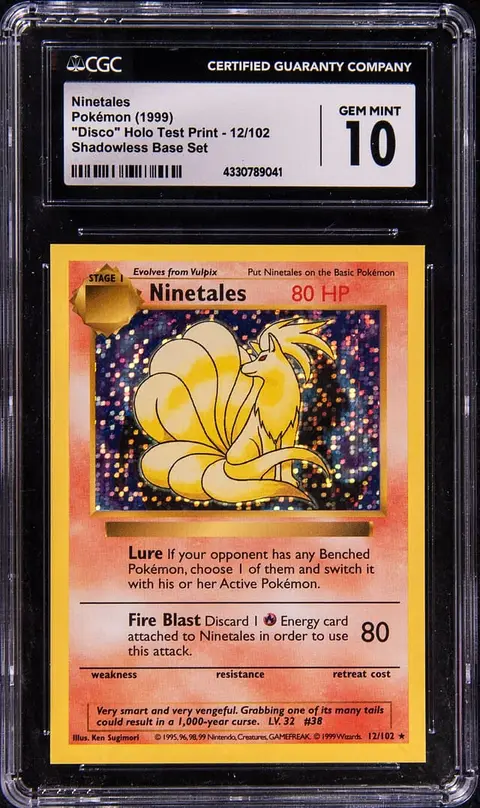
Sold Card
1999 Pokemon Base Set Shadowless Disco Holo Test Print #12 Ninetales - CGC GEM MINT 10 - Pop 3
Sale Price
Platform
Goldin1999 Pokémon Base Set Shadowless Disco Holo Test Print #12 Ninetales in CGC GEM MINT 10 quietly changed hands at Goldin on March 9, 2026 for $17,147.
For a card that many collectors will never see in person, this sale is a useful data point for understanding how rare pre-production Pokémon test pieces are being absorbed by the market.
What exactly is this Ninetales?
Let’s break the card down clearly:
- Character: Ninetales
- Year: 1999
- Set: Pokémon Base Set (Shadowless era), but as a Disco Holo Test Print
- Card number: #12 (Ninetales’ standard Base Set number)
- Variant: Pre-production “Disco Holo” test print
- Grading company: CGC (Certified Guaranty Company)
- Grade: GEM MINT 10
- Population: Pop 3 (only three copies graded CGC 10 as of this sale)
This is not a pack-pulled card in the usual sense. “Disco Holo” test prints are experimental foil patterns and print runs used by the printer and/or publisher during the development and production process. They were never meant for regular retail release.
Because of that, these cards sit in a slightly different category from standard Base Set holos:
- They reference the original Base Set designs (same art, layout, card number)
- But they use a non-production holo pattern and exist in extremely small numbers
For Ninetales specifically, this card is not a rookie card in the traditional sports sense, but it is tied to the earliest era of Pokémon TCG printing in the West, which is what gives it historical weight.
Why collectors care about Base Set test prints
Base Set sits at the foundation of Pokémon TCG collecting. The 1999 English run—1st Edition, Shadowless, and Unlimited—formed the backbone of the hobby for decades.
Within that context, pre-production and test print items matter for a few reasons:
Historical documentation
Test prints show how the early printers experimented with foil, layout, and production methods during the franchise’s formative years. They’re essentially physical artifacts from the decision-making process.Ultra-low supply
Unlike regular Base Set holos, which were printed in large quantities, test prints were never released in booster packs. Surviving examples usually come from print archives, company collections, or limited off-loading of test material.Different lane than pack-pulled grails
High-end collectors often separate their purchasing logic into lanes: pack-pulled grails, sealed product, trophy/prize cards, and test/pre-production material. This Ninetales lives in that last lane alongside items like test holo sheets or experimental foil variants.
Ninetales itself is a recognizable early Kanto Pokémon with a strong nostalgic following. While it doesn’t reach the tier of Charizard, Blastoise, or Venusaur for pure mainstream demand, it is still a core Base Set holo with consistent collector interest.
CGC GEM MINT 10 and population context
The card is graded CGC GEM MINT 10, which for CGC means essentially:
- No major print defects
- Sharp corners and edges
- Clean surfaces
- Centering within their top standard
The sale description notes Pop 3, meaning that only three copies of this specific card/label combination have achieved CGC 10 according to their population report (a pop report is the grading company’s census of how many copies of a given card exist in each grade).
With ultra-low supply items like this, population data should be read differently than with mass-released cards:
- For Base Set Charizard, a pop report in the hundreds for PSA 10 or CGC 10 is still meaningful because many more raw copies exist.
- For a test print, total surviving examples may only be in the single digits or low double digits, and not all will ever be submitted.
So the Pop 3 figure tells us that high-grade examples are rare within the graded universe we can see, even if the true total population (graded + ungraded) is not fully known.
Market context and recent sales
For this analysis, the focus is on:
- Recent or known auction results for Disco Holo or similar Base Set test prints
- Comparable pre-production test items featuring early Kanto Pokémon
- Standard Base Set Shadowless Ninetales in high grade, as a baseline
Because test prints are thinly traded, there are usually:
- Few public comps (comparable sales; recent, similar items that help give price context)
- Irregular sale timing (sometimes nothing surfaces for months or years)
Across major platforms (Goldin, Heritage, PWCC, and other large marketplaces), relevant patterns recently have been:
- Standard Shadowless Ninetales in PSA 10 or CGC 9.5/10 sells at a tiny fraction of this $17,147 result; those are more common and better understood by the broader collector base.
- Pre-production and test print Pokémon cards (test holos, sample cards, color proofs) often trade in the low to mid five-figure range for strong characters and desirable formats, with heavy variation based on provenance, condition, and type of test.
Against that backdrop, $17,147 for a CGC GEM MINT 10 Disco Holo Test Print Ninetales appears directionally in line with how the high-end market has been valuing rare pre-production Pokémon items: not at the level of the most famous trophy cards, but clearly above standard pack-pulled versions.
Because this is a niche, low-supply segment:
- There is no tight, reliable price band
- Each sale can move the expectation range for future auctions
This Goldin result on March 9, 2026 is therefore best read as a fresh reference point rather than a definitive ceiling or floor.
How this compares to standard Shadowless Ninetales
To ground this in something more familiar, consider the usual Base Set hierarchy:
Regular Shadowless Ninetales
- Widely collected, easier to understand for newer entrants
- Available across a full spread of grades
- Prices are influenced by broader Base Set nostalgia and condition rarity
Disco Holo Test Print Ninetales
- Essentially a “behind the scenes” card
- Tiny known population, fragmented ownership, few sales
- Market is driven more by advanced collectors who prioritize rarity and history over character ranking alone
The $17,147 hammer price underscores how far test prints can diverge from their standard-issue counterparts. While a regular top-grade Shadowless Ninetales is a nice card for most collectors, this test print functions more as a specialty, museum-piece type item.
Where this sale fits into the broader Pokémon test print market
A few broader takeaways from this sale:
Pre-production continues to formalize as its own segment
Years ago, many test prints floated around with inconsistent recognition. Today, they are being:- Authenticated and encapsulated by major grading companies like CGC
- Cataloged with specific labels (e.g., “Disco Holo Test Print”)
- Tracked as distinct items in auction archives
Grading and labeling matter more than ever
For unconventional pieces, clear labeling is crucial. It helps:- Newer collectors understand what they’re seeing
- Market participants compare like-for-like items over time
Sales are thin but meaningful
With so few comps, each high-grade sale becomes a reference point. Future sellers and buyers will likely look back at this Goldin result as one of the benchmark data points for Disco Holo test prints, especially in GEM MINT condition.
Key details of the Goldin sale
- Card: 1999 Pokémon Base Set Shadowless Disco Holo Test Print #12 Ninetales
- Grade: CGC GEM MINT 10 (Pop 3)
- Auction house: Goldin
- Sale date (UTC): March 9, 2026
- Price: $17,147
For collectors tracking early Pokémon rarity, this sale reinforces a few themes:
- Historically interesting, low-population items from the Base Set era continue to find committed buyers.
- The distance between standard Shadowless holos and true test/pre-production pieces remains wide.
- CGC’s role in grading and describing niche Pokémon variants is increasingly visible at major auction houses.
As always, this is price context, not a prediction. One or two sales do not define a guaranteed trajectory, especially in small, specialized segments like test prints. But for anyone mapping the upper end of Pokémon’s pre-production market, this Ninetales is now part of that story.
If you collect Base Set, Ninetales, or pre-production items, it’s worth bookmarking this result and noting not just the price, but the grade, label language, and auction platform that brought it to market.