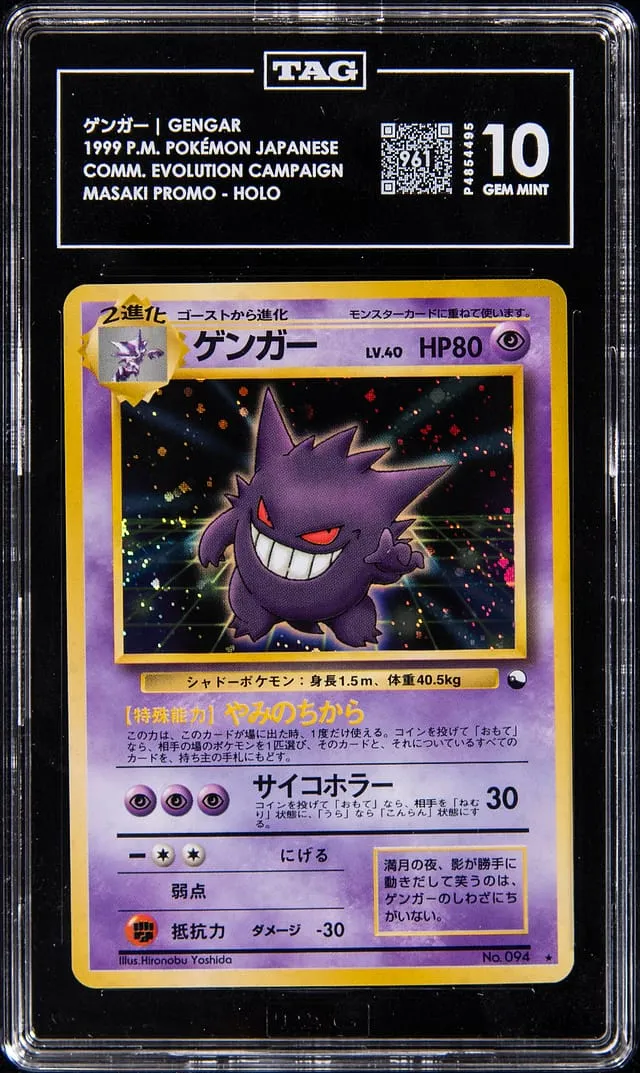
1999 Masaki Gengar TAG 10 Sale Tops $100K
Goldin sold a 1999 Japanese Masaki Promo Gengar TAG GEM MINT 10 (Pop 1) for $101,260. See how this six‑figure result fits the promo’s market.
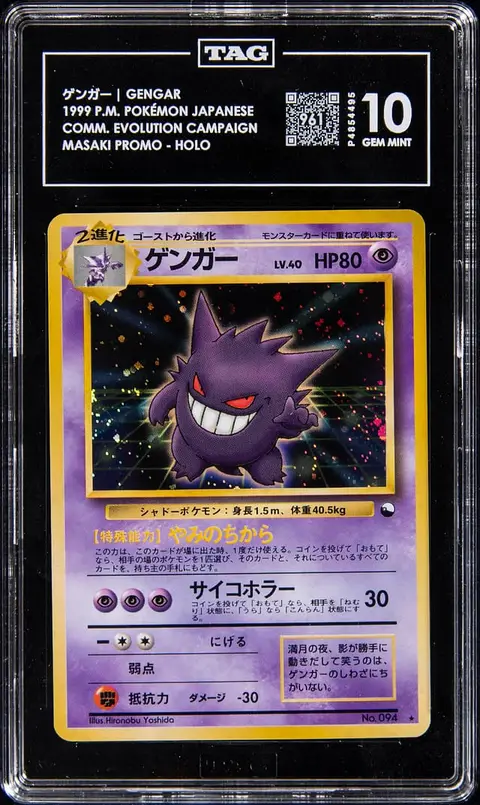
Sold Card
1999 Pokemon Japanese Commemorative Evolution Campaign Masaki Promo Holo #094 Gengar - TAG GEM MINT 10 - Pop 1
Sale Price
Platform
Goldin1999 Pokémon Japanese Commemorative Evolution Campaign Masaki Promo Holo #094 Gengar – TAG GEM MINT 10 – Pop 1
On April 6, 2026, a true niche grail in the vintage Pokémon lane crossed the auction block at Goldin: a 1999 Pokémon Japanese Commemorative Evolution Campaign Masaki Promo Holo #094 Gengar, graded TAG GEM MINT 10, and noted as a population 1. The card realized $101,260.
For a promo that was never released in English and required a mail-in process in Japan, this result offers an interesting data point for collectors who track high-end Japanese Gengar and Masaki promos.
Card snapshot
- Character: Gengar
- Year: 1999
- Set / Release: Japanese Commemorative Evolution Campaign (often called “Masaki promos”)
- Card number: #094
- Language / Region: Japanese
- Type: Holofoil promo card
- Key status: Widely regarded as a key Gengar card and a chase card within the Masaki promo run
- Grading company: TAG
- Grade: GEM MINT 10
- Population: Pop 1 (only one copy graded GEM MINT 10 by TAG at the time of sale)
- Auction house: Goldin
- Sale date (UTC): 2026-04-06
- Sale price: $101,260
There is no autograph, patch, or serial numbering here. The appeal is almost entirely about the card’s origin, condition, and how tough high-grade Masaki promos are relative to their age and distribution.
What is the Masaki Evolution Campaign?
The “Commemorative Evolution Campaign” is better known in the hobby as the Masaki promo series, named after the Game Freak designer Kouichi Masaki. These were late-1990s Japanese mail-in exchange promos. Players submitted specific cards to receive upgraded evolution forms by mail.
The Gengar in this run is part of a small group of evolved forms (including cards like Alakazam and Golem) that have become cult favorites for collectors of early Japanese exclusives.
Key points about the Masaki promos:
- Mail-in distribution: You had to send in cards to receive these, meaning not every player did it and many cards were handled like game pieces, not collectibles.
- Era: 1999 places them solidly in the early, pre–WOTC-English-boom Japanese era.
- Condition sensitivity: As with many late-90s promos, print and handling quality were inconsistent, and surviving gem-mint copies are relatively scarce.
The Masaki Gengar is not a “rookie card” in the sports sense, but within Gengar’s hobby history it is considered one of the character’s key early issues.
Understanding the $101,260 sale price
At $101,260, this TAG GEM MINT 10 sale belongs in the very high end of the Japanese Gengar and promo market. To understand what that means, it helps to look at a few layers of context.
1. Pop report and grading
A pop report (population report) is the census of how many copies of a given card have been graded at each grade by a grading company.
- This card is noted as Pop 1 in TAG GEM MINT 10, meaning it is the only example at that grade, at least at the time of sale.
- TAG is a newer grading company compared with PSA or BGS, and its population report is much smaller overall. That said, a pop 1 GEM MINT 10 still underscores that few Masaki Gengars have crossed their slab in top condition.
Because the sale is in a TAG holder, direct pop and price comparisons to PSA 10 or BGS 9.5/10 are not one-to-one. Collectors will often compare across companies, but they do so with an understanding that market preference and liquidity can differ by label.
2. Context from comparable sales (“comps”)
When collectors talk about “comps”, they mean recent comparable sales that help establish a realistic price range.
For a card like this, the relevant comps are:
- Other Masaki Gengar sales in high grade (especially PSA 9 and PSA 10).
- High-end Japanese Gengar key issues from the late 90s and early 2000s.
- Other Masaki promos (Alakazam, Golem, etc.) in gem-mint grades.
Publicly available data over the past few years has shown:
- PSA 10 Japanese Masaki Gengar promos have sold in the tens of thousands of dollars range, depending on timing and auction venue.
- PSA 9 copies have typically landed well below PSA 10s, with noticeable gaps between strong 9s and low 10s, which is common for important late-90s promos.
Because this particular sale involves a TAG GEM MINT 10 and not a PSA 10 or BGS 10, the market is effectively pricing:
- The card itself (Masaki Gengar, a known key piece);
- The scarcity of gem-level copies in any holder;
- The confidence level bidders have in TAG grading; and
- The auction environment at Goldin on April 6, 2026.
Given that many Masaki Gengar comps in high grade have already been strong, a finalized price above $100,000 positions this as a top-end outlier in the broader Gengar lane, even if it may sit roughly in line with what some collectors would expect for a pop 1 gem in a premium auction setting.
3. Typical, low, or high?
Relative to the general market for Gengar and Japanese promos:
- This result looks high in absolute terms, reflecting both character popularity and the niche appeal of early Japanese exclusives.
- Relative to other Masaki Gengar sales in strong grades, this appears on the upper end of the spectrum, which is consistent with its pop 1 gem status and the visibility of a sale at a major house like Goldin.
Because TAG population data and long-term price history are more limited than PSA’s, it is better to treat this sale as one strong benchmark rather than a definitive long-term price anchor.
Why collectors care about Masaki Gengar
Several factors converge to give this card its weight in the hobby.
1. Early-era Japanese history
The Commemorative Evolution / Masaki promos arrive at a time when:
- Pokémon was still primarily a Japanese phenomenon, even as it was starting to spread globally.
- Promotional campaigns like mail-in exchanges felt more like game-related rewards than collectibles.
For collectors who appreciate the roots of the TCG in Japan, Masaki promos are a clean representation of that early ecosystem.
2. Character: Gengar
Gengar has:
- A long-standing role as one of the most recognizable Ghost-type Pokémon.
- Strong crossover appeal with both players and collectors.
- A track record of high demand across multiple eras (WOTC holos, Japanese exclusives, modern sets, and alt arts).
Within Gengar’s card history, the Masaki promo is often listed alongside other key Gengar pieces (like early Japanese holos and notable alt arts) when collectors map out a character-focused checklist.
3. Condition and survivorship
Like many mail-in or campaign promos from the 90s:
- Cards were often handled, played, or stored casually.
- Centering, edges, and surface quality could vary from copy to copy.
The result is that true gem-mint copies are thin on the ground, especially once you restrict to a single grading company. That scarcity matters more for collectors who prize top-of-the-census examples.
4. Vintage vs. modern dynamics
This card sits in what many collectors would call early vintage or early-era Pokémon:
- Print runs were lower than many modern sets.
- Japanese promo distribution was targeted and sometimes complicated.
- There are fewer sealed sources left to crack.
Unlike ultra-modern chase cards that can see waves of new supply as more product is opened, Masaki promos are largely a fixed pool, and the number of cards that can realistically grade gem over time tends to move slowly.
What this sale might mean for the market
It’s important to avoid reading any single auction as a market-wide signal, but there are reasonable takeaways for different types of collectors.
For Gengar and Masaki collectors
- This sale reinforces that the top 1–2% of condition for Masaki Gengar can command a significant premium over mid and even high grades.
- Pop 1 status in any reputable holder is likely to remain a niche focus, but it does underscore the depth of demand for true best-in-class copies.
For Japanese promo enthusiasts
- The result supports a broader pattern: early Japanese promos with mail-in or limited-release histories continue to attract serious bidders when they appear at major auction houses.
- It also shows that language barriers are less of an obstacle at the high end; character and history can outweigh the lack of English text.
For newer or returning collectors
A sale like this does not mean that every Masaki promo is a six-figure card. Instead, it highlights how pricing can stretch when several factors align:
- Early-era, historically interesting promo
- Popular character
- Top-of-the-pop condition
- Visibility through a major auction venue
If you’re building a collection, it can be helpful to:
- Look at recent comps across grades to see how price steps up from raw to 8s, 9s, and gems.
- Decide whether you care more about owning the card, owning a high grade, or chasing top-of-the-census examples.
Using this sale as a reference point (not a forecast)
For figoca users tracking market history, the key takeaways from this Goldin sale on April 6, 2026 are:
- The 1999 Japanese Commemorative Evolution Campaign Masaki Promo Holo #094 Gengar in TAG GEM MINT 10 (Pop 1) realized $101,260.
- This sits toward the upper tier of historical sales for Masaki Gengar, particularly when compared with high-grade PSA comps.
- The sale emphasizes how scarcity plus condition plus character can converge to produce standout results, especially in a curated auction setting.
As more Japanese promos change hands and additional data points appear across grading companies, this sale will be one of the more notable benchmarks in the Masaki Gengar timeline—useful for understanding how the market values the intersection of history, character collecting, and true gem condition.