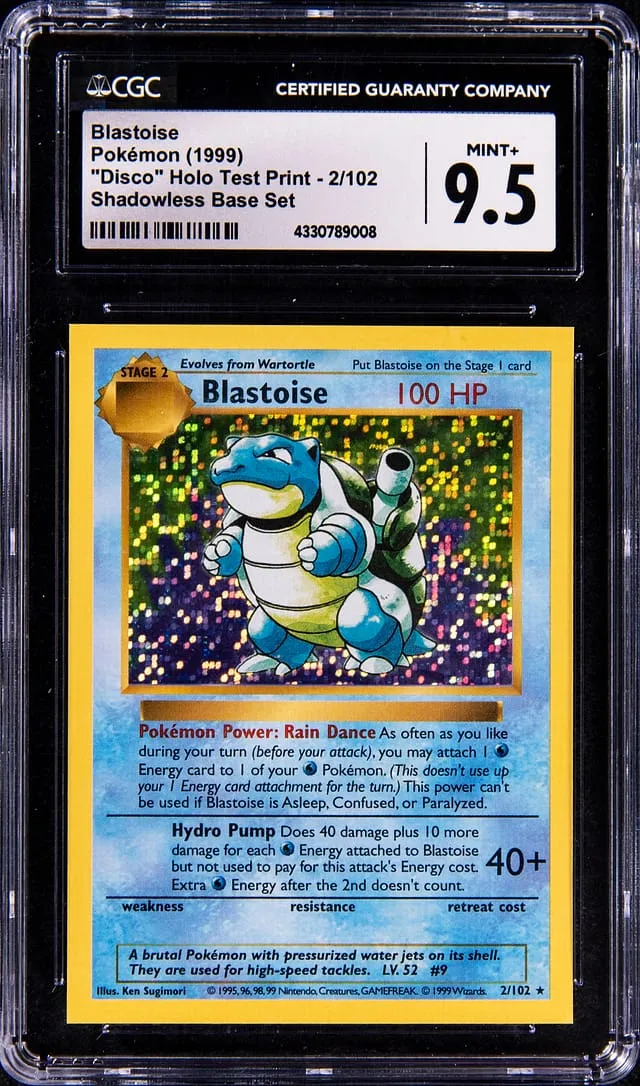
1999 Disco Holo Test Blastoise CGC 9.5 Sells
A 1999 Pokémon Base Set Shadowless Disco Holo Test Print #2 Blastoise CGC 9.5 sold for $12,810 at goldin. See how this rare prototype fits the market.
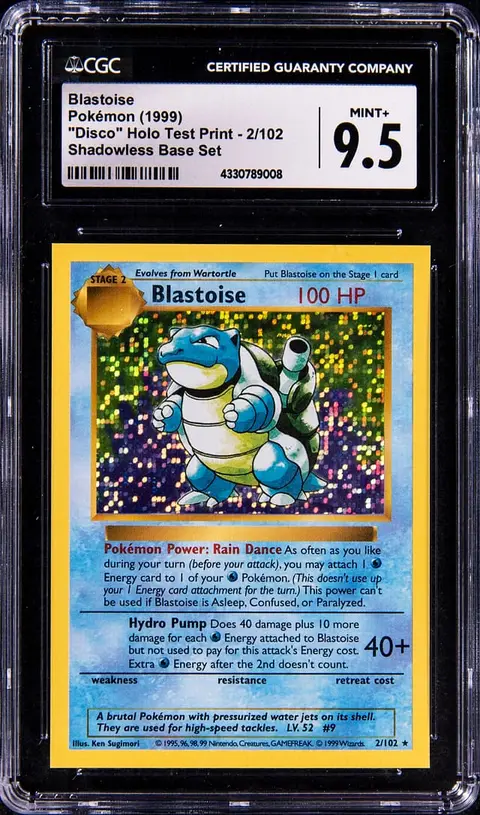
Sold Card
1999 Pokemon Base Set Shadowless Disco Holo Test Print #2 Blastoise - CGC MINT+ 9.5
Sale Price
Platform
Goldin1999 Pokemon Base Set Shadowless Disco Holo Test Print #2 Blastoise - CGC MINT+ 9.5 Sells for $12,810
When a truly unusual Pokémon test print surfaces at public auction, collectors tend to pause and take notice. That is exactly what happened at goldin on March 9, 2026, when a 1999 Pokémon Base Set Shadowless “Disco Holo” Test Print #2 Blastoise, graded CGC MINT+ 9.5, sold for $12,810.
Below, we break down what this card is, why it matters, and how this sale fits into the broader Pokémon market.
What exactly is the “Disco Holo” Shadowless Blastoise?
Card ID
- Year: 1999 (Wizards of the Coast era)
- Game: Pokémon TCG
- Character: Blastoise
- Set family: Base Set (Shadowless era), but this is a test print, not a pack-issued card
- Variant: “Disco Holo” / test foil pattern
- Card designation: Often cataloged as a “Test Print #2 Blastoise” by graders and auction houses
- Era: Vintage
Unlike the standard 1999 Shadowless Base Set Blastoise that came from retail booster packs, this “Disco Holo” is a production test sheet card. It was never meant to be distributed to players. Instead, it is believed to have been used internally to test foil and layout.
Because of that, it functions more like a prototype or proof than a normal chase card. For many advanced collectors, test prints sit in a category of their own: not tournament-legal, not pack-pulled, but critical to understanding how the earliest Pokémon cards were made.
Grading details: CGC MINT+ 9.5
This copy was graded by CGC (Certified Guaranty Company), one of the major grading companies in the TCG space.
- Grading company: CGC
- Grade: MINT+ 9.5
In CGC’s scale, a 9.5 sits just under gem mint, representing a card with extremely minimal flaws under close inspection. For a late-1990s test print that likely never had the same handling standards as pack-issued cards, that level of preservation is notable.
No additional attributes were noted in the sale description (such as autograph or serial numbering). The core appeal here is:
- Early WotC vintage era
- Test print / prototype status
- High technical grade
Why collectors care about this Blastoise test print
1. Blastoise is a cornerstone Gen 1 starter
Blastoise sits firmly in the Gen 1 “big three” alongside Charizard and Venusaur. While Charizard tends to dominate auction headlines, high-end, unusual Blastoise pieces have gained a more focused collector base over the last several years.
For many hobbyists who grew up with the Game Boy games and early TCG, Blastoise was their first starter evolution or their first major holo pull. That nostalgia helps support demand across:
- Standard Shadowless and 1st Edition Base holos
- Staff promos and unique distributions
- Prototypes and test prints like this one
2. Test print / prototype appeal
Test prints are not part of normal set checklists. They often feature:
- Unusual foil patterns or ink layouts
- Non-final backs or fronts
- Anomalous fonts, borders, or colors
This “Disco Holo” test Blastoise reflects that experimental phase. For collectors who focus on the history of how Pokémon cards were made, items like this document the design and production process at Wizards of the Coast in 1999.
Because many test pieces were never intentionally released, their survival often depends on small chains of custody: former employees, early collectors who acquired them second-hand, or later hobbyists who recognized their importance. That irregular path tends to keep populations low.
3. Vintage era scarcity, not just condition scarcity
Vintage Pokémon (late 1990s to early 2000s) is widely collected, but most attention goes to pack-issued holos. Test prints sit underneath that surface collecting layer.
The scarcity here has two parts:
- Production scarcity – test runs would have been very small compared to retail print runs.
- Survival and grading scarcity – few copies make it into major grading company holders, and even fewer reach CGC 9.5 and above.
That combination allows a card like this to stand out even in a crowded market of high-grade, standard-issue Blastoise cards.
Market context: how does $12,810 fit in?
This sale at goldin on March 9, 2026 closed at $12,810. For context, it helps to compare this to:
- Known sales of similar test prints
- High-grade mainstream Blastoise cards
Because test prints and prototypes typically trade infrequently and often privately, public “comps” (recent comparable sales) can be sparse. That makes it harder to draw tight price bands the way we can for more common cards.
What we can say with reasonable confidence:
Mainstream Shadowless and 1st Edition Blastoise
- High-grade PSA 9 and PSA 10 Shadowless and 1st Edition Blastoise have established price ranges, with multiple public sales per year on major platforms. Their values reflect broader nostalgia demand and are far easier to track.
- Those cards have more predictable price movement because the population is larger and sales are more frequent.
Prototype and test print Blastoise cards
- Highly unusual pieces such as the Wizards “Galaxy Star” test prints or various experimental foil patterns tend to appear irregularly at auction.
- When they do surface, they often realize strong prices relative to mainstream Blastoise issues despite having far fewer recorded sales.
Within that context, a price point of $12,810 for a CGC 9.5 “Disco Holo” Shadowless Test Print #2 Blastoise sits in a tier consistent with:
- A niche, historically significant prototype
- Strong but targeted demand from advanced collectors
Because there are so few direct public comps, it is more accurate to view this realized price as an updated data point rather than a definitive market benchmark. Future sales of similar test prints in different grades or with different provenance will add clarity over time.
How this sale fits into broader Pokémon trends
A few longer-term hobby trends intersect here:
Increased interest in production history
As the Pokémon TCG matures, more collectors are moving beyond booster box ripping and standard set collecting toward items that document the franchise’s development—things like:- Test prints
- Sample cards
- Pre-release variations and staff promos
Prototype-level Blastoise pieces fall directly into that lane.
Graders’ role in cataloging oddities
Companies like CGC have been active in labeling and encapsulating unusual TCG items. Clear labeling such as “Test Print” helps:- Standardize terminology
- Make auction listings easier to search and verify
- Give collectors more confidence that what they’re buying is what it claims to be
Selective strength at the high end
Even when more common cards soften or move sideways, rare, well-documented oddities often continue to draw focused interest. This doesn’t mean they are immune to broader market shifts, but they tend to be less driven by short-term hype and more by deep collector demand.
What this means for collectors and small sellers
For collectors:
- If you collect Blastoise specifically, this sale reinforces that the character’s market extends beyond standard set cards. Rare prototypes and test pieces continue to carve out their own lane.
- If you focus on WotC-era production history, this is another example of how test prints can command meaningful prices when authenticated and properly described.
For small sellers:
- Unusual or misprinted vintage cards are worth a closer look. When in doubt, researching similar items and consulting grading company resources can help clarify whether you’re holding a common error or something truly scarce.
- Public results like this one at goldin give you an additional reference point when evaluating rare, non-standard Pokémon items, while still recognizing that each test print can be unique.
Key takeaways
- A 1999 Pokémon Base Set Shadowless “Disco Holo” Test Print #2 Blastoise graded CGC MINT+ 9.5 sold for $12,810 at goldin on March 9, 2026 (UTC).
- The card is a test print/prototype, not a pack-issued card, which puts it in a niche category focused on production history and rarity rather than gameplay.
- Limited public comps make this sale a notable data point rather than a full price guide, but the result aligns with sustained interest in rare, vintage Pokémon oddities.
As more early test prints surface and are documented by graders and auction houses, the market’s understanding of how to value and contextualize them will continue to evolve. For now, this CGC 9.5 Blastoise stands as a strong example of how deep the hobby’s interest in Pokémon’s earliest production history has become.