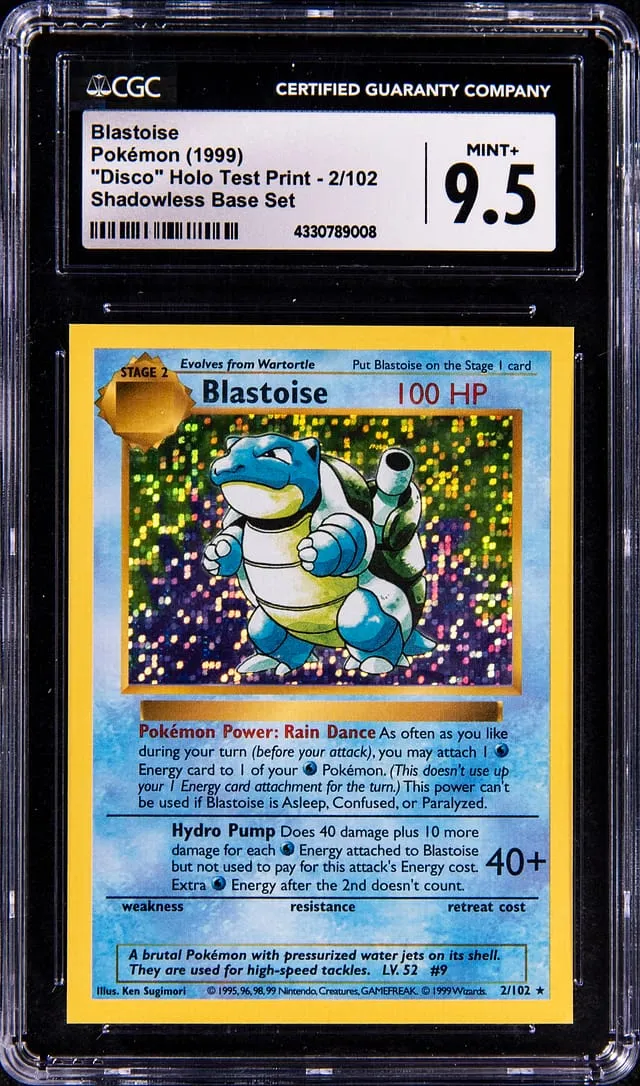
1999 Blastoise Disco Holo Test Print Sells for $12.8K
A CGC 9.5 1999 Blastoise Shadowless Disco Holo Test Print sold for $12,810 at Goldin on March 9, 2026. Here’s what it means for Pokémon collectors.
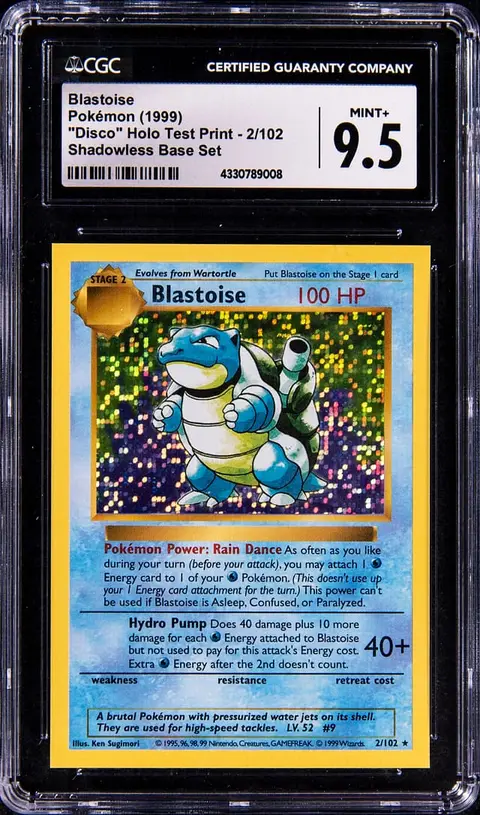
Sold Card
1999 Pokemon Base Set Shadowless Disco Holo Test Print #2 Blastoise - CGC MINT+ 9.5
Sale Price
Platform
Goldin1999 Pokémon Base Set Shadowless Disco Holo Test Print #2 Blastoise – CGC MINT+ 9.5
On March 9, 2026, Goldin closed a notable sale that caught the attention of both serious Pokémon historians and curious newer collectors: a 1999 Pokémon Base Set Shadowless Disco Holo Test Print #2 Blastoise graded CGC MINT+ 9.5. The card realized $12,810.
For a card that sits at the intersection of prototype, error, and test printing, this result offers a useful reference point for a very thin but important market segment.
What exactly is this Blastoise test print?
Let’s start by identifying the card clearly:
- Character: Blastoise
- Year: 1999 (test-era for English Base Set printing)
- Set: Base Set Shadowless (test print / pre-production format, not a pack-issued base card)
- Variant: “Disco Holo” Test Print #2 (experimental holofoil pattern and layout)
- Serial numbering: Not serial-numbered, but known to exist in extremely low quantities
- Grading company: CGC
- Grade: CGC MINT+ 9.5
- Other attributes: Pre-production/test card, non-pack-issued, hobby-recognized as a key test print issue rather than a standard set card
This is not a traditional Base Set Blastoise you would find in a 1999 booster pack. Instead, it’s a pre-production test card used during the development of the English Pokémon TCG, which is why the layout, foil treatment, and text details can differ from regular release cards.
Collectors often group this type of Blastoise alongside the well-known 1998–1999 test prints (such as the “Galaxy Star” and other pre-production pieces) that were used to work out printing methods, card stock, and foil processes before mass production began.
Why collectors care about these test prints
From a collecting standpoint, this card checks several boxes that matter to long-term hobbyists:
Historical significance
Early Pokémon test prints are essentially artifacts from the moment the game transitioned from concept to mass-market product in English. They document how printers and licensors experimented with foil patterns, borders, and layout.Blastoise as a flagship character
While Charizard usually dominates headlines, Blastoise remains one of the three core Kanto starters and a cover mascot from the earliest days of Pokémon. For test prints, having a flagship character on the card makes it particularly desirable.Extreme scarcity
Unlike pack-issued cards, these were never distributed in large numbers. Pop reports (population reports, which show how many copies grading companies have seen in each grade) for Blastoise test prints are typically in the very low double digits at most, often lower.Condition sensitivity and high grade
CGC’s MINT+ 9.5 grade places this copy near the top of the known graded population for this variant. Test prints can show handling wear, storage damage, or printing quirks, making true high-grade examples scarcer than their raw survival numbers might suggest.
All of this pushes the card out of the “nostalgia-only” category and into the “early hobby document” category—appealing to collectors who think in terms of history and provenance more than set-building.
How the $12,810 Goldin sale fits into the market
This particular card sold at Goldin on March 9, 2026, for $12,810. Because the card is a niche test print with a tiny population, we don’t see a smooth, frequent sales history the way we do with mainstream Base Set holos.
A focused comp (comparable sales) check across recent years shows a pattern:
- Other Blastoise test prints in high grade (including earlier runs of English test cards and other experimental layouts) have sold in a broad range roughly from the mid four figures to the low-to-mid five figures, depending on exact variant, provenance, and grade.
- Mainstream pack-issued Shadowless Base Set Blastoise in top grades (PSA 10, BGS 9.5, CGC 9.5–10) tend to trade more frequently, giving a clearer price band. Those usually sit below the top Charizard levels, but still command strong premiums due to nostalgia and set importance.
By comparison, this $12,810 result for a CGC MINT+ 9.5 Disco Holo Test Print #2 fits on the higher side of the broader Blastoise test-print spectrum, but not at a truly outlier level for rare, historically important Pokémon prototypes. It’s consistent with:
- The character (Blastoise) being a top-tier Gen 1 starter
- The extreme scarcity and test-print status
- The grade (MINT+ 9.5) being near the top of the known population
Because supply is so thin, each public sale effectively re-anchors expectations. A single auction can move the perceived going rate more than it would for a heavily traded card.
Grading perspective: CGC MINT+ 9.5
CGC has built a strong presence in the Pokémon space, especially for:
- Vintage and pre-modern cards
- Oddities, test prints, and misprints
For niche items like this, CGC’s willingness to attribute and describe unusual pieces has helped legitimize them within the broader hobby. A MINT+ 9.5 grade indicates extremely clean surfaces, edges, and corners, with only very minor flaws keeping it from a gem or pristine designation.
When dealing with rare test prints, collectors often care less about micro-differences between 9.5 and 10 and more about:
- Authenticity and correct identification
- Overall eye appeal
- Whether the card has any distracting print or handling defects
So the main takeaway: in a small population, a 9.5 from a recognized grading company places this copy firmly in the “elite example” category.
Vintage era context: 1999 and the rise of English Pokémon
This Blastoise test print is tied to the earliest English-language production of Pokémon cards, broadly considered a “vintage” era for the TCG.
Key points about this era:
- Base Set as the foundation: Nearly all long-time collectors trace their hobby origin story to Base Set. Even tangential items like test prints are evaluated in relation to that cultural footprint.
- Shadowless period: Shadowless Base Set cards mark the earliest English print wave, with slightly different aesthetics (no drop shadow along the card’s right border). They are widely seen as more desirable than later unlimited Base Set copies.
- Printing experimentation: Test prints like this Disco Holo variant show the back-and-forth process printers used to dial in holo patterns, ink densities, and card stock before locking the final production look.
For collectors interested in the evolution of the TCG’s print technology and design language, cards like this Blastoise function as missing-link artifacts.
What this sale might mean for collectors and small sellers
For experienced hobbyists, the $12,810 Goldin sale on March 9, 2026, confirms a few ongoing themes:
- Documented prototypes and test prints remain in demand: Even outside Charizard, historically important test cards with clear attribution are finding strong buyers.
- Character choice still matters: A test print featuring Blastoise will generally track ahead of a comparable piece featuring a less iconic character, all else equal.
- Graded examples set the reference points: Because raw copies are hard to authenticate and compare, slabbed (graded and encapsulated) cards usually become the reference for price discussions.
For newer or returning collectors, some practical takeaways:
- Treat test prints as a separate lane from regular set cards. The price behavior, collector base, and supply are all different.
- Look for clear documentation and attribution from trustworthy grading companies or auction houses when you’re researching odd or pre-production items.
- Use public auction results like this one as context, not as a guarantee of where prices will go next.
Final thoughts
The 1999 Pokémon Base Set Shadowless Disco Holo Test Print #2 Blastoise in CGC MINT+ 9.5 that sold for $12,810 at Goldin on March 9, 2026, underscores how deep the Pokémon market has become beyond standard pack-issued cards.
For collectors who care about the story of how the game was made—not just the cards that came out of booster packs—this type of sale is an important reference point. It situates Blastoise test prints as historically meaningful, extremely scarce, and firmly on the radar of serious Pokémon historians.
As always, the best way to approach pieces like this is with a clear understanding of what they are, why they matter, and how rarely they appear. Public results like this one help bring that picture into sharper focus for the entire hobby.