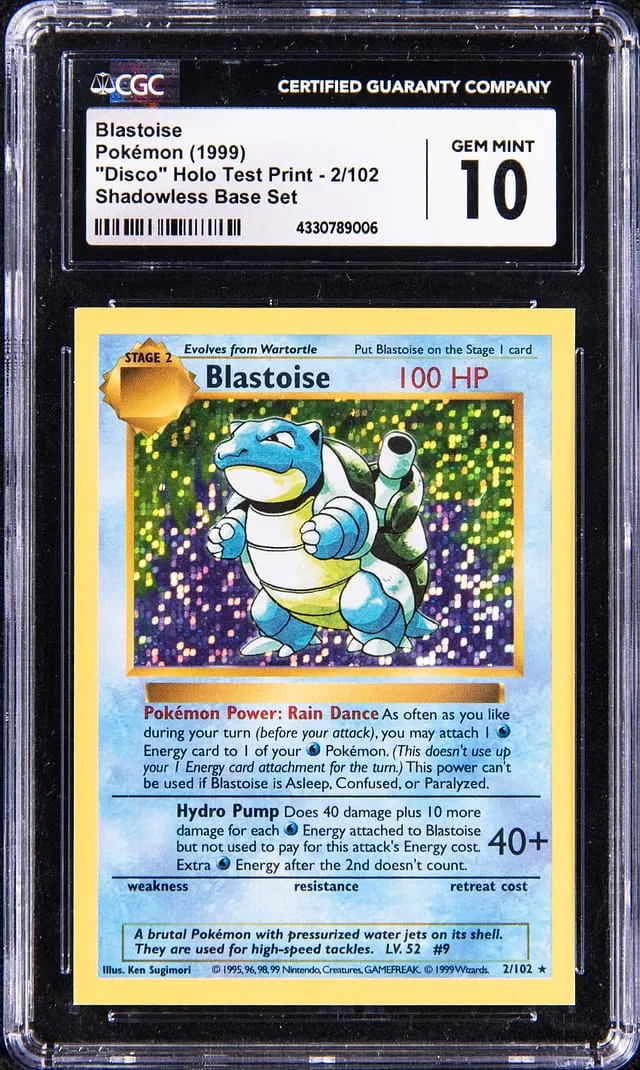
1999 Blastoise Disco Holo Test Print CGC 10 Sale
A $19,840 Goldin sale for a 1999 Blastoise Shadowless Disco Holo Test Print CGC 10 Pop 3 adds a key data point to the vintage Pokémon test print market.
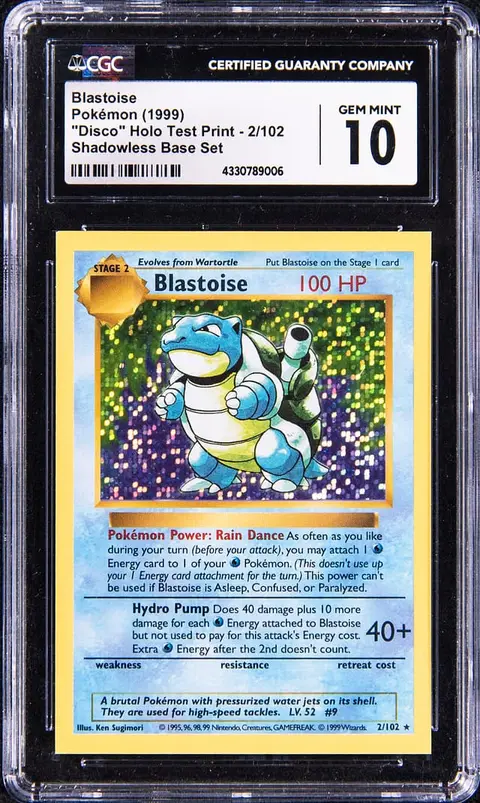
Sold Card
1999 Pokemon Base Set Shadowless Disco Holo Test Print #2 Blastoise - CGC GEM MINT 10 - Pop 3
Sale Price
Platform
Goldin1999 Pokémon Base Set Shadowless Disco Holo Test Print #2 Blastoise (CGC GEM MINT 10, Pop 3) sold for $19,840 at Goldin on February 16, 2026. For a niche, pre-release test print, that is a notable result and a useful data point for anyone following the high-end vintage Pokémon market.
In this article, we’ll walk through what this card actually is, why collectors care, and how this sale fits into the broader market context.
Card at a glance
- Character: Blastoise
- Year: 1999
- Set / Type: Base Set-era Shadowless “Disco Holo” Test Print #2 (pre-production / test print, not a pack-issued card)
- Card number: Test Print #2 (non-standard numbering; part of a small test run)
- Variant: “Disco Holo” test pattern, Shadowless layout
- Era: Vintage (late 1990s)
- Grading company: CGC Trading Cards
- Grade: CGC GEM MINT 10
- Population: Pop 3 in this grade (per the sale description)
- Attributes: Pre-production test print, extremely low population, key early WOTC-era oddity
This is not a standard 1999 Base Set Blastoise you’d pull from a booster pack. It is a test print – a card produced as part of the printing and finishing experiments around the original English Base Set. The "Disco Holo" nickname usually refers to a distinctive, patterned foil effect that differs from the production holofoil we see on pack-issued cards.
What is a Base Set Shadowless Disco Holo Test Print?
Test prints occupy a small but important niche in Pokémon. They are production proofs, experiments, or internal samples used by printers and licensors to dial in things like:
- Holofoil pattern and brightness
- Card stock thickness and feel
- Color balance and layout tweaks
In this case, the Shadowless Disco Holo Test Print #2 Blastoise sits squarely in that category. While details on exact print quantities are not publicly documented, these cards are generally accepted as extremely limited compared with pack-issued Base Set cards.
Key points collectors focus on:
Shadowless layout
Shadowless Base Set cards are the early print runs that lack the darker “shadow” along the right side of the Pokémon art box. They’re widely viewed as scarcer and more desirable than later unlimited Base Set prints. A test print that already uses this Shadowless frame ties directly into that early, important production window.Disco holo effect
The holofoil pattern on these test prints is different from the final production holofoil. It has a more experimental, “disco” look, which is why the hobby uses that nickname. That makes the card visually distinct even to casual observers.Pre-release nature
Because these were not publicly distributed in 1999 packs, they fall into the category of pre-release production materials. For collectors who focus on the history of the game and its printing, that’s a major draw.Iconic character
While Charizard is the headliner, Blastoise remains one of the most recognizable Base Set starters. In a tiny, experimental run, having a flagship evolution like Blastoise matters.
Grading context: CGC GEM MINT 10, Pop 3
This copy graded CGC GEM MINT 10, which is the top standard grade in CGC’s scale. In practical terms, that means:
- Centering, corners, edges, and surface all present at or near perfect
- No major printing defects beyond those potentially tolerated in a 10
The listing notes a population (pop) of 3 at this grade level. A population report – often called a "pop report" – is the grading company’s public count of how many copies of a card exist at each grade. Pop 3 means only three copies of this exact test print have reached CGC 10 so far.
For test prints, pop reports can be especially meaningful because the total number of existing cards is already low. When only a handful of known copies exist, and just three achieve a true GEM MINT designation, condition scarcity layers on top of the already limited print.
The sale: $19,840 at Goldin (February 16, 2026)
- Auction house: Goldin
- Sale date (UTC): 2026-02-16
- Realized price: $19,840 (hammer + buyer’s premium, as reported)
Goldin has become one of the primary platforms for high-end and specialty Pokémon pieces, alongside other major auctioneers and fixed-price marketplaces. The fact that this test print ran there, rather than only in private sales or low-visibility venues, is itself part of the story: it puts this niche item directly in front of serious collectors and consignors.
Market context and comps
Because this is a specialized test print, exact one-to-one comps (short for "comparable recent sales") are limited. Most public price histories focus on:
- Standard Base Set Blastoise (1st Edition, Shadowless, Unlimited)
- Other rare or experimental Blastoise printings (e.g., pre-release variants, staff promos, or other test / prototype pieces)
Within that broader context, here is how collectors can think about the $19,840 result:
Compared to regular Base Set Blastoise
High-grade pack-issued Base Set Blastoise cards can range from the low four figures to strong five figures depending on edition stamp, grading company, and grade. Test prints sit outside that structure. They appeal less to set-builders chasing completion and more to specialists who prize print history and uniqueness.Within the test print and prototype niche
Across the hobby, notable test print and prototype cards (in Pokémon and other TCGs) often sell in a similar band: mid four figures up through mid-to-high five figures, with outliers in six figures for truly historic or widely-recognized pieces. A result like $19,840 for a pop 3 GEM MINT test print of a flagship Base-era Pokémon fits meaningfully within that range.Grade premium
For niche issues with small populations, each step up in grade can have an outsized effect. While detailed sales history for lower-grade copies of this exact test print is limited publicly, it is reasonable to see a strong premium for a CGC 10 given the pop 3 status.Limited, patchy price history
Because these cards do not change hands often, the market does not have a neat curve of sales every few months. Instead, a single public sale like this becomes a reference point rather than a definitive “true value.” Collectors will likely refer back to this Goldin result when future copies appear.
Where information is thin, it’s more useful to treat this sale as one more data point in a thinly traded segment, not as a concrete benchmark that applies in all situations.
Why collectors care about this card
1. Early WOTC-era history
This test print traces back to the early days of Wizards of the Coast (WOTC) handling the English-language Pokémon TCG. That era carries a lot of nostalgia and historical weight. Items that document how the earliest English sets were created, tested, and refined attract:
- Vintage Pokémon purists
- Printing and production history collectors
- Long-time players who remember Base Set as their entry point
2. Pre-production scarcity
Unlike a numbered insert or a serially stamped modern chase card, there is no official print run size documented for these test prints. But hobby experience, known copies, and grader populations all suggest that they are inherently scarce.
That scarcity is qualitative as much as quantitative: you’re not just chasing a low serial number; you are chasing a card that was never meant for broad public distribution in the first place.
3. Visual and conceptual uniqueness
The “Disco Holo” effect and the Shadowless layout combine to make this card stand out even in a display of high-end Blastoise pieces. For many collectors, one compelling part of test prints is that they show alternate design directions that could have been used in the final product but were not.
Owning a copy is not only about rarity; it’s about holding a piece of the “what if” pathway of Base Set’s visual identity.
4. Cross-collector appeal
This card can slot into multiple collecting lanes:
- Blastoise character PC (player collection)
- Base Set / early WOTC history
- Test print / prototype focus
- High-grade CGC registry-style collecting
Any time a single card serves several collector niches, you tend to see deeper bidding when it finally surfaces.
Era and condition considerations
Being a 1999 vintage piece, this test print lives in the same calendar window as pack-issued Base Set, but its condition story is different. Test prints and production proofs can be:
- Handled in non-collector environments (print shops, offices)
- Stored without long-term archival care in mind
- Subject to factory-level mishandling or experimental processes
This makes a GEM MINT 10 particularly significant. It suggests the card either remained in careful hands from early on or simply avoided the typical wear that many pre-production items experience.
What this sale may signal
Without over-interpreting a single auction result, the $19,840 Goldin sale hints at a few broader themes:
Growing attention to non-pack-issued Pokémon items
As many collectors have already added the standard headliner cards (Charizard, Blastoise, key promos), there is more focus on items that tell the story behind the sets themselves: test prints, sample cards, and unusual pre-release pieces.Stability around historically meaningful items
While modern, ultra-modern, and hype-driven cards can see sharp swings, historically grounded vintage items – especially with extremely low known populations – tend to change hands less often and with more measured bidding.Visibility for CGC-graded Pokémon
High-profile CGC 10 sales, especially on platforms like Goldin, reinforce CGC’s place alongside other grading companies in the Pokémon space. For collectors who already favor CGC’s subgrades, plastic, or consistency, each strong result helps build comfort with the brand’s high-end performance.
Takeaways for collectors and small sellers
For collectors considering cards in this niche:
- Treat each public sale as a reference point, not a price guarantee.
- Pay attention to grade, grading company, and eye appeal; with populations this small, individual copies can vary meaningfully.
- Recognize that test prints and prototypes are a long-horizon segment of the market; they do not change hands frequently.
For small sellers or anyone thinking of consigning similar items:
- Major auction houses like Goldin can provide targeted exposure for rare, story-driven pieces that might be overlooked on more casual marketplaces.
- Clear descriptions that explain what a test print is, why it matters, and how many exist in top grade can help bidders understand what they are looking at.
The February 16, 2026 sale of the 1999 Pokémon Base Set Shadowless Disco Holo Test Print #2 Blastoise CGC GEM MINT 10 (Pop 3) at $19,840 doesn’t rewrite the Pokémon market on its own. But it does give collectors one more solid data point in a thinly traded, historically interesting corner of the hobby—and highlights how deep the story of Base Set really goes beyond the cards we pulled from packs in 1999.