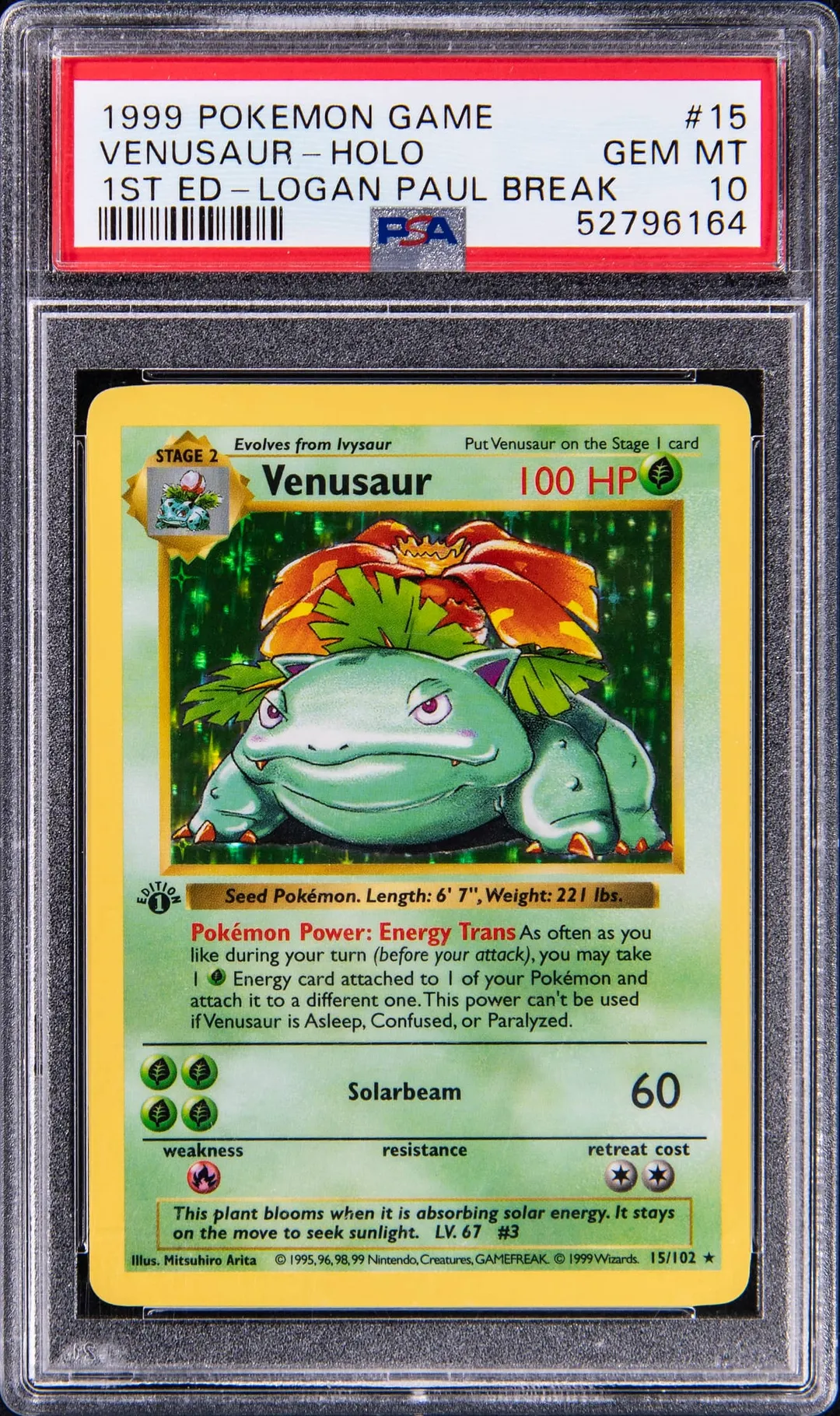
1999 1st Edition Venusaur PSA 10 Sells for $75K+
Breakdown of the 1999 Pokémon Base 1st Edition Holo Venusaur PSA 10 that sold for $75,640 at Goldin on 2/16/26, with context for collectors.
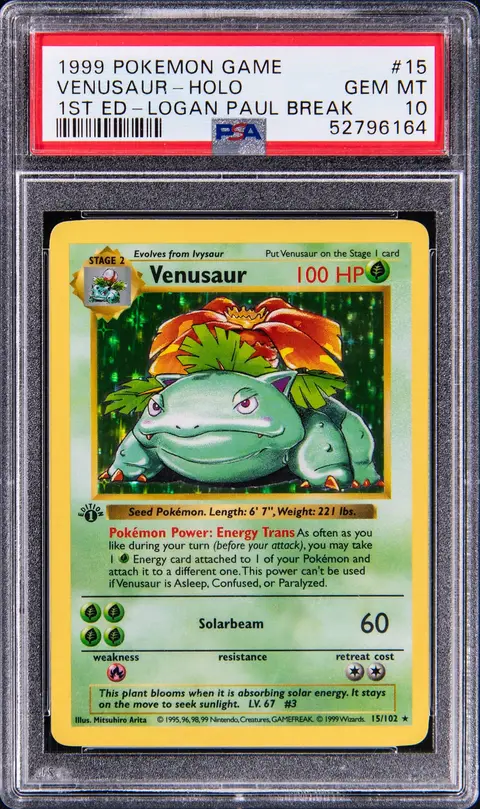
Sold Card
1999 Pokemon Base Set 1st Edition Rare Holo #15 Venusaur - Logan Paul Break - PSA GEM MT 10
Sale Price
Platform
Goldin1999 Pokémon Base Set 1st Edition Holo Venusaur in PSA 10 crossing $75,640 at Goldin is the kind of result that makes both vintage Pokémon specialists and returning collectors stop and take notice.
In this breakdown for figoca, we’ll walk through what this card is, why it matters, how this sale fits into recent market data, and what collectors might take away from it.
The card at a glance
Card: 1999 Pokémon Base Set 1st Edition Rare Holo Venusaur
Card number: #15/102
Character: Venusaur
Set: 1999 Pokémon TCG Base Set (English), 1st Edition
Rarity: Holo Rare
Publisher: Wizards of the Coast
Era: Vintage / WotC era
Grade: PSA GEM MT 10 (Gem Mint)
Sale: $75,640 via Goldin on 2/16/26 (UTC)
Provenance note: Described as from a Logan Paul break
This is not a rookie card in the sports sense, but it is a key early appearance of one of the three original Kanto starters from the very first English Pokémon set. The 1st Edition Base Set Holo trio of Charizard, Blastoise, and Venusaur is widely viewed as a core pillar of vintage Pokémon.
The card is graded GEM MT 10 by PSA, meaning it meets PSA’s highest standard for pack-fresh condition: sharp corners, clean edges, strong centering, and clean surfaces.
The “Logan Paul break” label refers to the card’s origin in one of the influencer’s high‑profile 1st Edition Base Set box breaks, which drew mainstream attention to the hobby in the early‑to‑mid 2020s. That kind of provenance does not change the technical grade, but some collectors consider it an interesting piece of modern hobby history.
Why this Venusaur matters to collectors
Iconic set, iconic starter
The 1999 Base Set 1st Edition is the first English Pokémon TCG release. Within that set, the Holo Rare starters are among the most recognizable cards for both players and collectors who grew up with the Game Boy games and the anime.
Venusaur holds a few key distinctions:
- It is the final evolution of Bulbasaur, the very first Pokédex entry (#001).
- It appears on one of the original Game Boy game covers (Pokémon Green in Japan).
- Alongside Charizard and Blastoise, it completes the “starter trio” collecting goal many vintage fans aim for.
For many collectors, owning a 1st Edition Base Venusaur—especially in PSA 10—checks the box of completing that original trio at the highest common grading standard.
Vintage WotC scarcity and condition
The Wizards of the Coast (WotC) era (1999–2003) sits in a sweet spot of nostalgia and relative scarcity. Compared with ultra‑modern print runs, early Pokémon print quantities were lower, and pack‑fresh condition was hard to preserve.
Holo cards like Venusaur are especially prone to:
- Surface scratches and print lines on the foil background
- Edge chipping from handling or play
- Silvering along the borders
Because of that, high‑grade copies are much harder to find than raw, played examples. That’s what gives a PSA GEM MT 10 copy its separation in the market.
Population and grading context
When collectors talk about a “pop report,” they mean the population report: how many copies of a card a grading company has graded at each grade.
For 1st Edition Base Venusaur, PSA’s population report shows:
- A meaningful number of graded copies across all grades (this is a key card from a heavily graded set).
- A comparatively small subset in PSA 10 relative to total submissions.
Even without exact current counts, the long‑term pattern for 1st Edition Base holos has been:
- Most cards cluster in PSA 7–9, with print and handling defects.
- PSA 10s remain a small minority and have tended to command strong price premiums versus PSA 9.
That scarcity at the top grade is what supports notable auction results like this one.
The Logan Paul break connection
The listing notes this Venusaur as a “Logan Paul Break” card, indicating it came from one of Logan Paul’s streamed 1st Edition Base box breaks.
Those events became a cultural moment:
- They brought in a large audience of non‑traditional collectors.
- They associated specific 1st Edition Base cards with a documented, public box break.
- They coincided with a sharp rise in prices for premier vintage Pokémon cards during the early 2020s.
Not every collector assigns additional monetary value to this kind of provenance, but for some, it is a story element: they like that the card can be tied back to a specific, publicly watched opening.
From a research standpoint, the more concrete driver of value remains the card itself: 1st Edition Base, holo, starter Pokémon, and PSA 10 condition.
Recent sales and price context
This Venusaur sold for $75,640 at Goldin on 2/16/26 (UTC).
When looking at “comps”—a shorthand in the hobby for comparable recent sales—collectors usually compare:
- The same card in the same grade (1999 1st Edition Venusaur, PSA 10).
- The same card in adjacent grades (PSA 9 or BGS 9.5, for example).
- Similar flagship cards from the same set (Charizard and Blastoise) to understand relative demand and hierarchy.
Across major marketplaces and auction houses over the past few years, 1st Edition Base Venusaur PSA 10 has generally trailed Charizard by a wide margin, and at times has been closer to or somewhat above Blastoise, depending on the period. Prices have shifted through:
- The peak hype period where many WotC grails saw sharp spikes.
- A consolidation phase, where prices retraced from the highs and then found new ranges as more data accumulated.
- A more recent data‑driven environment, where buyers lean heavily on historical comps and population data.
Within that context, a $75,640 result:
- Sits in the upper tier of what has historically been achievable for this card in PSA 10.
- Aligns with the idea that truly high‑end, story‑rich copies—1st Edition, gem mint, with notable provenance—can still attract strong bidding when they surface at established auction houses like Goldin.
Because individual sales can be influenced by timing, bidder circumstance, and provenance, it’s best to interpret this as one strong data point rather than a new guaranteed baseline.
How this sale fits the broader Pokémon market
A result like this touches on a few broader themes in the Pokémon TCG market:
Vintage blue chips still matter
Cards from the earliest WotC sets—especially 1st Edition Base holos—continue to function as reference points for the entire Pokémon market. Their performance is often watched by collectors who also buy Neo, e‑Series, and modern chase cards.Top grades separate from the field
The gulf between PSA 9 and PSA 10 on key WotC holos can be substantial. This reflects how difficult it is to find and preserve truly gem‑mint examples from 1999 packs.Provenance can add interest
The Logan Paul break note is not a grading attribute, but it adds a narrative layer. Collectors who value story and traceable history may prioritize cards that come from notable events, especially in a set as iconic as Base 1st Edition.Data‑aware collecting
Increasingly, collectors use a combination of population reports, auction archives, and marketplace histories to decide what they are comfortable paying. This Goldin result becomes another reference number future buyers will look back on.
Takeaways for collectors and small sellers
A few practical observations, framed for information rather than advice:
Condition still drives the top end. Raw or lightly played copies of 1st Edition Base Venusaur can be special keepsakes, but the big auction results are almost always tied to PSA 10 or equivalent top grades.
Grading select cards can be worthwhile for documentation. Even if a card does not approach five‑figure or six‑figure levels, encapsulation provides an agreed‑upon condition standard and long‑term protection that many collectors value.
Provenance and story can differentiate similar cards. Two PSA 10s may have the same technical grade, but a card tied to a notable break, collection, or pedigree sometimes stands out in competitive bidding.
Use multiple comps, not a single sale. When evaluating your own cards, it can be useful to look at several recent sales across different venues, time periods, and grades rather than anchoring on a single headline result.
Final thoughts
The 1999 Pokémon Base Set 1st Edition Rare Holo Venusaur #15, PSA GEM MT 10, selling for $75,640 at Goldin on 2/16/26 (UTC) underscores how central early WotC cards remain to the Pokémon hobby.
For some, this card is about completing the original starter trio at the highest grade. For others, it’s a piece of hobby history tied to the Logan Paul break era and the broader rediscovery of Pokémon by a new generation of collectors.
Either way, it is another clear signal that well‑documented, gem‑mint examples of key 1st Edition Base holos continue to command attention—and careful analysis—from the collector community.
At figoca, we track these kinds of results so you can place your own cards, goals, and collecting plans within a clearer, more data‑driven context.