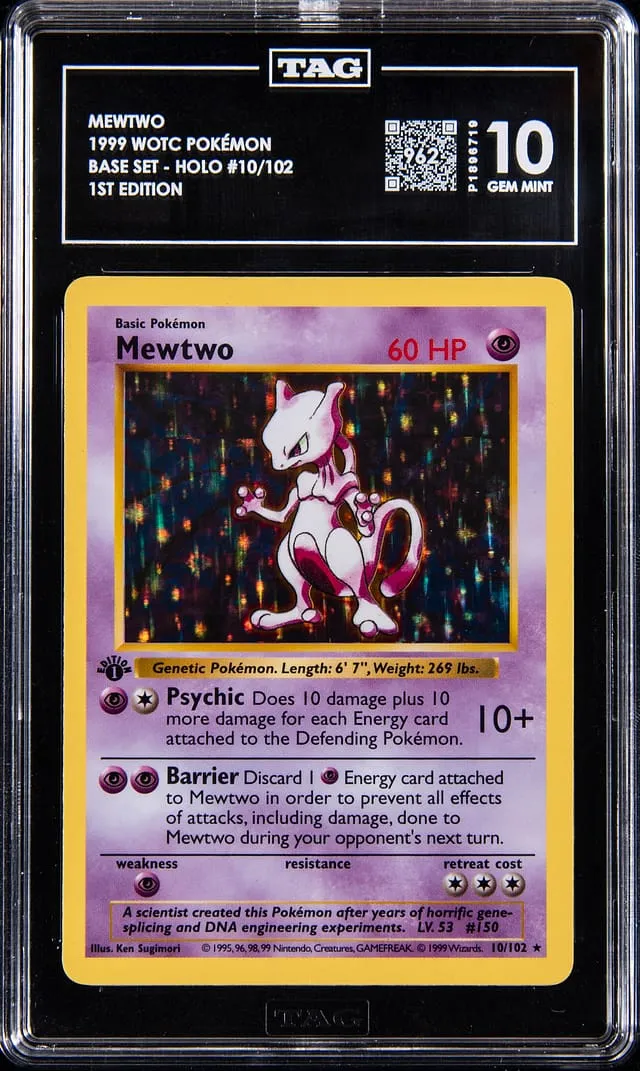
1999 1st Edition Holo Mewtwo TAG 10 Sells for $23K
Goldin sold a 1999 Pokémon Base 1st Edition Holo Mewtwo TAG GEM MINT 10 for $23,180. See what this low-pop, Rank 1 card means for the market.
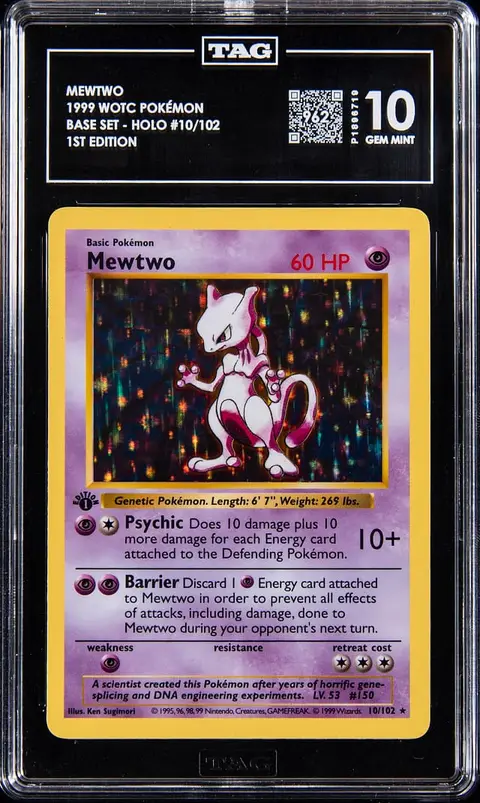
Sold Card
1999 Pokemon Base Set 1st Edition Holo #10 Mewtwo - TAG GEM MINT 10 - Pop 2; Rank 1
Sale Price
Platform
Goldin1999 Pokémon Base Set 1st Edition Holo Mewtwo TAG 10 Sells for $23,180
On March 9, 2026, a key graded copy of one of the hobby’s most recognizable vintage Pokémon cards crossed the block at Goldin: a 1999 Pokémon Base Set 1st Edition Holo #10 Mewtwo, graded TAG GEM MINT 10 and labeled Pop 2; Rank 1. The card realized $23,180.
For collectors trying to understand what this sale means, let’s break down the card, the grade, and the recent market context around 1st Edition Base Set Mewtwo.
The card at a glance
- Character: Mewtwo
- Year: 1999
- Set: Pokémon Base Set 1st Edition (English)
- Card number: #10/102
- Finish: Holographic (holo foil)
- Key issue status: Core holo from the original English TCG release; one of the marquee non-Charizard holos
- Grading company: TAG Grading
- Grade: GEM MINT 10
- Population note: TAG label indicates Pop 2; Rank 1, meaning there are only two GEM MINT 10s in TAG’s population, and this copy is tied for the highest grade they’ve assigned for this card.
This is not a “rookie card” in the sports sense, but for Mewtwo it is effectively the premier early English TCG appearance most collectors target, especially in 1st Edition holo form.
Why 1st Edition Base Mewtwo matters
1999 1st Edition Base Set is the foundation of English Pokémon TCG collecting. Alongside Charizard, Blastoise, Venusaur, and a handful of other holos, Mewtwo is one of the key chase cards in that original run.
Collectors care about this card because:
- Historically important set – 1st Edition Base is the first major English Pokémon TCG release. Cards from this set are treated similarly to “rookie era” cards in sports.
- Popular character – Mewtwo has anchored the franchise since the original games and first movie, giving the card cross‑generational demand.
- Holo rarity and condition difficulty – Original WotC (Wizards of the Coast) holos often suffer from print lines, edge wear, and surface scratching, making true gem copies uncommon.
This combination of set importance, character popularity, and condition scarcity is what keeps 1st Edition Base Mewtwo in the conversation for serious vintage Pokémon collectors.
Understanding the TAG GEM MINT 10 grade
Most market data for this card historically revolves around PSA and BGS grading, because they have the longest track records and largest populations. TAG is a newer grading company that emphasizes automated, highly consistent grading and detailed sub-surface analysis.
Key points about this particular grade:
- GEM MINT 10 at TAG corresponds to a top‑tier, essentially flawless card under their standards.
- Pop 2; Rank 1 means TAG has only graded two copies at GEM MINT 10, and none higher.
- Because TAG’s population is still relatively small compared to PSA, the pop number is more about relative scarcity within TAG’s ecosystem than across the entire hobby.
Newer grading companies can sometimes trade at a discount to PSA 10 or BGS 9.5/10 equivalents until a track record of auction sales develops. That context matters when you compare this result to older comps.
Market context and recent sales
In hobby shorthand, “comps” means comparable sales—recent auction or fixed-price results for the same card (or very close versions) that help bracket a realistic price range.
Because this sale occurred on March 9, 2026 at Goldin and the grading company is TAG, direct historical comps for TAG GEM MINT 10 Mewtwo 1st Edition Base are likely sparse or non‑existent. Instead, most collectors will triangulate value using:
- PSA 10 1st Edition Base Mewtwo
- BGS 9.5 and BGS 10 1st Edition Base Mewtwo
- Strong PSA 9 copies, to understand the step‑up to gem
While exact figures fluctuate with the broader Pokémon market and individual card eye appeal, long‑term patterns around this card typically show:
- PSA 10: Historically one of the top non‑Charizard holos from the set, with auction results that have sometimes pushed into the mid‑five‑figure range in stronger markets.
- PSA 9 / BGS 9.5: Often cluster in the lower to mid‑four‑figure range, depending on timing and venue.
- PSA/BGS population: Higher than TAG’s, but still limited relative to demand for a flagship vintage Mewtwo.
Against that backdrop, this $23,180 result for a TAG GEM MINT 10 at Goldin sits comfortably in serious high‑end territory for the card, but not out of line with where strong graded copies have traded in the past when the vintage Pokémon market is healthy.
Because TAG is still building its auction history, this sale also helps establish an early reference point for how TAG GEM MINT 10 1st Edition Base holos are treated by bidders relative to more established labels.
Vintage era scarcity and condition
The 1999 Base Set falls into what many collectors call the vintage Pokémon era. From a market perspective, that era tends to share a few traits:
- Original print runs were large, but not all cards survived in top condition; many were played, traded, or handled without sleeves.
- Grading standards matter: early print quality issues (holo scratches, centering, edge chipping) mean the gap between a nice PSA 9 and a true gem can be visually obvious.
- Long-term demand tends to be more stable than ultra-modern chase cards because these are tied to the franchise’s origin years.
Mewtwo’s holo sheet issues and dark background can highlight flaws. That makes the GEM MINT 10 grade particularly meaningful, regardless of grading company.
Why this Goldin sale matters
A single auction does not “set the market,” but certain sales do provide useful reference points.
This Goldin result is notable because:
- It benchmarks TAG’s top grade for a blue-chip vintage Pokémon card.
- It reinforces demand for high-end 1st Edition Base holos beyond Charizard.
- It demonstrates that collectors are willing to engage with alternative grading companies when the card itself is important and the auction platform is trusted.
For collectors and small sellers, the takeaway isn’t that every Mewtwo will now sell at this level, but that:
- Condition, grading label, and venue (in this case, Goldin) significantly shape realized prices.
- Top‑end examples—especially low‑population gem copies—continue to attract focused bidding.
How to think about your own Mewtwo
If you own or are considering a 1999 Base Set 1st Edition Holo Mewtwo, here are a few practical points:
Check centering and holo surface first
Print lines, scratches, and edge whitening are the biggest grade killers. Even raw cards that look “clean” at a glance often fall into the mid-grade tier on closer inspection.Compare across grading companies
Market participants still tend to use PSA 9/10 as the main pricing anchors. TAG, BGS, and CGC can trade at slight discounts or premiums depending on eye appeal, subgrades, and buyer confidence.Use multiple comps, not just one sale
One strong Goldin result is useful datapoint, but it’s best to look at a basket of recent auctions and fixed-price sales across platforms when trying to understand a realistic range.Separate card quality from short-term hype
Vintage flagship holos like Mewtwo often hold collector interest across market cycles because of what they represent: the earliest days of the Pokémon TCG.
Final thoughts
The March 9, 2026 Goldin sale of a 1999 Pokémon Base Set 1st Edition Holo #10 Mewtwo – TAG GEM MINT 10 (Pop 2; Rank 1) for $23,180 underscores the continued importance of 1st Edition Base holos in the modern hobby.
For serious collectors, it’s another data point showing that high‑end, low‑population gem copies of core vintage characters remain a focal point of the market. For newer or returning collectors, it’s a reminder that the cards many people grew up with have matured into a structured, data‑driven collectible space—where grading standards, auction venues, and population reports all play a role in how a single card is valued.
As always, any individual card’s value will depend on its exact condition, grading label, timing, and buyer demand. But sales like this help map out the upper end of what serious collectors are currently willing to pay for one of the hobby’s most recognizable vintage Mewtwo cards.