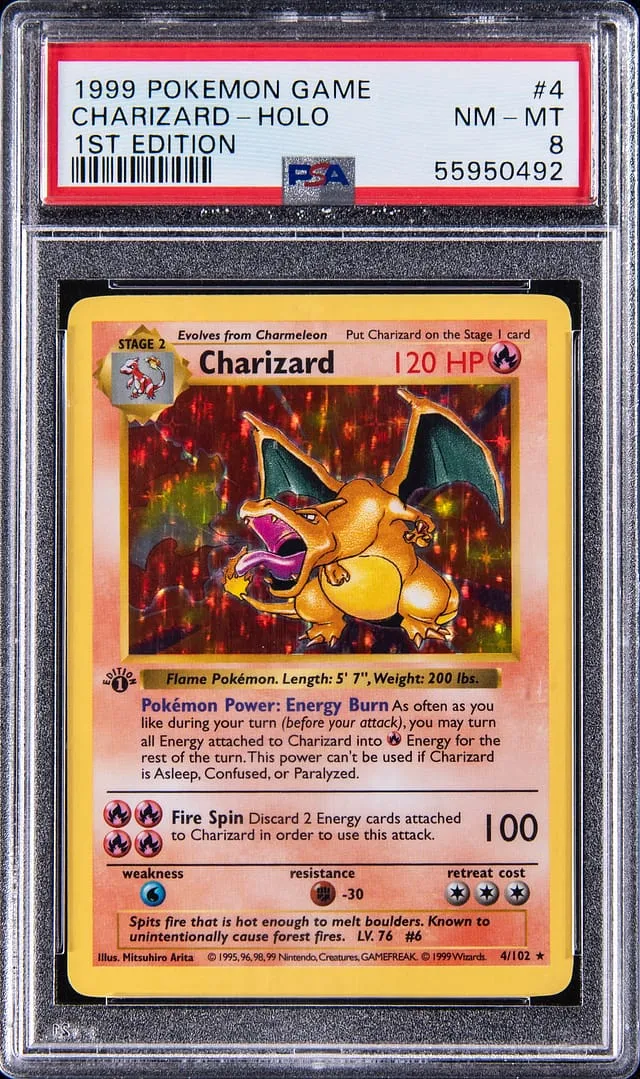
1999 1st Edition Holo Charizard PSA 8 sells for $36k
Goldin sold a 1999 Pokémon Base Set 1st Edition Holo Charizard PSA 8 for $36,844 on March 9, 2026. See how this result fits recent market trends.
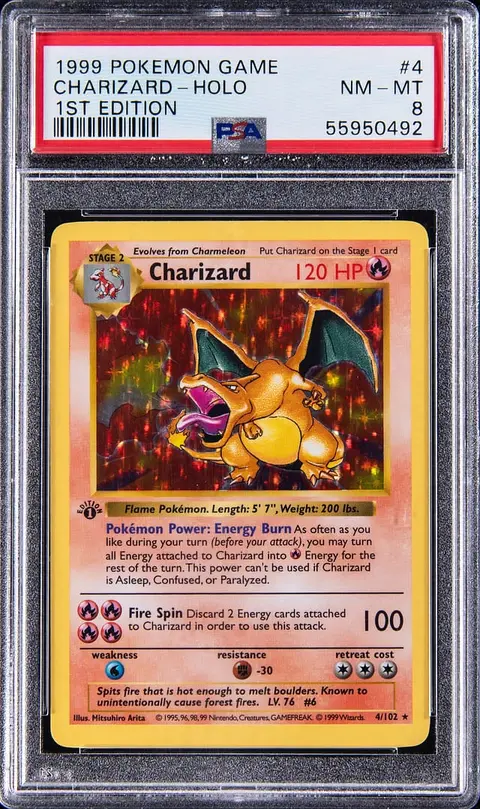
Sold Card
1999 Pokemon Base Set 1st Edition Holo #4 Charizard - PSA NM-MT 8
Sale Price
Platform
Goldin1999 Pokémon Base Set 1st Edition Holo Charizard in PSA 8 has long been one of the hobby’s most watched benchmark cards. A fresh example just crossed the auction block, and it offers a useful snapshot of how the market is treating this iconic vintage Pokémon grail.
On March 9, 2026, Goldin sold a 1999 Pokémon Base Set 1st Edition Holo #4 Charizard, graded PSA NM‑MT 8, for $36,844.
In this breakdown, we’ll walk through what this card is, why it matters, and how this sale fits into recent price history.
The card at a glance
Card: 1999 Pokémon Base Set 1st Edition Holo Charizard
Card #: 4/102
Set: Base Set (English), 1st Edition print run
Character: Charizard
Year: 1999
Publisher: Wizards of the Coast
Variant: 1st Edition, Holographic
Grading company: PSA (Professional Sports Authenticator)
Grade: PSA 8 – NM‑MT (Near Mint–Mint)
Key issue status: Keystone card of the English Pokémon TCG; widely treated as the flagship Charizard and a hobby blue‑chip.
There are no autos, patches, or serial numbering on this card—its importance comes from being the first English holo Charizard, in the first English Pokémon TCG set, in the most coveted print run (1st Edition).
Why collectors care about this Charizard
For many collectors, Base Set 1st Edition Charizard is the face of Pokémon cards. It checks several boxes that usually define a hobby cornerstone:
- Historically important set: Base Set is the first English Pokémon TCG release, making it the foundational set for the entire game and collecting culture that followed.
- Most popular character: Charizard sits at the intersection of nostalgia, gameplay, and pop culture. For a large segment of collectors, this is the card they remember from childhood.
- Key 1st Edition holo: Within Base Set, the 1st Edition holos are the premium tier. Charizard is typically viewed as the flagship card of the run.
- Vintage era: Released in 1999, this card falls firmly into the vintage category for Pokémon. Vintage tend to have organic scarcity—cards were played with, shuffled, and handled, not slabbed from day one.
Put simply, this card is not a niche parallel or a short‑printed insert. It’s a central piece of the Pokémon hobby, consistently used by collectors and market watchers as a barometer for interest in vintage Pokémon as a whole.
Understanding PSA 8 for this card
PSA uses a 1–10 grading scale. A PSA 8 (Near Mint–Mint) typically allows for:
- Light wear on corners or edges
- A few minor surface or print imperfections
- Centering that may be slightly off, within PSA’s NM‑MT tolerances
For a thick, holo‑foil card from 1999, this level of preservation is still considered strong. Many copies saw heavy play or rough storage, leading to whitening, creases, or heavy scratching.
On the population side (often called the “pop report,” which is simply how many copies PSA has graded at each grade level), PSA 8 is a mid‑to‑high grade tier for Base Set 1st Edition Charizard. There are more 8s than true high‑end 10s, but 8s remain clearly in the collectible, investment‑grade conversation, especially for collectors who want an original 1st Edition Charizard without stepping into six‑figure territory.
Market context: where does $36,844 fit?
This Goldin sale closed on March 9, 2026, for $36,844. To understand that number, it helps to look at how PSA 8 copies of this card have behaved over the last few years and how they relate to other grades.
1. PSA 8 vs. higher grades
Across public auction data over the past few years, PSA 10 and 9 examples of this card have attracted the most headlines and record prices. PSA 10s have historically sold in the high five‑figure to well into six‑figure range depending on timing and broader hobby sentiment. PSA 9s have generally landed significantly higher than PSA 8s, reflecting the steep premium for cleaner surfaces and centering.
PSA 8 typically sits a tier or two below those levels but above raw or lower‑grade copies, acting as a “reachable but still premium” option for serious collectors.
2. PSA 8 recent‑sales band
Public sales for PSA 8 1st Edition Holo Charizard have shown meaningful swings over the years as the Pokémon hobby cycled through sharp run‑ups and corrections. In broad terms, recent auction results for PSA 8 examples have tended to:
- Cluster in a mid five‑figure band during stronger demand windows.
- Dip into lower five‑figure territory in softer periods or for examples with weaker eye appeal.
At $36,844, this Goldin result lands inside the established recent range for strong‑eye‑appeal PSA 8s rather than representing a new record or a steep discount. It reads as a solid, market‑respecting price rather than an outlier.
3. Relation to lower grades
Looking further down the scale, PSA 6 and 7 copies usually trade at a noticeable discount to 8s, especially if they show more visible whitening or scratching. The premium for PSA 8 over 7 is often about securing a card that still feels “display‑grade” while keeping the cost well below 9s and 10s.
This sale reinforces that stratification: collectors continue to differentiate clearly between 7, 8, 9, and 10, with each step up or down carrying a meaningful shift in price.
Why this sale matters for the market
While any single auction result should be viewed as one data point, some cards function as informal market indicators. Base Set 1st Edition Charizard is one of them.
Here’s what this particular sale hints at:
Stability in a key vintage benchmark
Seeing a PSA 8 example land in the expected band suggests that the market for flagship vintage Pokémon has found a relatively stable footing, at least at this point in time. It doesn’t mean prices can’t move, but it does show ongoing willingness from bidders to pay established levels for strong copies.Continued demand for mid‑high grades
With PSA 10s and 9s often priced beyond the reach of many collectors, PSA 8 remains an active battleground grade. The Goldin result confirms that collectors still see meaningful value in owning a high‑quality 1st Edition Charizard even if it isn’t a top‑pop gem.Charizard’s staying power
Pokémon interest has cycled up and down, but Charizard—especially this exact card—continues to attract serious bids. As anniversaries, new game releases, and broader pop‑culture nostalgia keep Pokémon in the spotlight, this card consistently appears whenever major auction houses assemble flagship Pokémon offerings.
Key takeaways for collectors and small sellers
If you’re new to Pokémon or returning after a break, here are a few practical observations you can draw from this sale:
Focus on condition and eye appeal. Even within the same grade, copies with cleaner centering, stronger holo surfaces, and less whitening often perform better. Auction results like this one reflect that nuance.
Know your grade tiers. PSA 8 isn’t just “pretty good”—for this card, it’s a recognized, respected grade that sits in a defined price band between more affordable mid‑grades and much pricier 9s and 10s.
Use multiple comps. “Comps” are comparable recent sales of the same card and grade. When evaluating a card like this, it’s helpful to look at several recent public auctions, not just one stand‑out result, to understand the current range.
Treat headline cards as reference points, not blueprints. Most collections won’t revolve around a 1st Edition Base Charizard, but results like this provide context for how the market values vintage keys relative to modern cards, alternative Charizard printings, and other sets.
Final thoughts
The March 9, 2026 sale of a 1999 Pokémon Base Set 1st Edition Holo #4 Charizard in PSA 8 for $36,844 at Goldin is another data point confirming this card’s status as a long‑term centerpiece of the hobby.
It doesn’t reset the record books, but it does underline a pattern: even as the broader market evolves, high‑quality copies of historically important, nostalgia‑driven cards continue to draw consistent attention and strong bids.
For collectors and small sellers who track the health of the Pokémon market, keeping an eye on this card—across several grades—remains one of the clearest ways to understand where vintage Pokémon stands today.