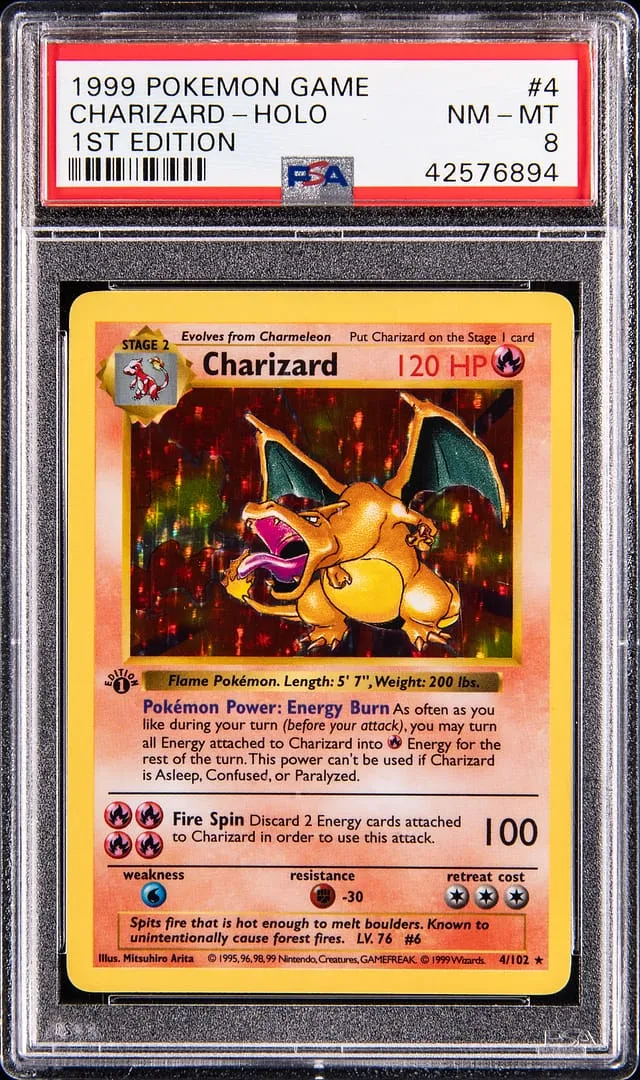
1999 1st Edition Holo Charizard PSA 8 sells for $34K
A PSA 8 1999 Pokémon Base 1st Edition Holo Charizard sold for $34,160 at Goldin on April 27, 2026. See how this result fits recent market trends.
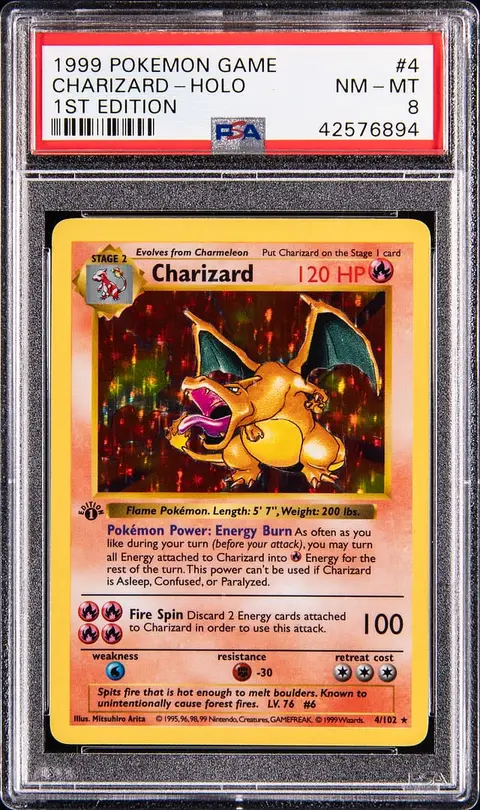
Sold Card
1999 Pokemon Base Set 1st Edition Holo #4 Charizard - PSA NM-MT 8
Sale Price
Platform
Goldin1999 Pokémon Base Set 1st Edition Holo Charizard in PSA 8 is one of those cards that keeps anchoring the vintage Pokémon market. On April 27, 2026, Goldin auctioned a copy for $34,160, offering another useful data point for collectors who track this iconic card.
In this breakdown for figoca, we’ll cover what exactly this card is, why it matters so much, and how this latest sale fits into recent price trends.
The card at a glance
- Character: Charizard
- Year: 1999
- Set: Pokémon TCG Base Set (English)
- Edition: 1st Edition
- Rarity/Finish: Holographic rare
- Card number: #4/102
- Key status: Core grail from the original English Pokémon run; not a rookie in the sports sense, but effectively the flagship vintage Charizard
- Grading company: PSA (Professional Sports Authenticator)
- Grade: PSA NM-MT 8 (Near Mint–Mint)
- Attributes: No autograph, no serial numbering; the appeal here is entirely set, stamp, holo, and grade
Within Pokémon, this is the card most people picture when they think of “grail” territory: 1st Edition, Base Set, holo Charizard. It’s part of the very first English set released in 1999 and has long been a benchmark for the health of the vintage Pokémon market.
Why this Charizard matters to collectors
A cornerstone of vintage Pokémon
The 1999 Base Set is the starting point for most English Pokémon TCG nostalgia. It introduced the familiar layout, the early artwork, and the rarity structure that many collectors grew up with.
Within that set, 1st Edition holo Charizard is:
- The flagship chase card: Charizard quickly became the face of early Pokémon power in both the game and the cartoon. The card’s high attack damage and striking Ken Sugimori artwork made it the centerpiece of playground trading.
- A key vintage blue chip: In hobby terms, a "blue chip" card is a historically important card that tends to remain relevant over long periods. Base 1st Edition Charizard has filled that role in Pokémon much like iconic rookie cards do in sports.
- Era context – true vintage: 1999 now sits firmly in the vintage category for Pokémon. Print runs were meaningful but nowhere near the scale of today’s ultra-modern era. Condition sensitivity (silvering, edge wear, holo scratching) makes higher grades significantly more desirable.
PSA 8: balancing condition and accessibility
PSA uses a 1–10 grading scale, with 10 being Gem Mint. A PSA 8 (Near Mint–Mint) typically allows for:
- Minor edge or corner wear
- Light surface or holo scratching
- Decent overall eye appeal, but short of high-end display perfection
For Base Set 1st Edition Charizard, PSA 8 often sits in the middle ground:
- Above the heavily played copies that many people remember from childhood collections
- Below the premium pricing tiers of PSA 9 and especially PSA 10, which can move into very different budget ranges
This helps explain why PSA 8 copies tend to see steady transaction volume: they’re still clearly investment-grade condition without crossing into the six-figure territory that some top-end examples have reached in past cycles.
Market context and recent sales
The Goldin sale on April 27, 2026 closed at $34,160. To understand that number, it helps to look at a few layers of context: same card in similar grade, adjacent grades, and the card’s broader market history.
Same card, same grade: PSA 8
Recent public auction results for 1999 Pokémon Base Set 1st Edition Holo Charizard – PSA 8 have generally clustered in the mid–five-figure range, with fluctuations depending on:
- Eye appeal (centering, holo scratching, print quality)
- Subtler condition aspects that don’t show directly on the label
- Auction platform and timing (large event auctions vs. routine weekly sales)
The $34,160 realized at Goldin sits within that established range for early- to mid-2020s pricing, and reflects a market that has cooled from 2020–2021 peaks but remains orderly and active for marquee vintage Pokémon.
Because this card trades relatively often compared with true 1-of-1s or ultra-rare inserts, buyers and sellers tend to anchor around recent “comps” — short for comparable sales, meaning the last few verified transactions for the same card and grade.
Adjacent grades: PSA 7, PSA 9, PSA 10
Looking at nearby grades helps put the PSA 8 level in perspective:
- PSA 7: Typically sells at a noticeable discount to PSA 8, as surface wear and edge issues become more obvious. It often serves as an entry point for collectors who want 1st Edition Charizard but prioritize budget over condition.
- PSA 9: Commands a strong premium over PSA 8, reflecting sharper corners and cleaner surfaces. For many collectors, PSA 9 is the “sweet spot” between high-end eye appeal and the sharp price jump into PSA 10.
- PSA 10: Historically, this grade has seen some of the most widely reported Pokémon sales, including headline-making six-figure and, at times, higher peaks during speculative periods. Population (the total number of cards graded at a given level, often called the "pop report") is far lower in PSA 10 compared with PSA 8.
The PSA 8 tier tends to move somewhat in parallel with these other grades, but with smaller absolute dollar swings. That makes it useful as a barometer for how the broader 1st Edition Charizard market is behaving.
Longer-term perspective
Over the past several years, 1st Edition Base Charizard in PSA 8 has:
- Spiked during the 2020–2021 surge when interest in trading cards broadly accelerated
- Retraced from peak levels as the market normalized
- Settled into a tighter trading band driven by collector demand rather than purely speculative activity
This $34,160 sale at Goldin fits into that “post-surge normalization” narrative: the card still commands a strong premium due to its cultural weight and grade, but pricing appears more measured and data-driven than at the height of the frenzy.
What this sale tells collectors
1. Base 1st Edition Charizard remains a reference point
When hobby conversations turn to Pokémon benchmarks, this is still the default example. The PSA 8 result from April 27, 2026 reinforces that:
- There is ongoing, reliable demand for vintage key issues
- The market continues to recognize 1st Edition Base Charizard as a central piece of the Pokémon story
Collectors often watch this card’s performance to gauge the overall tone of vintage Pokémon—similar to how certain flagship rookie cards function in sports.
2. Condition and presentation still matter within the same grade
Even within PSA 8, there can be a wide range of eye appeal. While the label is the same, factors like:
- Centering
- Holofoil scratching and print lines
- Edge chipping and corner sharpness
can all influence bidder confidence and final price. This helps explain why two PSA 8 copies might close at different levels in different auctions.
3. Platform and timing play a role
This sale took place on Goldin, a well-known auction house for trading cards and collectibles. High-visibility platforms can:
- Draw a deeper pool of serious bidders
- Create more consistent price discovery (more informed buyers and sellers reacting to recent comps)
The April 27, 2026 date also matters. Market sentiment, broader economic conditions, and the current level of Pokémon hobby interest can all affect how aggressively bidders pursue a given copy.
Key takeaways for different types of collectors
New or returning collectors
If you’re just getting back into the hobby or starting fresh:
- This card is a cornerstone piece, but it’s not the only way to collect Charizard.
- Later printings (Unlimited Base, Shadowless, reprints, or modern Charizard sets) can provide similar nostalgia at more modest prices.
- Watching PSA 8 sales like this gives you a clear sense of how the top end of the nostalgia market behaves over time.
Active hobbyists and small sellers
For those who track comps more closely:
- Use sales like this as a data point, not a target. Each card’s specific eye appeal and the auction’s visibility can push prices slightly up or down.
- Consider pairing public auction data with population reports and your own observations of card quality when assessing relative value.
- If you’re holding lower grades of 1st Edition Charizard, this PSA 8 sale helps frame the condition ladder and potential spread between grades.
Long-term collectors
For long-term vintage Pokémon builders, this result underscores that:
- Key 1999 holos, especially in 1st Edition, continue to be actively traded and tracked.
- The card has transitioned from a speculative lightning rod into a more established reference asset within the hobby.
Again, none of this is a prediction about future value, just an observation that the card retains consistent attention and liquidity.
Final thoughts
The 1999 Pokémon Base Set 1st Edition Holo #4 Charizard – PSA NM-MT 8 sale for $34,160 at Goldin on April 27, 2026 is another clear sign that vintage Pokémon’s flagship cards remain central to the hobby’s identity.
For collectors, this kind of sale is useful less as a headline and more as a practical benchmark: it helps set expectations, informs buying and selling decisions, and provides a window into how the market currently values one of the most recognizable cards in the game.
As always, it’s worth viewing any single auction result as part of a broader pattern. Track multiple recent sales, consider condition carefully, and collect the way that best fits your own goals and enjoyment. figoca will keep surfacing these data points so you can see the bigger picture, one key card at a time.