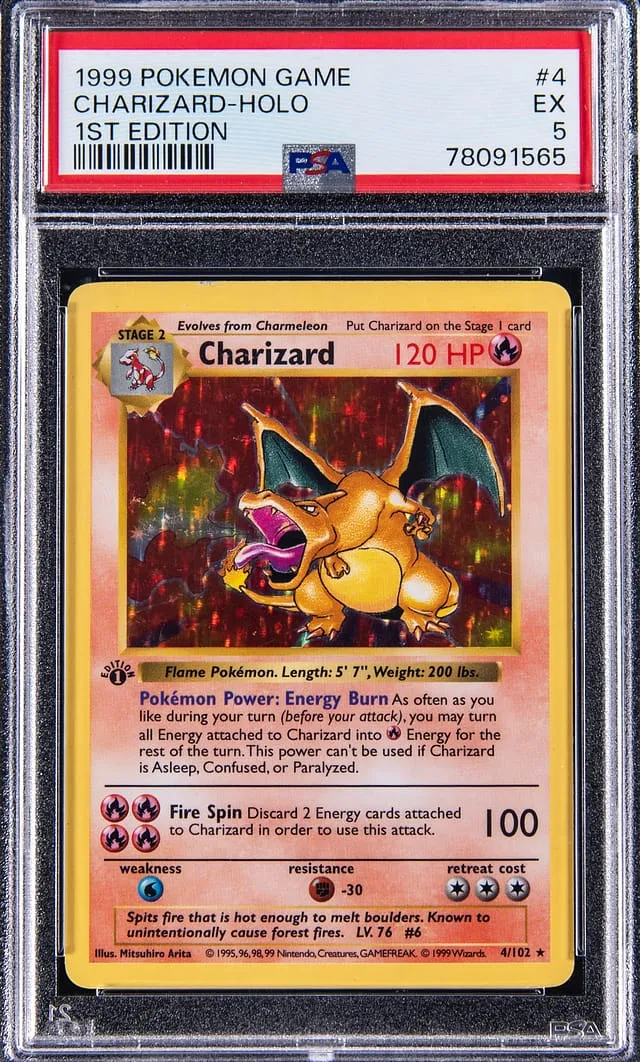
1999 1st Edition Holo Charizard PSA 5 Sells for $14.9K
Goldin sold a 1999 Pokémon Base Set 1st Edition Holo Charizard PSA 5 for $14,945. See how this result fits recent comps and the vintage Pokémon market.
Sold Card
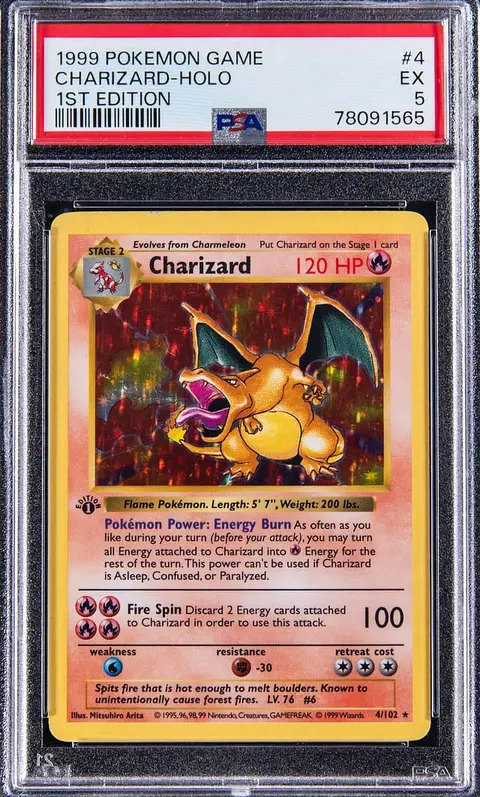
1999 Pokemon Base Set 1st Edition Holo #4 Charizard - PSA EX 5
Sale Price
Platform
Goldin1999 Pokémon Base Set 1st Edition Holo Charizard in a PSA EX 5 holder is one of those cards that instantly signals what era of the hobby you came from. For many collectors, this is the chase from the original English Pokémon TCG run—card #4 from the 1999 Base Set, in its most iconic configuration: 1st Edition, holographic, and anchored by the hobby’s most famous dragon-like Fire-type.
On March 9, 2026, Goldin sold a copy of this card for $14,945 in a PSA EX 5 grade. For context, that’s a mid-grade example—not a high-end museum piece, but not a beater either. In today’s Pokémon market, that middle ground can be an interesting place to watch.
Card snapshot
- Card: 1999 Pokémon Base Set 1st Edition Holo Charizard
- Set: Base Set (English), 1st Edition, holographic
- Card number: #4/102
- Character: Charizard
- Year: 1999
- Key status: Core key card of the entire Pokémon TCG; often treated like a “rookie card” for Charizard in English
- Grading company: PSA (Professional Sports Authenticator)
- Grade: EX 5 (Excellent)
- Auction house: Goldin
- Sale date (UTC): 2026-03-09
- Sale price: $14,945
There are no special inserts or patches in Pokémon the way there are in sports cards. What makes this card special is the combination of:
- 1st Edition stamp
- Holographic Charizard artwork by Mitsuhiro Arita
- The fact that it’s from the very first English set released by Wizards of the Coast
Within the Pokémon world, this is the flagship Charizard and a central key to the entire 1990s era.
Why this card matters to collectors
Cornerstone of the Base Set
The 1999 Base Set is effectively the original “vintage” Pokémon release in English. It’s the set many Western collectors first encountered as kids: the one seen on playgrounds, in binders, and at local shops in the late 1990s and early 2000s.
Among all Base Set cards, 1st Edition Holo Charizard has become the visual shorthand for the entire era. It combines a few important traits:
- Beloved character: Charizard has stayed popular across video games, anime, and merchandise for over two decades.
- Top rarity in the set: Holo, 1st Edition, and one of the most chased cards even at release.
- Condition sensitivity: Original holo foiling and early printing/handling issues mean clean copies are hard to find.
For many returning collectors, this is the card they remember seeing in a binder and never owning. That nostalgia drives consistent demand across a wide range of grades.
Era and scarcity
This card comes from what many call the “vintage” Pokémon era. Print runs were substantial, but few copies survived in truly sharp condition. Kids played with these, carried them around, and stored them in non-ideal conditions.
Grading companies like PSA help clarify condition with numeric grades from 1 to 10. A PSA EX 5 is firmly a middle grade: noticeable wear, but still presentable. High grades (PSA 9 and 10) are both much scarcer and dramatically more expensive, but the entire population curve—from 1 through 8—still sees regular demand because collectors often prioritize owning the card itself over chasing a perfect grade.
Market context for a PSA 5 Charizard 1st Edition Holo
To understand what $14,945 means, it helps to frame this sale against the broader market.
A quick note on “comps” and pop
- Comps (comparable sales): When collectors say “comps,” they mean recent completed sales of the same card and grade, usually from major marketplaces and auction houses. These create a rough price range, not a guarantee.
- Pop report (population report): PSA publishes how many copies of a card they’ve graded at each grade level. This helps collectors gauge relative scarcity by condition.
For 1st Edition Holo Charizard, PSA’s population report shows a large number of graded copies, with a concentration in the middle grades (3–6). Higher grades (8–10) are significantly rarer and command a premium.
How this result fits in
This specific sale closed at $14,945 at Goldin on March 9, 2026. Without referencing every individual comp by timestamp, a few general patterns have been consistent in recent years:
- PSA 10 examples are in a completely different pricing tier, often many multiples higher than middle grades.
- PSA 9 and 8 copies also command strong premiums above the mid-grade range.
- PSA 4–6 have often functioned as the “reachable but still serious” segment—expensive, but far below top-pop prices.
Within that landscape, a PSA EX 5 at this level places the card in a range that reflects:
- Ongoing demand for 1st Edition Charizard across all conditions
- A gap between PSA 5 and the higher-eye-appeal grades (7–9)
- The fact that mid-grade copies are more common than top-end ones, but still heavily pursued by collectors who want an original 1st Edition without stretching into higher-grade price territory
Because Pokémon prices can move with broader hobby sentiment, macro conditions, and nostalgia cycles, it’s best to view this result as one data point in a continuing trend rather than a standalone signal.
Why collectors still chase mid-grade copies
One of the more interesting dynamics with this card is that demand doesn’t stop at the upper grades. There are a few reasons PSA 5 can still draw attention:
Entry into the 1st Edition tier
Many collectors specifically want the 1st Edition stamp. A PSA 5 is a more realistic target than an 8, 9, or 10 while still being authenticated and encapsulated.Nostalgia over perfection
For some, visible wear (edge chipping, surface scratches, soft corners) is acceptable as long as the holo still presents well. The goal is to own the Charizard they remember from childhood.Binder-to-slab journey
A lot of PSA 5s began life in binders, decks, or shoeboxes. Grading those copies has been a common route for both personal collections and small sellers.Liquidity across grades
Historically, 1st Edition Holo Charizard has had active buyers and sellers in nearly every grade level. That doesn’t mean every copy sells instantly, but it does mean the card itself tends to be recognizable and easier to move than more obscure issues.
What this sale might signal
Rather than trying to forecast the future, it’s more helpful to think of this Goldin sale as a reference point:
- It contributes another data marker for PSA 5 pricing in a well-tracked card.
- It sits within the established pattern where mid-grade Charizards remain meaningful purchases, not bargain-bin options.
- It reinforces that major auction houses like Goldin continue to be venues where even mid-grade copies of key vintage Pokémon cards find competitive bidding.
If you’re tracking this card, watching several sales across different platforms—Goldin, Heritage, PWCC, eBay, and others—over months is usually more informative than focusing on a single auction.
Takeaways for collectors and small sellers
For newcomers, returning collectors, or small sellers considering this card:
- Recognize the hierarchy: 1st Edition Holo Charizard is a key card across the entire TCG, with a long-established track record of demand.
- Condition still matters: Even within the same numeric grade, eye appeal (centering, holo scratches, print lines) can influence how collectors feel about a copy.
- Use multiple comps: Look at several recent sales of the same grade, and, when possible, compare photos to understand why some examples may have sold higher or lower.
- Think in ranges, not absolutes: A single $14,945 result is useful as part of a range, not as a guaranteed target.
The March 9, 2026 Goldin sale is another reminder that even decades after release, the 1999 Pokémon Base Set 1st Edition Holo Charizard continues to function as a benchmark card—one that anchors conversations about vintage Pokémon, condition, and long-running collector interest.
At figoca, we track these kinds of sales so you can understand not just the headline numbers, but how they fit into the broader picture of the trading card market.