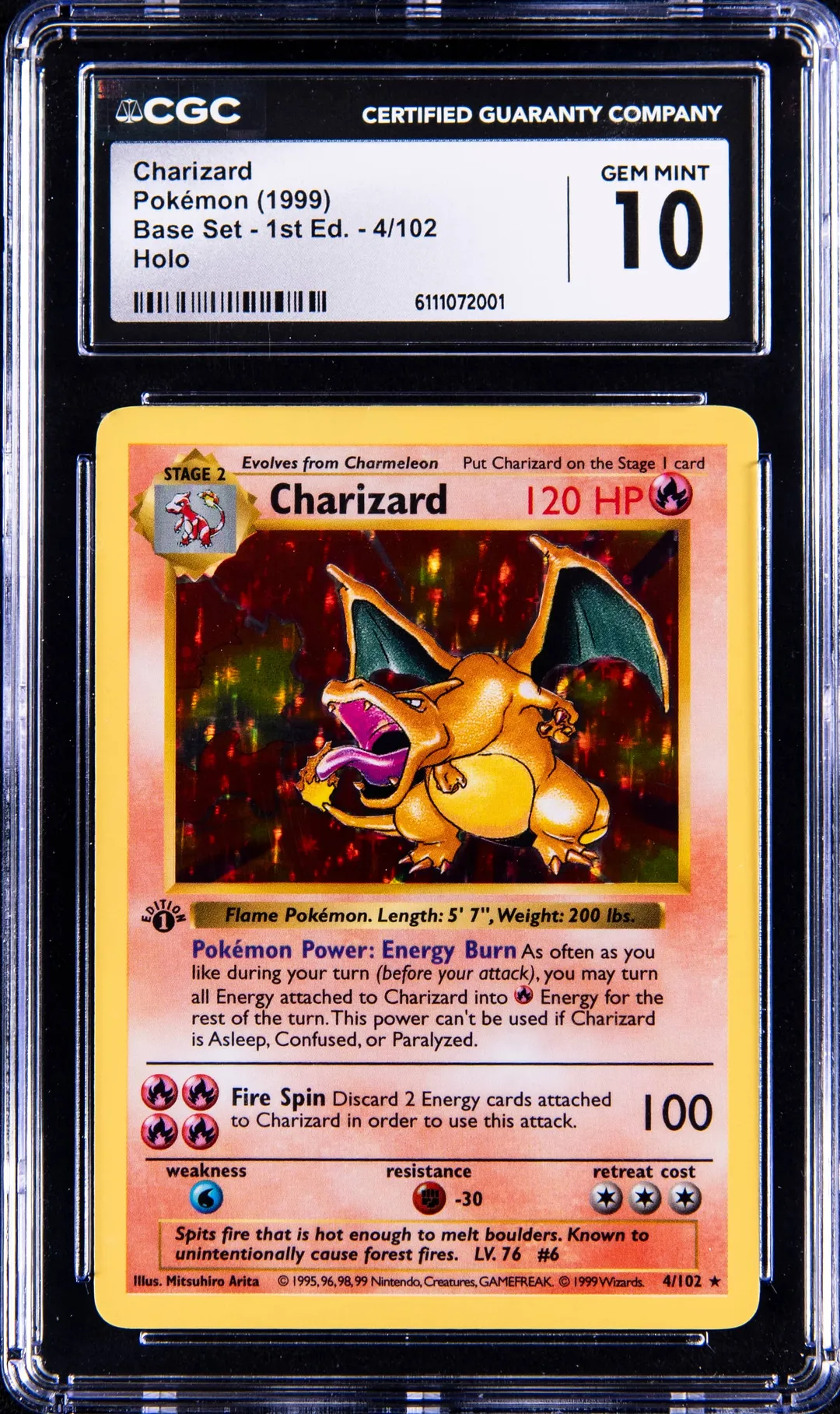
1999 1st Edition Holo Charizard CGC 10 Sells for $105K
A CGC GEM MINT 10 1999 Pokémon Base Set 1st Edition Holo Charizard sold for $105,400 at Goldin. A calm, data-focused look at what this means.
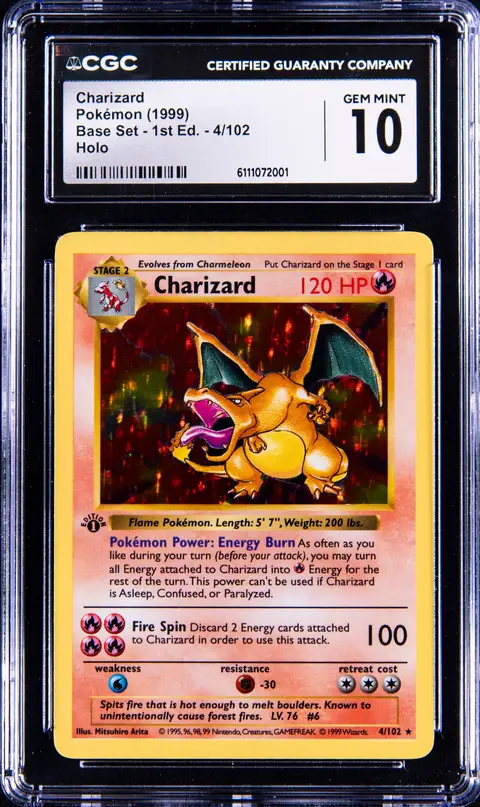
Sold Card
1999 Pokemon Base Set 1st Edition Holo #4 Charizard - CGC GEM MINT 10
Sale Price
Platform
Goldin1999 Pokémon Base Set 1st Edition Holo Charizard in CGC GEM MINT 10 just changed hands for $105,400 at Goldin on 02/16/26. For many collectors, this is one of the cornerstone cards of the entire Pokémon hobby, and seeing a true top-grade copy surface at public auction is always worth a closer look.
The card at a glance
- Card: 1999 Pokémon Base Set 1st Edition Holo Charizard
- Number: #4/102
- Character: Charizard
- Set: English Base Set (1st Edition, shadowed holofoil)
- Year: 1999
- Grading company: CGC
- Grade: GEM MINT 10
- Key issue: Iconic, early-era Charizard; widely treated as the flagship chase of the English Pokémon TCG
This is the original English 1st Edition holo Charizard, not an unlimited, Shadowless, or later reprint. Within Pokémon, it fills a role similar to a flagship rookie card in sports: it is not Charizard’s literal first appearance in any medium, but it is the defining, most recognizable early card for the character in the core TCG.
CGC’s GEM MINT 10 label indicates extremely strict centering, surface, corners, and edges. While the exact subgrades are not provided here, the standard is broadly comparable to mint/gem-mint tiers at PSA and BGS, with CGC often viewed as grading harshly on centering and surface.
Why this Charizard matters
A pillar of the Pokémon hobby
The 1999 Base Set is the first English Pokémon TCG release. Its 1st Edition holo cards, especially Charizard, are:
- Historically important: They mark the launch of Pokémon cards in North America and the height of the original Pokémon boom.
- Widely recognizable: Even non-collectors often recognize this Charizard art by Mitsuhiro Arita.
- Condition-sensitive: Original kids’ products rarely survived in high grade. Many copies were played, carried in pockets, or rubber-banded.
Because of that mix of nostalgia, cultural recognition, and condition scarcity, the 1st Edition holo Charizard has become the main reference point when people talk about “high-end Pokémon cards.”
Where this sale fits in the market
This card sold at Goldin on 02/16/26 for $105,400. To understand that number, it helps to look at “comps,” short for comparable sales—recent realized prices for the same or very similar cards.
Over the past several years, record-level prices in this lane have mostly been set by:
- PSA 10 1st Edition Holo Charizard: Premiums often reach well into six figures, with peak boom-era sales well above that. Prices have cooled and stabilized since the early-2020s spike but still generally sit at the top of the Pokémon market.
- BGS 9.5 and BGS 10 copies: Strong gem copies, especially true Pristine or Black Label examples, have occasionally competed with or exceeded top PSA results.
CGC’s population of GEM MINT 10 1st Edition Charizards remains relatively small compared to the total number of Base Set Charizards graded across all companies. As of recent population data, true gem 1st Edition copies—regardless of grading company—represent only a tiny fraction of all graded examples.
Within that context, $105,400 for a CGC GEM MINT 10 sits in line with the modern, post-boom landscape:
- It is far above the prices typical for PSA 8–9 or CGC 8–9 copies.
- It is comfortably within the six-figure range that serious collectors and high-end buyers have grown accustomed to seeing for top-tier Base 1st Edition Charizard.
- It reflects a market where condition and label still command large spreads, but where the wild volatility of early-2020s pricing has largely settled into more consistent ranges.
Exact price comparisons differ auction to auction depending on eye appeal, centering, and the grading label involved. But this Goldin result reinforces the idea that top-grade Base 1st Edition Charizards continue to attract deep bidding when they appear.
Grading, population, and scarcity
Collectors often talk about the “pop report,” short for population report. This is a grading company’s public count of how many cards of each type and grade they have encapsulated.
While the detailed CGC population numbers for this exact card are subject to change as more cards are graded, a few points stand out:
- Total graded population across all companies is large, but the vast majority cluster between lightly played and near-mint/mint.
- True GEM MINT 10s are scarce. Even if multiple grading companies each have their own 10s on record, that slice of the total population is small.
- Condition sensitivity: Factory print lines, holofoil scratching, centering, and edge chipping are all common on 1999 Base holos, which helps explain why a clean, centered GEM MINT example can command a strong premium.
For buyers and sellers, this is where the biggest gaps in value often appear: small differences in centering or surface can move prices significantly at the very top of the grading scale.
Collector significance today
Nostalgia across generations
The Base Set Charizard hits several collector groups at once:
- Original kids from 1999: Many are now adults revisiting childhood favorites with more disposable income.
- Newer Pokémon fans: Even those who started later often see this card as the “grail” of the earliest era.
- Crossover collectors: Sports card and comic collectors frequently recognize this specific Charizard as the key Pokémon card.
Because of this, demand doesn’t rely on a single short-term news event. Instead, it’s tied to the long-running cultural footprint of Pokémon as a franchise and Charizard as a mascot-level character.
Era and print realities
The 1999 Base Set sits at the boundary of what many would call the “vintage” Pokémon era in English. Print runs were significant, but they were not handled as collectibles by most kids at the time. That combination tends to yield:
- Plenty of lower-grade, nostalgic copies in binders and bulk boxes.
- A relatively thin supply of pristine, pack-fresh cards that meet modern grading standards.
This is part of why population reports and grading trends matter so much here: the difference between a creased childhood copy and a GEM MINT 10 is night and day in terms of both preservation and price.
What this sale tells us about the market
Looking at the $105,400 Goldin result in February 2026, a few takeaways emerge:
- High-end Pokémon remains a defined segment. Six-figure results for top Base Set Charizards are no longer outliers; they’re part of a recognizable tier of the market.
- Grading competition is real. PSA, BGS, and CGC each have a footprint in the early Pokémon space. Strong sales in CGC GEM MINT 10 show that the market is willing to value top-grade CGC examples alongside established labels, with card quality and eye appeal doing much of the talking.
- Stability over spikes. Instead of chasing short-term headlines, most recent Charizard results fit into a narrower band than the early-2020s spike era. Collectors and sellers can look to a more consistent set of comps when evaluating their own copies.
Takeaways for different types of collectors
New or returning collectors
- If you grew up with this card, you don’t need a six-figure example to participate. Lower grades, raw (ungraded) copies, and later printings like Unlimited or non-1st Edition Base can be much more accessible.
- Learning to read condition—centering, edges, holo scratches—goes a long way, even if you never submit a card for grading.
Active hobbyists
- When reviewing comps, make sure you’re filtering by edition (1st Edition vs Unlimited), grading company, and grade. Even one grade point can be a large price jump in this lane.
- Pay attention to eye appeal. Two GEM MINT 10s can still look different to the naked eye, and bidders often notice that too.
Small sellers
- If you handle raw Base Set collections, it’s worth carefully checking any Charizard for print lines, surface scratches, and centering before deciding whether to grade.
- Even mid-grade 1st Edition Charizards can be meaningful pieces of inventory. Clear, accurate condition descriptions and good photos help buyers trust your listings.
Final thoughts
The sale of a 1999 Pokémon Base Set 1st Edition Holo #4 Charizard – CGC GEM MINT 10 for $105,400 at Goldin on 02/16/26 is another data point confirming this card’s role as a long-term reference piece for the Pokémon market. It shows that, even as overall hobby conditions evolve, the top-end, historically important cards from 1999 still command strong attention and serious bids.
For collectors at every level, it’s a reminder of how much condition, edition, and grading matter—and how a single card design from 1999 can continue to anchor conversations about the entire Pokémon TCG today.