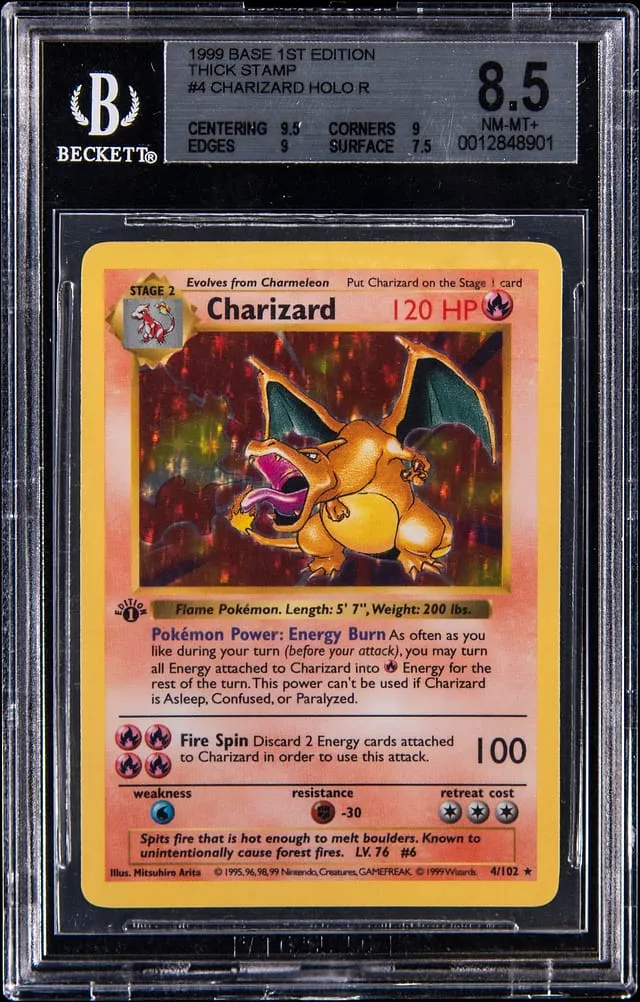
1999 1st Edition Holo Charizard BGS 8.5 Sells for $29K
Goldin sold a 1999 Pokémon Base Set 1st Edition Holo Charizard BGS 8.5 Thick Stamp for $29,280. See how this result fits current Charizard market trends.
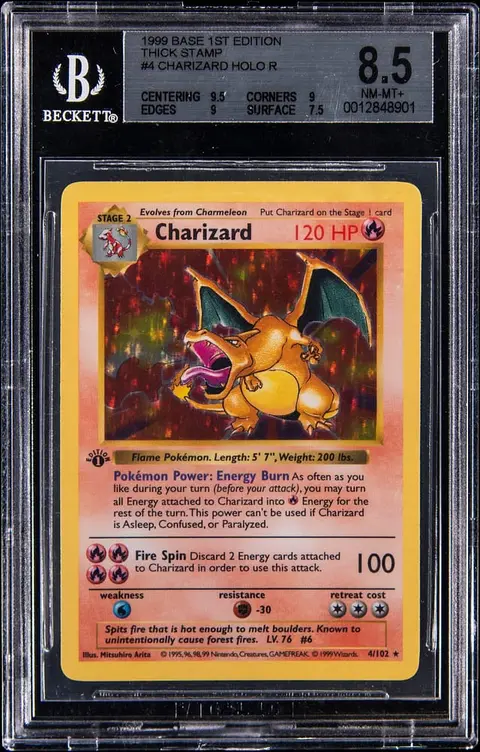
Sold Card
1999 Pokemon Base Set 1st Edition Rare Holofoil #4 Charizard, Thick Stamp - BGS NM-MT+ 8.5
Sale Price
Platform
Goldin1999 Pokémon Base Set 1st Edition Holo Charizard is one of those cards that quietly anchors the entire Pokémon market. A recent example – a 1999 Pokémon Base Set 1st Edition Rare Holofoil #4 Charizard, Thick Stamp, graded BGS NM-MT+ 8.5 – just sold at Goldin on 2026-05-04 for $29,280.
Below, we’ll break down what this card is, why the “Thick Stamp” and BGS 8.5 grade matter, and how this sale fits into the broader price picture for hobbyists and small sellers.
Card basics: what exactly sold at Goldin?
- Character: Charizard
- Year: 1999
- Set: Pokémon Base Set, 1st Edition
- Card number: #4/102
- Rarity: Rare Holofoil
- Variant: 1st Edition “Thick Stamp” (early print run style of the 1st Edition stamp)
- Grading company: Beckett Grading Services (BGS)
- Grade: NM-MT+ 8.5 (Near Mint-Mint Plus)
- Key issue / rookie status: Widely treated as Charizard’s key early flagship card and the defining card of the WOTC (Wizards of the Coast) era.
There are no autos, patches, or serial numbering here. The card’s importance comes from its place in the hobby: the original English Base Set 1st Edition holo Charizard is one of the most recognized trading cards across any TCG.
The “Thick Stamp” note refers to the style of the black “1st Edition” stamp on the left side of the artwork box. Early sheets used a thicker font; later “Thin Stamp” versions used a slimmer font. Both are legitimate; collectors often track them separately because of print history and aesthetics.
Why this Charizard matters to collectors
1. The face of vintage Pokémon
This card sits at the center of the vintage Pokémon era (roughly 1996–2002). For many collectors, it was the chase card when Pokémon first hit North America. It combines:
- The first English expansion (Base Set)
- The first print run (1st Edition)
- A fan-favorite evolution (Charizard)
- Holofoil treatment
That combination makes it a “flagship” card – a card that effectively represents the entire product line in the eyes of the hobby.
2. WOTC era scarcity and condition curve
Compared to modern ultra-printed sets, 1999 1st Edition Base was produced in relatively modest quantities, and few copies were pulled, sleeved, and stored carefully at the time. Many surviving raw copies show:
- Heavy edge and corner wear from play
- Print lines and surface scratching on the holofoil
- Silvering along the borders
This is why high grades command a strong premium, and why grade bands (8.5 vs 9 vs 9.5 vs 10) see large price gaps.
3. Thick vs Thin stamp
Within 1st Edition Charizards, collectors often distinguish between:
- Thick Stamp: Bolder, more filled-in “1” and lettering; associated with an earlier segment of production.
- Thin Stamp: Sharper, narrower text; likely a later print style.
Neither is an error or short print in an official sense, but the distinction has become part of the card’s collecting story. Some collectors prefer Thick Stamp examples for the early-print narrative; others simply pursue the nicest copy they can find, regardless of stamp style.
Understanding the BGS 8.5 grade
Beckett’s NM-MT+ 8.5 sits at an interesting point on the condition spectrum:
- Above standard Near Mint (8.0)
- Below Mint (9.0) and Gem Mint (9.5)
BGS 8.5 copies typically show minor but visible wear – light edge or corner touches, a small print line, or modest holo scratching – while still presenting very well overall.
Because BGS uses subgrades (centering, corners, edges, surface), certain 8.5s can be particularly appealing if they cluster around 9+ subgrades with one weaker area. Many collectors treat those as strong “value plays” versus jumping up into BGS 9 or PSA 9 pricing.
Market context: where does $29,280 fit in?
The Goldin sale on 2026-05-04 closed at $29,280. To understand that number, collectors typically look at comps – recent comparable sales of the same card and close variants.
For 1st Edition Base Charizard, recent public sales and historical ranges (across Goldin, Heritage, PWCC, eBay, etc.) have generally shown:
- BGS 8 / PSA 8 range: Often in the mid–five-figure band, with variability based on eye appeal (centering, color, print lines) and auction timing.
- BGS 8.5 / PSA 8.5 range: Historically a step above 8s but meaningfully below true Mint 9s, sometimes clustering in the high-teens to low–five-figure range, with standout copies occasionally stretching higher.
- BGS/PSA 9 range: Frequently well into the higher five-figure territory and, for strong copies, crossing into six figures.
- Top-end grades (BGS 9.5, PSA 10): Long-established six-figure cards in strong markets, with record-level results significantly higher during peak hobby cycles.
Within that general landscape, a $29,280 result for a BGS 8.5 Thick Stamp Charizard sits toward the upper end of what many collectors would expect for this grade band in a measured market. It reflects:
- The enduring demand for 1st Edition Base Charizard
- Added appeal of the Thick Stamp variant
- The liquidity that major auction platforms like Goldin can provide
This price does not suggest a new overall record for the card, but it does reinforce that well-presenting mid-high grade copies remain highly contested.
Thick Stamp BGS 8.5 vs. other versions
When collectors compare price points, they often layer in:
- Grade: 8 vs 8.5 vs 9
- Grading company: BGS vs PSA vs CGC
- Stamp style: Thick vs Thin
While exact population counts for Thick Stamp specifically are less formalized than overall 1st Edition totals, a few general patterns show up in the market:
- 8.5 sits in a sensitive price band. Moving from BGS 8.5 to BGS 9 / PSA 9 can mean a very large price jump. That makes strong-looking 8.5s appealing to collectors who prioritize the card over the label.
- Thick Stamp often carries a slight premium. Not every auction reflects this perfectly, but many collectors are now aware of the distinction.
- Eye appeal can bend the curve. Centering, color saturation, and holo clean-ness can push an 8.5 toward 9-level interest, or pull it back toward 8-level pricing.
The Goldin sale at $29,280 is consistent with the idea that collectors are still willing to stretch for a desirable 8.5, especially when combined with the Thick Stamp note and a trusted auction house.
Historical context and past peaks
Over the past several years, 1st Edition Base Charizard has seen:
- Highly publicized six-figure and above sales for PSA 10 and BGS 9.5 copies
- Strong five-figure results across 8–9 grade bands during peak hobby momentum
- A cooling and stabilization phase as the broader market normalized
Against that backdrop, a mid–five-figure result like $29,280 for a BGS 8.5 in 2026 lines up with a more mature, data-aware market rather than a speculative spike. Collectors today often cross-check multiple auction archives, population reports, and recent comps before bidding.
What this sale means for collectors and small sellers
For those holding or chasing this card, here are a few takeaways:
1. Key vintage anchors remain liquid
This result from Goldin on 2026-05-04 supports the idea that cornerstone vintage cards – especially Base Set 1st Edition holos – continue to draw deep bidder pools. That doesn’t mean prices move in one direction, but it does underline ongoing demand.
2. Grade bands and label details matter
The difference between a BGS 8, 8.5, and 9 can be significant. Small sellers considering grading raw copies should weigh:
- Centering and visible surface wear
- The likelihood of landing in a specific grade band
- The fee and turnaround differences between grading companies
Because price gaps between bands are wide, it’s helpful to review several recent sales before deciding how and where to grade.
3. Provenance and venue can influence outcomes
Sales through established auction houses such as Goldin can sometimes outperform lower-visibility listings because:
- More eyes see the card
- Bidders trust the venue
- Marketing and auction timing are optimized for high-end pieces
This doesn’t mean every card should go to auction, but for iconic cards like 1st Edition Charizard, venue choice is a meaningful piece of the strategy.
For newer and returning collectors
If you’re just coming back to the hobby or starting fresh:
- 1st Edition Base Charizard is considered a “blue chip” of Pokémon – a historically important card that many collections are built around.
- You don’t need a 1st Edition copy to enjoy the card. Unlimited Base, Shadowless, reprints, and later Charizard cards can offer similar nostalgia at different price tiers.
- Comps and pop reports help you frame the market.
- Comps are recent comparable sales; looking at several rather than a single auction result gives a more balanced price picture.
- Population reports show how many copies exist in each grade from a grading company, helping you understand relative scarcity by condition.
The Goldin sale at $29,280 for a BGS 8.5 Thick Stamp doesn’t tell the whole story, but it is a clear, recent data point that shows how the market continues to value this card more than 25 years after release.
Summary
- Card: 1999 Pokémon Base Set 1st Edition Rare Holofoil #4 Charizard, Thick Stamp
- Grade: BGS NM-MT+ 8.5
- Auction house: Goldin
- Sale date: 2026-05-04 (UTC)
- Price: $29,280
For collectors and small sellers, this sale reinforces the long-term importance of 1st Edition Base Charizard and highlights how factors like grade band, stamp style, and auction venue continue to shape realized prices.
As always, it’s worth tracking multiple recent sales and focusing on the specific copy in front of you – eye appeal, centering, and condition – rather than relying on any single auction result as a guarantee of future value.