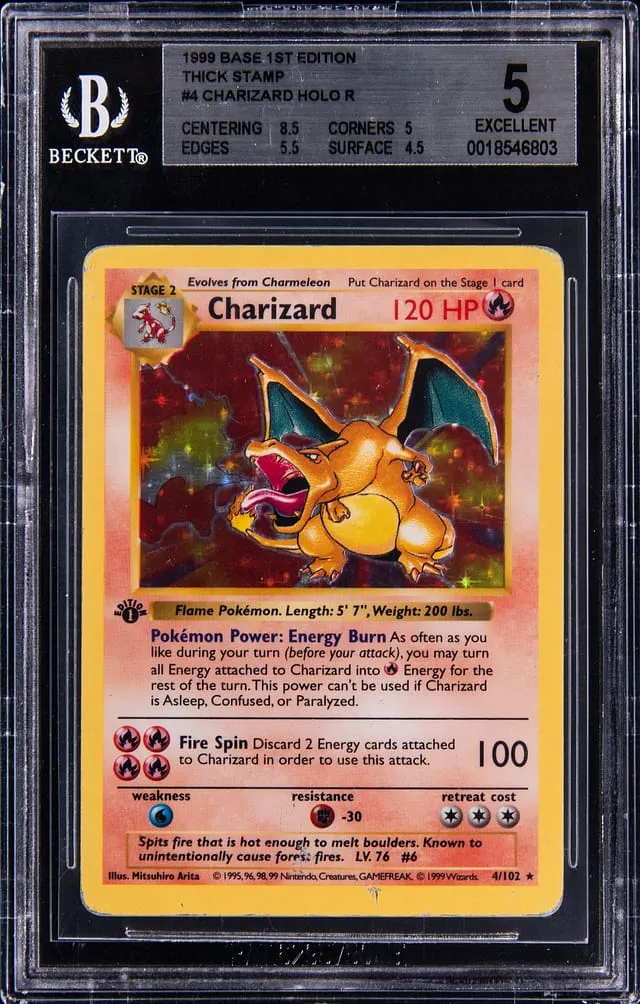
1999 1st Edition Holo Charizard BGS 5 Sells for $13K
Goldin sold a 1999 Pokémon Base Set 1st Edition Holo Charizard BGS EX 5 for $13,420. See what this means for mid-grade Charizard and the vintage market.
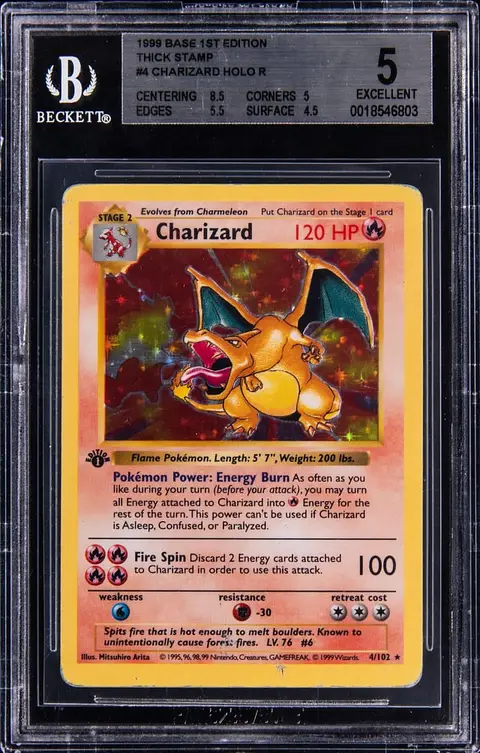
Sold Card
1999 Pokemon Base Set 1st Edition Holo #4 Charizard - BGS EX 5
Sale Price
Platform
Goldin1999 Pokémon Base Set 1st Edition Holo Charizard remains one of the most recognizable cards in the entire trading card hobby, and a recent sale shows how strong demand still is even in mid-grade condition.
On February 23, 2026, Goldin sold a 1999 Pokémon Base Set 1st Edition Holo Charizard #4 graded BGS EX 5 for $13,420.
In this post, we’ll break down what this card is, why collectors care so much about it, and how this sale fits into the broader market context.
Card overview: what exactly sold?
- Character: Charizard
- Year: 1999
- Set: Pokémon Base Set (1st Edition, English)
- Card number: #4/102
- Variation: 1st Edition Holofoil
- Status: Key issue / chase card of the set (not a rookie in the sports sense, but the flagship Charizard)
- Grading company: Beckett Grading Services (BGS)
- Grade: EX 5 (Excellent)
- Attributes: Holographic foil, iconic Ken Sugimori art, 1st Edition stamp
For Pokémon collectors, this is the Charizard: the original English 1st Edition Holo from the Base Set released in 1999. It sits at the top of many “grail” lists because it combines nostalgia, early TCG history, and genuine scarcity in high grade.
An EX 5 from BGS signals noticeable wear—edge whitening, surface scratching, or creases—but still a structurally intact and presentable copy. Importantly, this keeps the card more accessible than high-end gem mint examples while still carrying the prestige of the 1st Edition Holo status.
Why this Charizard matters so much
Several factors make the 1st Edition Base Set Charizard a cornerstone card:
Flagship of the Base Set
Base Set is the first English Pokémon release. Within that set, Charizard is the flagship chase card—the one kids traded for on playgrounds and the image many people think of when they remember the early Pokémon era.Era: late-1990s “vintage” Pokémon
1999 sits firmly in what collectors often call the vintage or early era for Pokémon. Print runs were smaller than modern sets, and survivorship in clean condition is limited because these cards were played and handled heavily.1st Edition + Holo combination
Not all Base Set Charizards are created equal. In rough order of desirability, collectors generally place them as:- 1st Edition Holo (this card)
- Shadowless Holo (no 1st Edition stamp, earlier print run)
- Unlimited Holo (more common, later widespread release)
The 1st Edition stamp on a holographic Base Set Charizard is one of the most recognized markers of premium Pokémon cardboard.
Cross-collector appeal
Unlike many niche key cards, this Charizard is chased by:- Pokémon-only collectors
- Crossover sports card collectors
- Nostalgic returning collectors who started in the 1990s
That broad demand base gives the card deep liquidity across different parts of the hobby.
Market context: where does $13,420 sit?
The Goldin sale closed at $13,420 on February 23, 2026. To understand that number, it helps to look at three things:
Grade tier and grading company
BGS and PSA grades are not always valued the same. Many Pokémon collectors treat PSA as the default grading company, but BGS still has a following, especially for subgrades and for collectors coming from the sports side.An EX 5 in BGS indicates mid-grade condition. Most high-profile record sales you see for this card are for PSA 9, PSA 10, or BGS 9.5+ copies. Those sit in a very different price tier.
Recent sale ranges for mid-grade copies
Public auction results over the past few years show a clear pattern:- Gem mint (PSA 10 / BGS 9.5–10): Historically six-figure to high six-figure results at market peaks, settling lower as the broader market cooled.
- Near mint–mint (PSA 8–9, BGS 8–9): Often in the mid to high five-figure range, depending on eye appeal and timing.
- Mid-grade (PSA/BGS 4–6): Typically trading in the lower five-figure band, with variations based on centering, print quality, and auction house visibility.
Within that framework, $13,420 for a BGS EX 5 is broadly consistent with the idea that:
- There is still strong baseline demand for authentic 1st Edition Charizards, even with visible wear.
- The gap between mid-grade and high-grade examples remains large, reflecting collectors’ preference for condition at the top end.
Comparison to iconic record sales
This sale is not a record for the card, and it doesn’t aim to be. Instead, it shows how the market has matured:- The headline-making six-figure and higher sales for PSA 10 / BGS 9.5 examples set the ceiling and captured mainstream attention.
- Sales like this BGS 5 demonstrate the floor and middle of the market—what everyday collectors are actually transacting at when they want a copy of the card without stretching into high-end territory.
In other words, the Goldin result lands in a realistic zone for a mid-grade, third-party-graded copy of an elite key card.
Collector significance and demand drivers
Several ongoing themes continue to support demand for this card:
Nostalgia from returning collectors
Many people who opened Base Set as kids are coming back into the hobby with higher disposable income. For them, this Charizard is often at the top of their want list, even if they are comfortable with a lower grade.Set-building and registry competition
Some collectors build complete 1st Edition Base Set holo runs or pursue graded set registries (checklists that track graded copies). Having the Charizard is essential to completing those goals.Long-standing icon status
Unlike cards tied to an active player’s seasonal performance, Charizard’s appeal is not about current events. It is rooted in its place as a mascot-level character and a symbol of early Pokémon.Vintage vs. modern dynamics
Modern Pokémon releases tend to have much higher print runs and better pack-to-sleeve preservation. By contrast, 1999 Base Set was printed for play, not long-term collecting. That means even mid-grade, nicely centered, visually appealing copies can feel special in hand.
At the same time, the broader hobby has cooled from the most aggressive pandemic-era spikes. Prices today often reflect a more measured, data-aware market rather than pure speculation.
Reading the Goldin result as a collector
For collectors and small sellers, this $13,420 sale at Goldin on February 23, 2026, suggests a few practical takeaways:
Authentic mid-grade copies still carry substantial value
Even with an EX 5 grade, the combination of 1st Edition, holo, and Charizard keeps this card firmly in the high four-figure to low five-figure conversation.Grade is only part of the story
Within the same numerical grade, eye appeal—centering, color, and how distracting the wear is—can push results up or down. Auction house exposure and timing also matter.The card behaves more like an established blue-chip than a short-term spec play
While prices move up and down over time, the consistent presence of this card in auctions and private deals, across multiple market cycles, speaks to enduring demand rather than a passing fad.BGS vs. PSA preferences can shape comps
When looking at “comps” (comparable recent sales used for price context), it’s important to compare:- Similar grades across the same grading company, and
- Then make cautious adjustments when crossing between BGS and PSA.
A BGS EX 5 price will not map 1:1 to a PSA 5, but they can give a directional sense of where the mid-grade market sits.
Final thoughts
This 1999 Pokémon Base Set 1st Edition Holo Charizard #4 in BGS EX 5 selling for $13,420 at Goldin on February 23, 2026, is not a record-setting headline—but that’s exactly why it matters.
It shows where real collectors are transacting for a well-known, mid-grade copy of one of the most important Pokémon cards ever printed. For newcomers and long-time hobbyists alike, it’s a useful benchmark when evaluating your own Charizard goals, whether you’re chasing eye appeal on a budget or planning a long-term build toward higher grades.
As always, treat individual sales as data points rather than guarantees. Markets evolve, conditions vary, and personal collecting goals matter just as much as any price chart.
If you’re tracking key Pokémon sales across grades and grading companies, keeping an eye on results like this helps build a grounded picture of where the 1st Edition Base Set Charizard actually trades—beyond the headline gems that make the news.