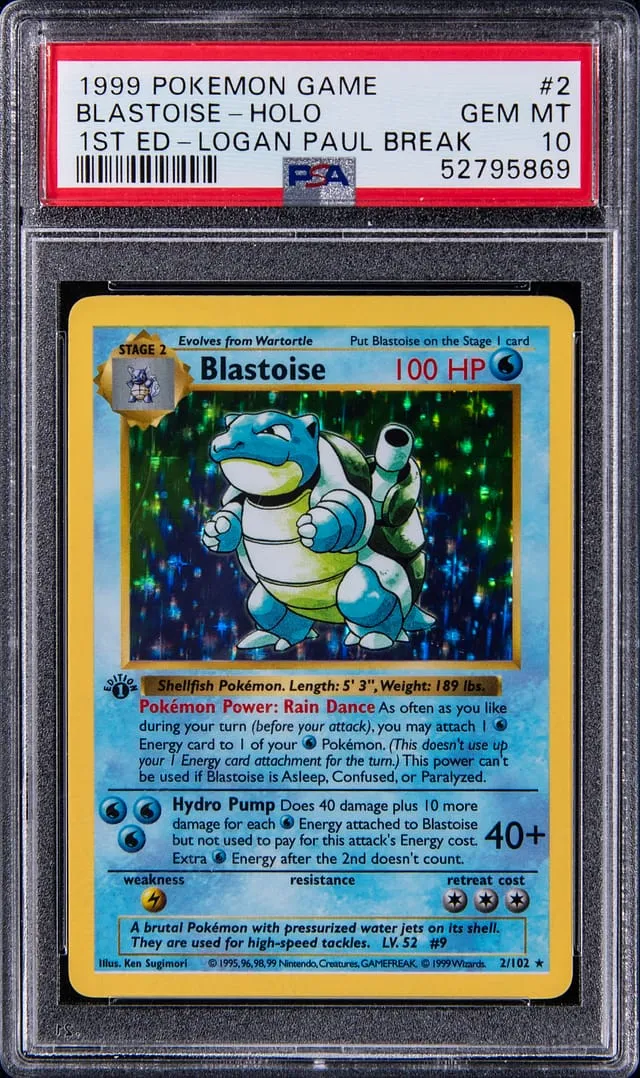
1999 1st Edition Holo Blastoise PSA 10 Sells for $138k
Goldin sold a 1999 Pokémon Base Set 1st Edition Holo Blastoise PSA 10 for $138,880 on Feb 16, 2026. See why this vintage grail still commands six figures.
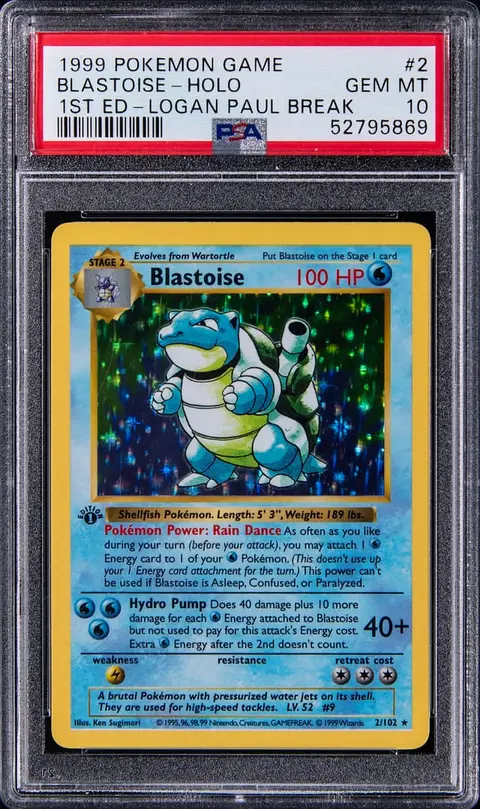
Sold Card
1999 Pokemon Base Set 1st Edition Rare Holo #2 Blastoise - Logan Paul Break - PSA GEM MT 10
Sale Price
Platform
Goldin1999 Pokémon Base Set 1st Edition Holo Blastoise in PSA 10 is one of the foundational cards of the hobby. When a copy with a clear connection to Logan Paul surfaces, collectors tend to pay attention.
On February 16, 2026, Goldin sold a 1999 Pokémon Base Set 1st Edition Rare Holo #2 Blastoise – Logan Paul Break – PSA GEM MT 10 for $138,880. For many collectors, this sale touches three key pillars at once: the iconic Base Set, top-tier PSA grading, and the modern celebrity-break era.
The card at a glance
- Character: Blastoise
- Year: 1999
- Set: Pokémon Base Set 1st Edition
- Card number: #2
- Rarity: Rare Holo
- Grading company: PSA (Professional Sports Authenticator)
- Grade: GEM MT 10 (PSA’s highest standard grade for pack-issued cards)
- Era: Vintage Pokémon (Wizards of the Coast era)
- Key issue: Early flagship Blastoise, part of the original English Base Set trio (Charizard, Blastoise, Venusaur)
- Provenance note: Labeled as from a Logan Paul Break, tying it to one of the best-known high-profile box breaks in the hobby.
This card is not a rookie card in the sports sense, but within Pokémon, 1st Edition Base Set holos are treated similarly: they are the earliest, most recognized English releases for many of the franchise’s flagship characters.
Why 1st Edition Base Set Blastoise matters
Within the Pokémon TCG, 1st Edition Base Set is viewed as the starting point for English-language collecting. It has several qualities that make it foundational:
- Historical importance: Released in 1999, English Base Set introduced Pokémon trading cards to a generation of collectors. 1st Edition copies were the earliest, limited-marked print run.
- Flagship character: Blastoise is one of the original fully evolved Kanto starters. While Charizard tends to dominate headlines, Blastoise has long been a core chase card for set builders and starter Pokémon fans.
- Vintage era scarcity: Compared with modern print runs, 1999 print volumes and preserved-condition copies are much more limited. Many Base Set cards were heavily played by kids rather than carefully stored.
Within that context, PSA 10 examples sit at the very top of the condition pyramid. Even for a card that has had thousands of submissions, only a small fraction achieve GEM MT 10. PSA’s population report (the count of graded copies by grade) is one of the first tools experienced collectors check when they’re evaluating scarcity at a specific grade.
The Logan Paul factor and provenance
The auction title notes that this Blastoise is from a Logan Paul Break. That typically means it came out of a box opened during one of Logan Paul’s livestreamed 1st Edition Base Set breaks.
For some collectors, this kind of provenance—a traceable, documented origin—adds an extra layer of interest. It connects the card to a specific cultural moment in the hobby, when large, highly publicized breaks brought new attention (and controversy) to vintage Pokémon.
While not every collector pays a premium for celebrity provenance, auction houses often highlight it because it:
- Distinguishes the card from anonymous copies
- Links it to a specific event many hobbyists remember
- Can make the card more memorable when people look back at sale histories
Market context and recent sales
Looking across recent public sales for 1999 Pokémon Base Set 1st Edition Blastoise PSA 10, several patterns usually emerge:
- PSA 10 Base 1st Edition Blastoise has traded well into five figures for years. Even outside peak hype, it has typically sat in the upper tier of vintage Pokémon pricing, below Charizard but ahead of many other Base Set holos.
- Prices have shown the usual post-boom adjustment. After the intense wave of interest in 2020–2021, prices for many vintage staples cooled and then stabilized. Blastoise followed that broader pattern: earlier spikes, pullback, then a more measured market.
- Grade steps matter a lot. PSA 9 and PSA 8 copies usually sell at a significant discount to PSA 10. A clean GEM MT 10 can be several multiples of a PSA 9, which reflects how tight PSA is at the top grade.
Within that framework, a $138,880 sale at Goldin in early 2026 sits firmly in the upper tier for this card. It reflects:
- Strong ongoing demand for high-grade 1st Edition Base holos
- Collector willingness to pay up for a top grade combined with a notable provenance tag
Exact comparable sales (“comps”)—that is, other public sales used as reference points—can move around based on timing, auction venue, and card-specific details like centering or label notes. But this result clearly places PSA 10 1st Edition Blastoise on the short list of six-figure vintage Pokémon staples.
How this sale fits into the broader Pokémon market
The Pokémon market over the last few years has been defined by a few key themes:
- Maturity of vintage: WotC-era (Wizards of the Coast) cards from 1999–2003 are increasingly treated as established blue-chip pieces in the Pokémon world. They may move up or down with the wider market, but they rarely disappear from collector want lists.
- Separation by condition and provenance: As more data accumulates, the market continues to sort cards by condition and story. PSA 10 vs PSA 9, 1st Edition vs Unlimited, and notable-provenance vs anonymous copies all see increasingly distinct pricing.
- Steady demand for the original starters: Charizard leads, but Blastoise and Venusaur remain crucial building blocks for serious Base Set collections.
This Goldin sale underlines that high-end vintage Pokémon is still very much active. Even with normal market cycles, there is enduring collector interest in cornerstone pieces like 1st Edition Blastoise.
What collectors can take away
For new or returning collectors, this sale offers a few useful lessons:
Condition drives the ceiling. The gap between a played Blastoise and a PSA 10 is enormous. For vintage Pokémon, eye appeal, centering, and surface quality are all critical.
1st Edition matters. Base Set has Unlimited and Shadowless (non-1st Edition) printings as well. The 1st Edition stamp and earlier print run anchor it as the premier version for many collectors.
Provenance can be a tiebreaker. A Logan Paul Break note doesn’t change the card itself, but it can matter to specific buyers. When cards are otherwise similar, small narrative details can influence interest.
Use comps, not headlines. This $138,880 result is one data point. When you’re evaluating your own cards, look at multiple recent sales across auction houses and marketplaces and factor in grade, subgrade (if applicable), and any special labels or provenance.
Final thoughts
The 1999 Pokémon Base Set 1st Edition Rare Holo #2 Blastoise – PSA GEM MT 10 continues to hold its place as a core vintage Pokémon grail. The $138,880 Goldin sale on February 16, 2026 reinforces what many hobbyists already believed: high-grade, first-print-run starters from Base Set still sit near the top of the Pokémon food chain.
For collectors building long-term sets, tracking sales like this can help frame expectations and understand how vintage Pokémon behaves across different market cycles, without turning any single auction into a prediction. It’s one more chapter in the evolving story of a card that has been important to the hobby for more than two decades.