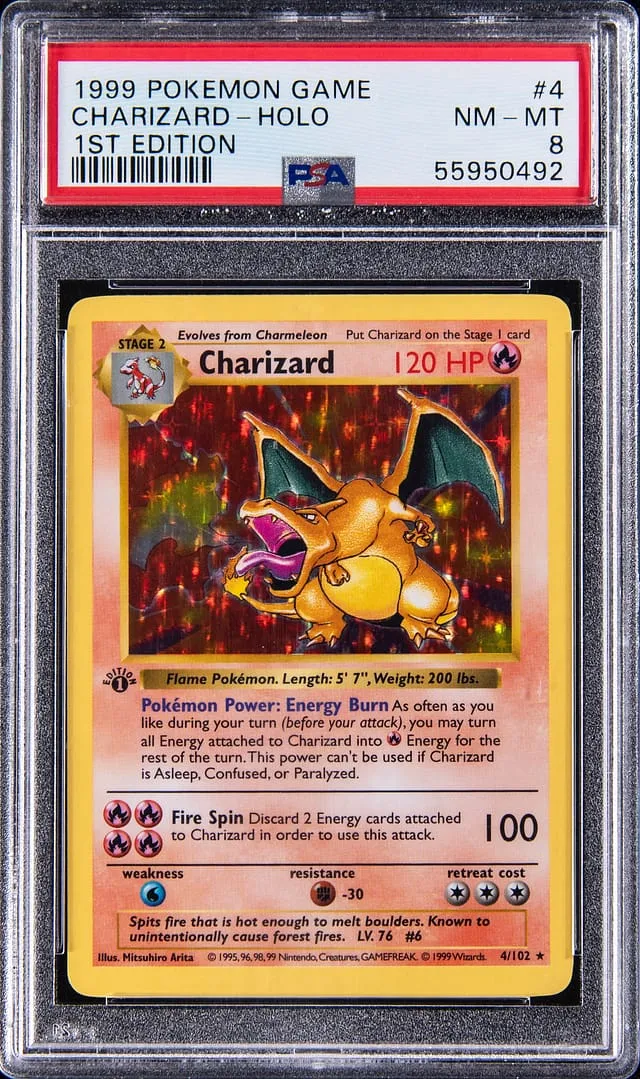
1999 1st Edition Charizard PSA 8 sells for $36,844
Goldin sold a 1999 Pokémon Base Set 1st Edition Holo Charizard PSA 8 for $36,844. See where this result fits in the vintage Pokémon market.
Sold Card
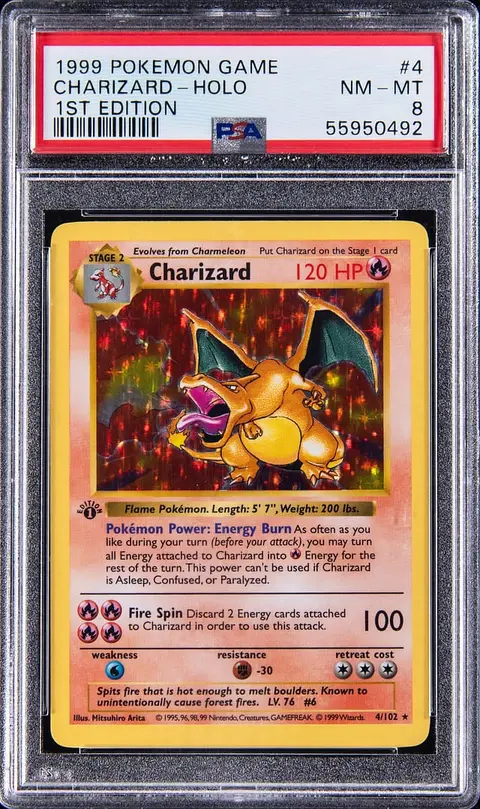
1999 Pokemon Base Set 1st Edition Holo #4 Charizard - PSA NM-MT 8
Sale Price
Platform
Goldin1999 Pokémon Base Set 1st Edition Holo Charizard in PSA 8 has long been one of the hobby’s core benchmark cards. On March 9, 2026, a copy labeled “1999 Pokémon Base Set 1st Edition Holo #4 Charizard – PSA NM-MT 8” sold at Goldin for $36,844.
For many collectors, this card is the closest thing Pokémon has to a “blue chip.” It anchors vintage Pokémon, it’s instantly recognizable even to people who don’t actively collect, and it has a long public auction history across multiple markets. In other words, it’s a useful reference point when you’re trying to understand where the broader Pokémon market is.
Card overview
- Character: Charizard
- Year: 1999
- Set: Pokémon TCG Base Set (English), 1st Edition
- Card number: #4/102
- Rarity: Holographic, 1st Edition stamp
- Key status: Widely treated as the flagship Charizard and a key issue for the entire Pokémon TCG
- Grading company: PSA (Professional Sports Authenticator)
- Grade: NM-MT 8 (Near Mint–Mint)
This is not a rookie card in the sports sense, but it is Charizard’s first mainstream English TCG appearance and the most important card from the first English Pokémon set. The 1st Edition stamp and holographic treatment make it the focus of much of the serious collecting attention in vintage Pokémon.
Why this card matters to collectors
Several factors make the 1999 Base Set 1st Edition Holo Charizard a cornerstone card:
- Origin set: Base Set is the first English Pokémon TCG release. It sits at the start of the era many collectors think of as “vintage” Pokémon.
- Character popularity: Charizard is one of the most popular Pokémon and often the face of the TCG.
- 1st Edition status: 1st Edition print runs are generally smaller than Unlimited prints, and the 1st Edition stamp is a key visual feature collectors look for.
- Holo rarity: Holographic cards were the top pulls from Base Set packs, and Charizard was the chase card.
- Long auction history: This card has been tracked, debated, and analyzed publicly for years, which makes it a useful data point for gauging sentiment in the Pokémon market.
Because of these factors, collectors treat this card similarly to how sports collectors treat iconic flagship rookie cards. It is a central piece for many long-term collections and a reference point for price discussions.
Where PSA 8 fits in the grading landscape
PSA’s NM-MT 8 grade signals a card in strong condition with minor wear visible under closer inspection. It is a collector-grade card that balances condition with relative affordability compared to ultra-high grades.
- PSA 10 Gem Mint: Top of the market. Extremely scarce relative to total copies.
- PSA 9 Mint: High-grade example with strong eye appeal, usually a large price step down from PSA 10 but still premium.
- PSA 8 NM-MT: Solid, presentable copy with light wear, far more accessible than 9s and 10s but still considered an investment-level condition by many serious collectors.
Historically, PSA 8 has been one of the more liquid grades for this card—“liquid” meaning it tends to buy and sell regularly because it sits at a price tier that many active collectors can reach.
Market context and recent sales
When collectors talk about “comps,” they mean comparable recent sales that help establish a realistic price range for a card. For a card like 1st Edition Charizard, comps across different grades help frame where a specific sale sits.
For this PSA 8 copy that sold at Goldin for $36,844 on March 9, 2026, the key context points are:
- Long-term trend: Over the last few hobby cycles, 1st Edition Charizard has seen periods of rapid price growth followed by pullbacks and consolidation. PSA 8s have generally traded well below the peaks seen during the most speculative phases of the market, with pricing stabilizing into a more data-driven range.
- Grade ladder: Higher grades such as PSA 9 and PSA 10 still command a significant premium over PSA 8. Lower grades (PSA 6–7 and below) typically sell at a meaningful discount, reflecting more visible wear.
- Market structure: Sales of this card show up at major auction houses (like Goldin, Heritage, PWCC) as well as fixed-price and auction listings on platforms such as eBay. Activity across these venues helps define the going range.
Precise, up-to-the-minute comp figures change constantly, but this sale slots into the modern pattern where:
- PSA 8 examples command a strong premium over raw (ungraded) or mid-grade copies because buyers are paying for a known, third-party-assessed condition level.
- The card’s pricing often acts as a barometer for confidence in vintage Pokémon—rising when interest and available capital increase, and leveling or softening when the hobby cools or focuses elsewhere.
Historical significance compared to premium grades
Over the years, record-setting sales have frequently involved higher-grade copies of this same card:
- PSA 10 copies have reached well into six figures at peak hobby moments.
- Strong PSA 9s have also posted notable auction results, often tied to high-visibility events or broader Pokémon news.
While this PSA 8 sale at $36,844 is not a record-breaker, it contributes to the ongoing data set that collectors reference when they:
- Compare grade-to-grade spreads (for example, the ratio between PSA 8 and PSA 9 pricing).
- Track how much collectors are currently willing to pay for a high-end but not top-population grade.
- Gauge whether the market is leaning more toward pure scarcity (chasing only the highest grades) or accepting a broader range of collector-grade copies.
Factors that can influence interest
A few ongoing themes tend to affect how collectors look at this card:
- Nostalgia and new entrants: Many buyers who grew up with Base Set continue to return to the hobby as adults. As they move from casual to more serious collecting, 1st Edition Charizard is often on their long-term radar.
- Overall Pokémon visibility: New games, shows, and anniversary events can bring fresh attention to the brand, which sometimes increases demand for the earliest TCG cards.
- Vintage vs. modern balance: When modern sets cool off after a new release cycle, collector interest can rotate back into vintage, where cards like this sit.
Rather than guaranteeing a direction, these themes simply add context for why demand can ebb and flow around key cards.
What this Goldin sale tells us
The $36,844 result at Goldin on March 9, 2026 reinforces a few points:
- PSA 8 remains an important, actively traded grade for 1st Edition Charizard.
- Serious auction platforms still attract strong bidding for vintage Pokémon anchors.
- The card continues to function as a reference point for how much collectors are currently prioritizing iconic vintage versus other segments of the hobby.
For collectors, this sale is another data point rather than a standalone signal. It’s useful to view it alongside:
- Other recent PSA 8 sales on major marketplaces
- Neighboring grades (PSA 7 and PSA 9) to understand the current price ladder
- Broader trends in vintage Pokémon, especially for other Base Set holo 1st Editions
Takeaways for different types of collectors
- Newcomers: If you are newer to Pokémon or to graded cards, this sale highlights how condition (verified by a grading company like PSA) dramatically affects prices. The same artwork in different grades can trade at very different levels.
- Returning collectors: For those coming back after a few years away, this PSA 8 result helps calibrate expectations around how far prices have moved since the most active boom periods. Watching a few consecutive auction cycles can give a clearer sense of the current range.
- Active hobbyists and small sellers: Using results like this as comps can help you price or evaluate other copies. Just remember that auction results, buyer demand at a given moment, and card-specific details (centering, eye appeal, and sub-grades where available) all factor into final prices.
As always, it’s wise to treat each sale as one piece of a larger picture. The 1999 Pokémon Base Set 1st Edition Holo Charizard in PSA 8 will likely continue to be tracked and discussed as a central marker in the vintage Pokémon market, and this Goldin result on March 9, 2026 is another notable entry in that ongoing story.