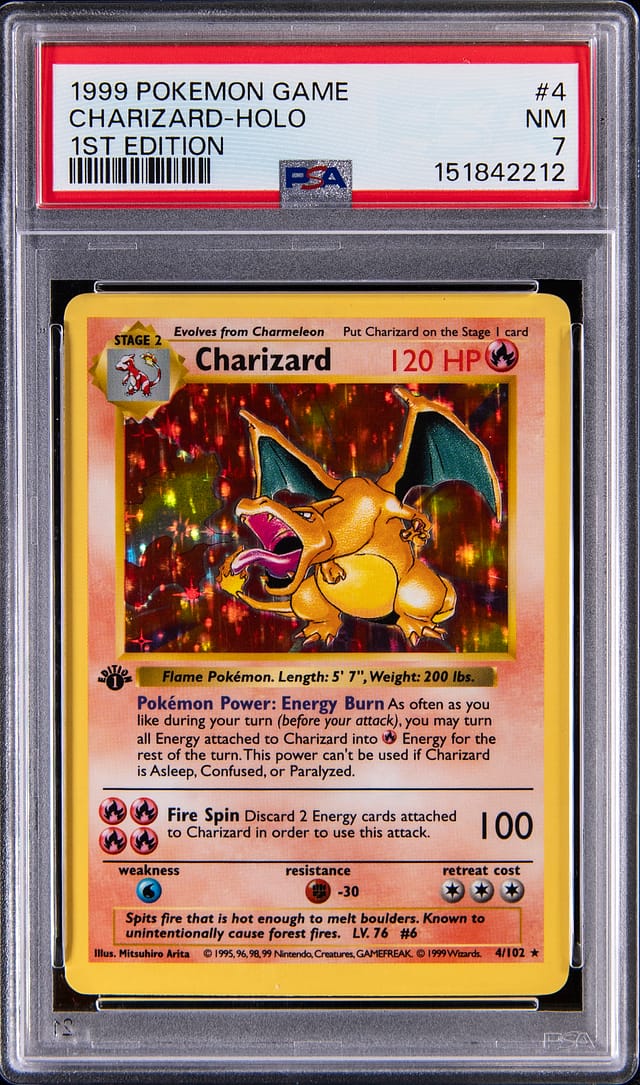
1999 1st Edition Charizard PSA 7 sells for $21,655
Goldin sold a 1999 Pokémon Base Set 1st Edition Holo Charizard PSA 7 for $21,655 on May 18, 2026. See how this result fits recent comps and the market.
Sold Card
1999 Pokemon Base Set 1st Edition Holo #4 Charizard - PSA NM 7
Sale Price
Platform
Goldin1999 Pokémon Base Set 1st Edition Holo Charizard PSA 7 Sells for $21,655
The 1st Edition Base Set Charizard continues to act like a barometer for the Pokémon market, and a recent sale at Goldin gives us another useful data point.
On May 18, 2026 (UTC), a 1999 Pokémon Base Set 1st Edition Holo #4 Charizard, graded PSA NM 7, sold at Goldin for $21,655. For many collectors, this card is the iconic Pokémon card, and its performance helps frame expectations for the rest of the vintage Pokémon market.
The card at a glance
- Character: Charizard
- Year: 1999
- Set: Pokémon Base Set (English), 1st Edition
- Card number: #4/102
- Variation: Holographic (Holo)
- Grading company: PSA (Professional Sports Authenticator)
- Grade: PSA 7 – Near Mint (NM)
- Key status: Widely treated as the flagship vintage Pokémon card; a central “grail” for many set and character collectors
This is not technically a rookie card in the sports sense, but in hobby terms it functions similarly: it is the first widely released English Charizard card from the original Base Set, in its most desirable print run (1st Edition, Holo).
Why 1st Edition Base Set Charizard matters
For newer or returning collectors, it’s hard to overstate the role of this card:
- Era: 1999 English Base Set sits firmly in the vintage era of Pokémon TCG.
- Cultural impact: This Charizard artwork became the face of the Pokémon card boom in the late 1990s and early 2000s.
- Print run dynamics: While not serial-numbered, 1st Edition Base Set was printed in much smaller quantities than Unlimited and Shadowless/Unlimited follow-ups, especially in high grades.
- Set importance: Base Set launched the English Pokémon TCG. Within that set, Charizard is the top chase card, both in raw copies and graded examples.
Because of this, Base Set 1st Edition Holo Charizard is often used as a “market thermometer.” When prices for this card move, people look for ripple effects in other vintage holos, sealed product, and even modern Charizard releases.
Market context for PSA 7 Charizard
To understand what this $21,655 sale means, it helps to look at:
- Recent sales of the same card and grade (PSA 7)
- How adjacent grades (PSA 6 and PSA 8) have been behaving
- How this compares to premium grades (PSA 9 and PSA 10)
Recent PSA 7 sales (general context)
In the last couple of years, PSA 7 1st Edition Base Set Charizard has generally traded in the high teens to low $20,000s range, with fluctuations depending on auction house, eye appeal (centering, print lines), and market sentiment at the time of sale.
Within that broad range:
- Some PSA 7s with strong centering and relatively clean holo have pushed into the low–mid $20k range.
- Examples with weaker centering, more visible scratching, or silvering often settle below $20k.
The $21,655 result at Goldin on May 18, 2026 fits comfortably in this context: not an outlier record, but a solid, market-reflective price.
How this sits versus nearby grades
When collectors talk about “comps,” they mean comparable recent sales used for reference, not guarantees. Looking at those comps across grades gives a clearer picture of relative value:
- PSA 6 (EX–MT): Typically lowers into the mid-teens, reflecting more visible wear, scratching, or centering issues.
- PSA 7 (NM): Often sits as a middle-ground option—noticeably more affordable than PSA 8, but still firmly in the “respectable vintage” range.
- PSA 8 (NM–MT): Often stretches into the mid-to-upper $20k territory, sometimes higher for particularly strong copies.
In other words, the Goldin PSA 7 sale lines up with the usual “step ladder” of pricing: PSA 6 < PSA 7 < PSA 8, with consistent spacing between those tiers.
Perspective from higher grades
Higher grades help frame how collectors think about scarcity and desirability:
- PSA 9: Historically has commanded a major premium over PSA 8, reflecting the limited supply of truly clean cards from 1999.
- PSA 10: Long known for headline-making sales in the six-figure and, at times, higher ranges during peak hobby surges.
The gap between a mid-grade (like PSA 7) and a high-grade (PSA 9/10) illustrates how condition sensitivity drives value. Many collectors use PSA 7 as an entry point into “blue-chip” vintage cards when higher grades are out of reach.
Population and perceived scarcity
A “pop report” is the grading company’s tally of how many copies of a card exist in each grade. For 1999 Base Set 1st Edition Holo Charizard, PSA’s population runs into the thousands across all grades, but the distribution is heavily slanted toward mid-grades and below.
Key takeaways for PSA 7 in that context:
- PSA 7 is relatively common compared to lower grades like PSA 2–4, but those lower grades tend to be less targeted by condition-focused collectors.
- PSA 7 offers a balance: not as scarce as PSA 9 or 10, but still clean enough for display and collection centerpiece purposes.
So while this card is not rare in an absolute sense, demand remains strong because:
- The total number of serious collectors who want one is large, and
- Many of those collectors prefer graded, authenticated copies of any grade.
Why collectors chase this card specifically
Reasons collectors keep circling back to this Charizard include:
- Nostalgia: For many, this is the card they remember from childhood binders, even if they never owned it personally.
- Character collecting: Charizard has one of the strongest fan bases in the Pokémon franchise.
- Historical status: As part of the first English TCG release, it feels foundational to a Pokémon collection.
- Liquidity: Among Pokémon cards, this is one of the most actively traded and easily recognizable. When you talk about buying, selling, or trading, most hobbyists understand where this card sits.
Because of its familiarity, some collectors treat this card as a long-term “anchor” for their Pokémon portfolio, even if they also enjoy chasing modern sets or rarer promos on the side.
Interpreting the $21,655 Goldin sale
A few points this result communicates to collectors and small sellers:
- The mid-grade lane is still active. Prices in the low $20k range for PSA 7 suggest that demand for presentable, non-high-end copies remains healthy.
- Auction house matters. Goldin attracts a broad audience of both dedicated Pokémon collectors and general alternative-asset buyers. That visibility often helps produce market-reflective prices.
- No sign of a dramatic swing. This sale does not look like a major breakout or collapse compared to other recent comps. Instead, it supports the idea of a relatively stable, mature market for this card in this grade, at least around the time of the sale.
It’s important to keep in mind that auction outcomes are influenced by bidder turnout, timing, and overall hobby sentiment. A single sale should be read as a data point, not a prediction.
Takeaways for different types of collectors
Newcomers and returning collectors
- If this card feels out of reach, its pricing can still help you understand how the hobby values rarity, nostalgia, and condition.
- Watching PSA 7–8 Charizard sales is a good way to learn how small differences in grade and eye appeal affect auction outcomes.
Active hobbyists
- This sale can serve as another reference when you’re evaluating raw copies, negotiating trades, or deciding whether to grade.
- Tracking how often PSA 7s appear at major houses like Goldin, Heritage, PWCC, and others can give a sense of supply pressure over time.
Small sellers
- If you handle mid-grade vintage Pokémon, results like this underline the importance of clear photos, centering details, and transparent condition notes when you list raw copies.
- Even within the same numeric grade, eye appeal can shift realized prices. Centering and holo surface often matter as much as the number on the label.
Final thoughts
The May 18, 2026 Goldin sale of a 1999 Pokémon Base Set 1st Edition Holo #4 Charizard in PSA 7 for $21,655 doesn’t reset the record books—but it doesn’t need to. Instead, it adds a steady, well-placed marker on the price curve of perhaps the most important Pokémon card in the hobby.
For collectors watching the long-term health of vintage Pokémon, this kind of consistent, data-supported result is exactly what helps ground expectations and guide thoughtful collecting decisions.
figoca tracks notable hobby sales and context so you can understand not just what a card sold for, but what that number might mean in the bigger picture.