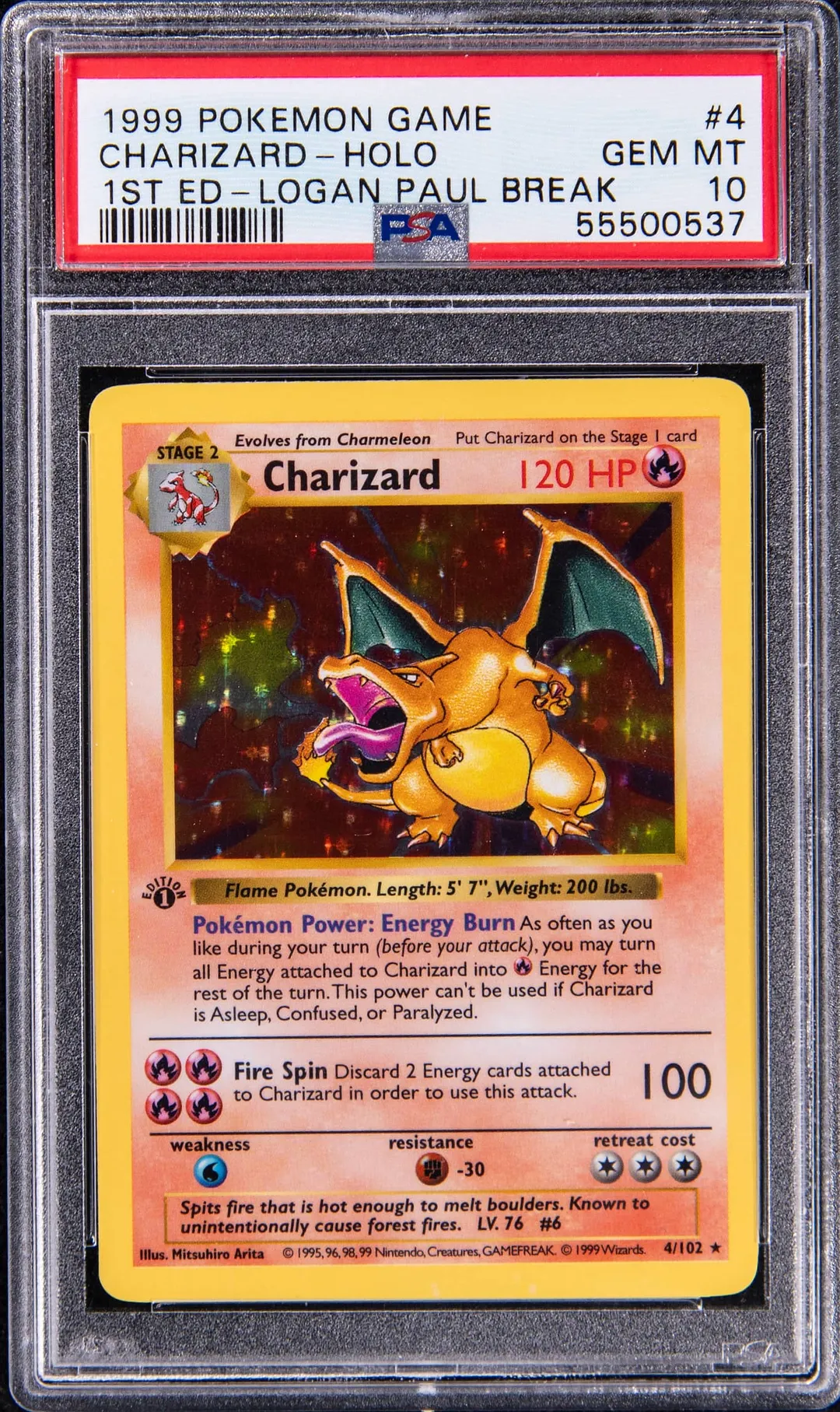
1999 1st Edition Charizard PSA 10 Logan Paul Sale
Breaking down Goldin’s $954,800 sale of the 1999 Pokémon Base Set 1st Edition Holo Charizard PSA 10 from the Logan Paul break.
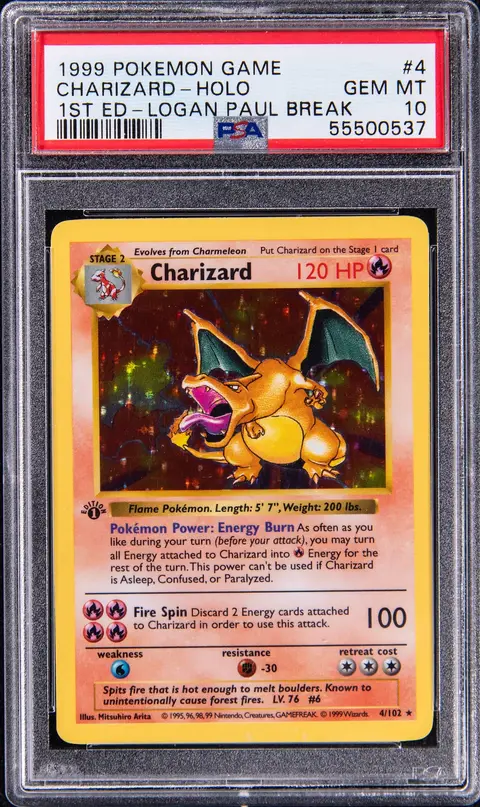
Sold Card
1999 Pokemon Base Set 1st Edition Holo #4 Charizard - Logan Paul Break - PSA GEM MT 10
Sale Price
Platform
Goldin1999 Pokémon Base Set 1st Edition Holo Charizard in PSA 10 is one of the most recognized cards in the hobby. When one of these copies also carries Logan Paul break provenance, it becomes a focal point for both Pokémon and broader trading card collectors.
On February 16, 2026, Goldin sold a copy titled:
1999 Pokemon Base Set 1st Edition Holo #4 Charizard - Logan Paul Break - PSA GEM MT 10
for $954,800.
In this post, we’ll walk through what this card is, why it matters, how this result fits into recent market data, and what collectors can reasonably take away from a sale like this.
The card at a glance
- Character: Charizard
- Year: 1999
- Set: Pokémon Base Set 1st Edition (English)
- Card number: #4/102
- Variation: 1st Edition Holofoil
- Status: Key issue / flagship Charizard of the WotC era, often treated as the “grail” of Pokémon TCG
- Era: Vintage (late 1990s, Wizards of the Coast printing)
- Grading company: PSA (Professional Sports Authenticator)
- Grade: GEM MT 10 (Gem Mint)
- Special attribute noted: Provenance from a Logan Paul break
This is not a rookie card in the sports sense, but it occupies a similar position: it’s the most famous early Charizard card from the first English Pokémon TCG set. For many collectors, it anchors the entire Pokémon market.
Why PSA 10 1st Edition Base Charizard matters
Among Pokémon cards, 1st Edition Base Set Charizard sits in a very small group of true blue-chip keys. A few reasons collectors care about this card:
- Historic set: 1999 English Base Set was the launchpad for Pokémon cards in many Western markets. First edition copies were the earliest, limited-marking print run.
- Charizard’s role: Charizard is the central nostalgia character for many who grew up with the franchise. The 1st Edition holo is the card people remember seeing in glass cases at local shops.
- Holo and condition sensitivity: Holographic foiling from this era scratches and shows print lines easily. Combined with centering and edge wear issues, true Gem Mint copies are hard to find.
- PSA 10 scarcity: PSA’s population report (a count of how many copies exist in each grade) has long shown a relatively low number of PSA 10s compared to the total number graded. That scarcity underpins the premium for the top grade.
- Cultural cross-over: This card has repeatedly crossed into mainstream media coverage. That exposure keeps it at the center of conversations any time a big sale appears.
The Logan Paul break provenance
The title of this copy specifically notes “Logan Paul Break.” Logan Paul, through his high-profile Pokémon events and record-seeking purchases, has been one of the most visible modern promoters of high-end Pokémon cards.
“Break” in hobby language refers to a live opening of sealed product (like a box) where participants buy in for a chance at the cards pulled. Cards tied directly to a well-known public break can gain a layer of story or provenance—collectors know exactly which event the card came from.
For this Charizard, the Logan Paul connection doesn’t change the cardboard itself, but it adds:
- Documented story: Collectors can point to a specific, highly visible break as the origin.
- Crossover appeal: Some buyers who follow influencer culture may find that story meaningful alongside traditional condition-based value drivers.
Market context: how $954,800 fits in
The Goldin result of $954,800 on February 16, 2026 places this card in the very top tier of Pokémon sales, but it needs to be understood alongside recent data.
When collectors talk about “comps,” they mean comparable recent sales that provide realistic pricing context. For a card like this, the key comps are:
- Same card, same grade: 1999 1st Edition Holo Charizard, PSA 10
- Same card, different grades: PSA 9 and PSA 8, which help show how steep the condition ladder is
- Same character, different versions: Other premium Charizards (e.g., Shadowless, Unlimited, high-end modern chase cards)
Over the last several years, PSA 10 1st Edition Base Charizard has shown:
- Peak-era public records well into the upper six figures and beyond, especially during the 2020–2021 surge when demand for grail Pokémon spiked.
- Post-surge normalization, where realized prices cooled from the absolute peaks but still held firmly in six-figure territory due to limited supply and enduring demand.
Within that context, a $954,800 sale sits toward the top end of the known range for this card, especially in recent, more stabilized conditions. The Logan Paul break provenance likely contributes to this result sitting above more typical, quiet-auction outcomes for a similar PSA 10 without added story.
Because markets move and not every sale is public, it’s useful to think of this as one data point:
- It confirms that high-end, provenance-rich PSA 10 copies still command near seven-figure attention.
- It separates this specific copy from more standard 1st Edition PSA 10s that may transact at different levels absent the high-profile narrative.
Comparing across grades and versions
Even if you never plan to chase a PSA 10 1st Edition Charizard, this sale helps frame the broader Charizard and Base Set ecosystem.
Within the same card:
- PSA 9 copies (Mint) are more common and show how much buyers pay for that last jump to Gem Mint. Historically, the PSA 10 multiplier over PSA 9 has been significant.
- PSA 8 and below still carry strong nostalgia demand but are more accessible to a wider slice of collectors.
Across similar Charizard cards:
- Shadowless Charizard (non–1st Edition, early print) and Unlimited Charizard trail behind 1st Edition in price but tend to move in the same general direction over longer periods.
- Modern high-end Charizards (e.g., low-serial, special set chases) may show sharp short-term moves, but the 1999 1st Edition holo remains the long-standing benchmark.
Seeing this hierarchy helps newer collectors understand why the 1st Edition, in the top grade, commands a dramatically different number than cards that look similar at a glance.
What this means for collectors and small sellers
A few grounded takeaways from the Goldin sale:
- Blue-chip Pokémon is still watched closely. Nearly seven figures for a single card in 2026 tells us that serious collectors and investors continue to allocate significant capital to top-grade, historically important Pokémon.
- Story and provenance can matter. The “Logan Paul Break” label adds a narrative layer that not every PSA 10 has. For high-end buyers, that kind of story can justify a premium versus a comparable copy with quieter origins.
- Condition gap remains steep. The spread between PSA 10 and lower grades continues to illustrate how much the market values top-tier condition for key vintage cards.
- Data over headlines. While this sale is notable, it should be weighed alongside other recent comps rather than treated as a guaranteed benchmark. Different auction houses, marketing reach, timing, and provenance can all influence final prices.
How to use this sale as a reference point
If you’re a new or returning collector:
- Use this Charizard as a case study in how rarity, condition, history, and story interact.
- When researching your own cards, look for: the set, exact version (1st Edition vs Unlimited), grade, and any special attributes.
If you’re an active hobbyist or small seller:
- Treat $954,800 as a top-of-market reference for a very specific, high-profile PSA 10 with public provenance.
- When comping your own Charizards, make sure you match edition, language, grade, and eye appeal; small differences can mean large price swings.
Final thoughts
The February 16, 2026 Goldin sale of the 1999 Pokémon Base Set 1st Edition Holo #4 Charizard – Logan Paul Break – PSA GEM MT 10 reinforces why this card sits at the center of the Pokémon TCG conversation.
It is a reminder that:
- Vintage, culturally significant cards can maintain deep demand years after initial hype cycles.
- Provenance and presentation still matter at the very top of the market.
- For most of us, the real value is understanding the structure of the market so we can collect with clear expectations and realistic context.
At figoca, we track these key sales as data points—not predictions—so collectors can see where the hobby has been and make better-informed decisions about where they want to go next.