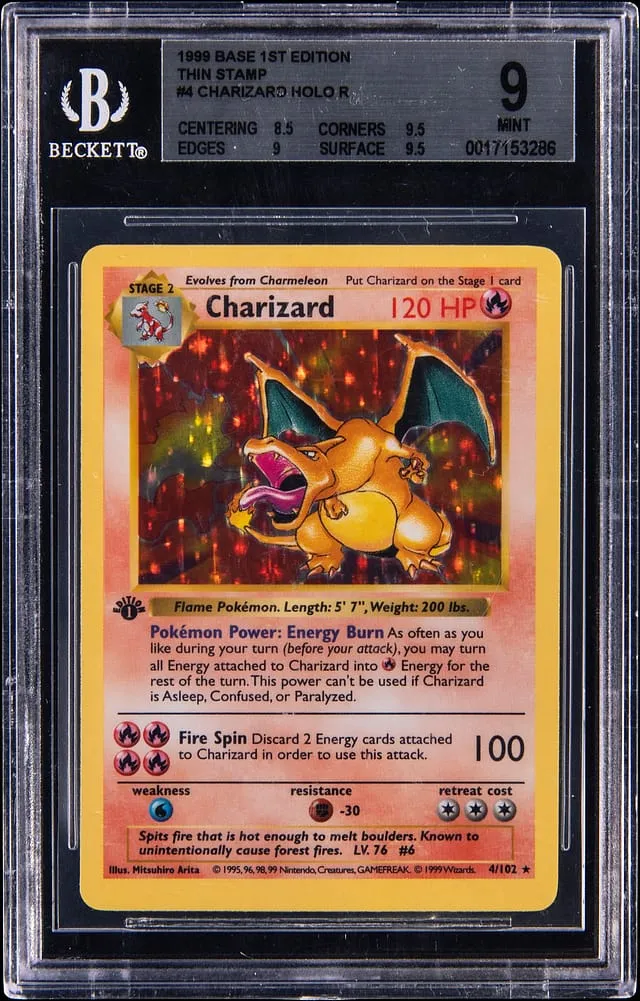
1999 1st Edition Charizard BGS 9 sells for $42,700
Goldin sold a 1999 Pokémon Base Set 1st Edition Holo Charizard BGS 9 for $42,700 on May 11, 2026. figoca breaks down what this means for collectors.
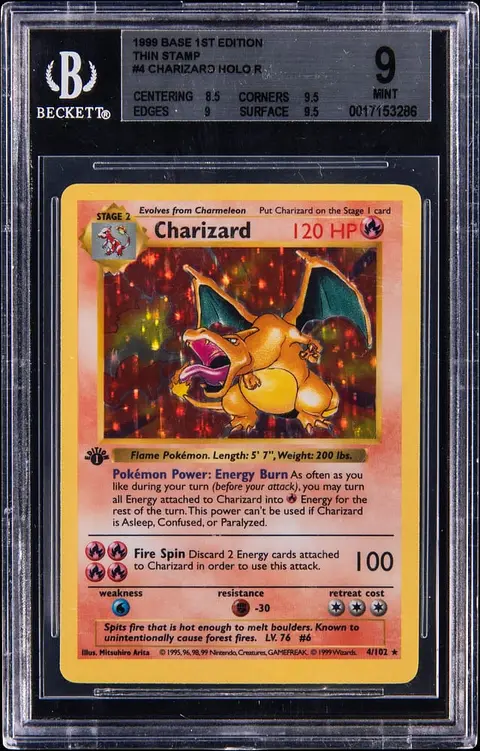
Sold Card
1999 Pokemon Base Set 1st Edition Holo #4 Charizard, Thin Stamp - BGS MINT 9
Sale Price
Platform
Goldin1999 Pokémon Base Set 1st Edition Holo Charizard is one of those cards that defines the entire hobby, and a recent Goldin sale has put another data point on the board for this icon.
On May 11, 2026 (UTC), a 1999 Pokémon Base Set 1st Edition Holo #4 Charizard, Thin Stamp, graded BGS MINT 9, sold at Goldin for $42,700. For a card that has anchored the modern Pokémon market for years, this result adds useful context for both collectors and small sellers trying to understand where high‑grade Base Set Charizard is settling.
The card at a glance
- Character: Charizard
- Year: 1999
- Set: Pokémon Base Set 1st Edition (English)
- Card number: #4/102
- Variant: 1st Edition Holo, Thin Stamp
- Era: Early WotC (Wizards of the Coast), considered vintage/early modern for Pokémon
- Grading company: Beckett Grading Services (BGS)
- Grade: BGS 9 MINT
This is not a rookie card in the sports sense, but in Pokémon terms it is Charizard’s flagship debut in the original English TCG. Among Pokémon collectors, that makes it a key issue—roughly equivalent to a blue‑chip rookie for a star athlete.
What is the “Thin Stamp” 1st Edition?
Early English 1st Edition Base Set cards were printed with two slightly different 1st Edition stamps:
- Thin Stamp: A narrower, lighter 1st Edition logo.
- Thick Stamp: A bolder, heavier 1st Edition logo.
Both are authentic 1st Edition prints. The Thin/Thick distinction is more of a collecting nuance than a hard rarity line. Some collectors prefer Thin for its look; others chase Thick. Market values can be very close, with premiums tending to come more from condition and eye appeal than from thin vs. thick alone.
Why this Charizard matters to collectors
This card carries weight for several reasons:
- Set importance: 1999 Base Set 1st Edition is the first widely distributed English Pokémon TCG release. It is the foundation for the entire English Pokémon card hobby.
- Character importance: Charizard is one of the franchise’s most recognizable characters, often seen as the flagship for collectors in the same way that Michael Jordan or Mickey Mantle function in their sports.
- Rarity in high grade: Raw copies are not difficult to find anymore, but true mint copies with strong centering, gloss, and minimal print defects are far less common. A BGS 9 MINT generally signals:
- Clean surfaces and holo foil
- Strong corners and edges
- Only minor centering or print issues
- Historical price anchor: This card (especially in top grades like BGS/PSA 10) has been at the center of multiple hobby cycles—surges, pullbacks, and stabilizations—since the late 2010s. It’s one of the benchmark cards people look at when they talk about “where the Pokémon market is.”
Understanding the BGS 9 grade
Grading companies assign numeric scores to summarize a card’s condition. BGS also provides subgrades (centering, corners, edges, surface), though those subgrades were not provided in the basic sale data.
For this card:
- BGS 9 (MINT) typically indicates:
- Minor flaws like a slight white speck on an edge, a small print line on the holo, or some centering that isn’t perfectly even.
- Overall excellent presentation suitable for high‑end collections.
- Below: BGS 8.5/8 and PSA 8 levels, where eye appeal begins to vary more.
- Above: BGS 9.5 GEM MINT and pristine 10s, which tend to see steeper price jumps due to lower populations.
Because BGS tends to be a bit stricter in some subgrades compared with PSA, some collectors see BGS 9 as comparable to many PSA 9s on this card, with precise value differences depending on subgrades and eye appeal.
Market context: where does $42,700 fit?
When collectors talk about “comps” (comparable sales), they’re looking at recent, similar sales to get a sense of current value trends—not guarantees, just context.
For this 1st Edition Holo Charizard, several factors tend to drive price:
- Grading company and grade (BGS 9 vs BGS 9.5 vs PSA 9/10)
- Thin vs Thick stamp (usually a secondary factor)
- Subgrades and eye appeal (centered vs off‑center, clean holo vs heavy print lines)
- Auction house and timing (who’s bidding, what else is on the block, overall hobby sentiment)
Recent years have seen:
- Top tier copies (BGS/PSA 10): Historically much higher prices, especially during peak hobby spikes, with a wide range depending on timing.
- Gem‑mint adjacent copies (BGS 9.5, strong PSA 9s): Often trading at a noticeable premium over straight 9s.
- Mint copies (BGS 9 / PSA 9): Serving as an “access point” for collectors who want a true 1st Edition holo Charizard but do not want to enter the pricing tier of 9.5s and 10s.
Against that broader backdrop, a BGS 9 Thin Stamp closing at $42,700 at Goldin in May 2026 suggests:
- The card remains squarely a five‑figure key for serious Pokémon collectors.
- There is still meaningful separation between a true mint, graded copy and raw or mid‑grade examples.
- While prices for this card have moved up and down over the last several years, high‑grade Base Set 1st Edition Charizard continues to clear significant bids when presented at a major auction house.
The exact positioning of this sale—whether slightly above or below the most recent cluster of BGS 9 results—will depend on:
- The BGS subgrades on this specific copy (for example, a 9.5 surface or centering subgrade often helps).
- Any notable eye appeal that isn’t fully captured by the numeric grade.
Those details are not always visible in headline sale data, but they usually matter to final price.
Thin Stamp vs Thick Stamp pricing
For 1st Edition Base Charizard, Thin vs Thick stamp is a well‑known nuance, but most of the long‑term price structure is still driven by condition and grade before stamp variety.
In practice:
- Some collectors build Thin or Thick master runs.
- Others are comfortable with either, focusing on centering, color, and holo quality.
- Price differences between Thin and Thick in the same grade can be modest and very dependent on individual auction dynamics.
This Goldin sale confirms that Thin Stamp copies in BGS 9 remain in demand alongside their Thick Stamp counterparts.
What this sale means for collectors
For different types of collectors and small sellers, a sale like this can mean different things.
For newcomers
- This card is one of the clearest examples of how a combination of nostalgia, character importance, and early set status can create a long‑running market anchor.
- You don’t need to chase a five‑figure Charizard to enjoy the hobby. But understanding why this card sits where it does helps you read the broader Pokémon landscape.
For returning collectors
- If you grew up with Base Set, this result is a reminder that condition is everything. The difference between a well‑loved childhood Charizard and a BGS 9 mint copy is huge.
- It may be worth having old copies graded if they appear very clean, but grading should be approached with a clear view of current grading fees and realistic condition assessments.
For active hobbyists and small sellers
- This sale offers a fresh reference point when you’re discussing high‑end 1st Edition Charizard with buyers or consignors.
- It reinforces the idea that presentation plus venue matter: major characters in strong grades often do best when photographed well and offered through platforms that reach serious bidders.
Final thoughts
The 1999 Pokémon Base Set 1st Edition Holo #4 Charizard, Thin Stamp, in BGS MINT 9 remains one of the hobby’s most studied and tracked cards. The $42,700 sale at Goldin on May 11, 2026 doesn’t rewrite the story of this card, but it does add another clear marker for where mint‑grade copies are currently landing.
As always, recent sales provide context rather than promises. For collectors, the real value in tracking results like this is the perspective they provide: how early Pokémon grails behave over time, how condition and grading shape those outcomes, and how enduring demand for key characters like Charizard continues to define the market’s foundation.
At figoca, we follow these sales so you can spend more time deciding what you actually want in your collection—and less time guessing what’s happening in the market.